Momo Witnesses the Birth and Passing of the Hour-Lilies
MomoProfessor Hora leads Momo to a hidden lake where a pendulum’s movement brings hour-lilies into bloom and then back into the water. The scene makes time visible as a succession of singular lives: each flower is unlike the one before it, yet each is born and passes within the same ordered movement. Its decisive revelation is personal as well as cosmic. The spectacle Momo takes for everyone’s time, Professor Hora explains on their return, is only her own; a place like it exists in every living soul.
The Journey to Time’s Source
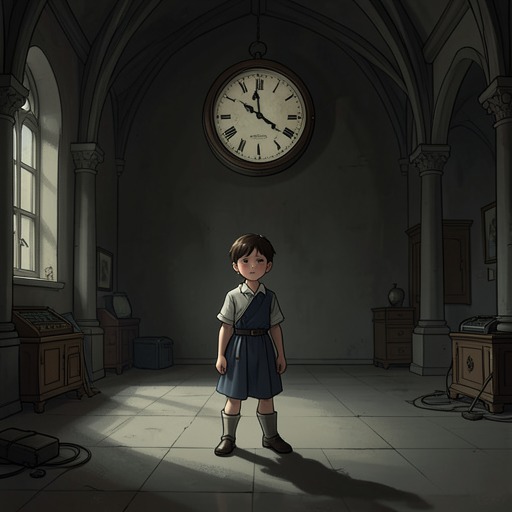
Before taking Momo to see where time comes from, Professor Hora asks her to promise not to speak or ask questions. Momo agrees. He stoops to pick her up, and his appearance seems to change: he becomes immensely tall and inexpressibly old, not like an aging man but like an ancient tree or primeval crag. The transformation makes the passage feel unlike an ordinary visit, while keeping the scene anchored in Momo’s experience of being carried by someone she trusts.
Professor Hora covers her eyes with his hand and walks through a long, dark tunnel. Momo senses his strides and first thinks she hears her own heartbeats; gradually she believes the sound is the echo of his footsteps. The darkness does not frighten her. She feels safe, and the contrast between obscured sight and growing certainty of protection prepares her to encounter something ordinary vision cannot reach. On the return journey, Professor Hora again covers her eyes and carries her through the tunnel, preserving the same quiet passage in reverse.
The Pendulum and the Flowers
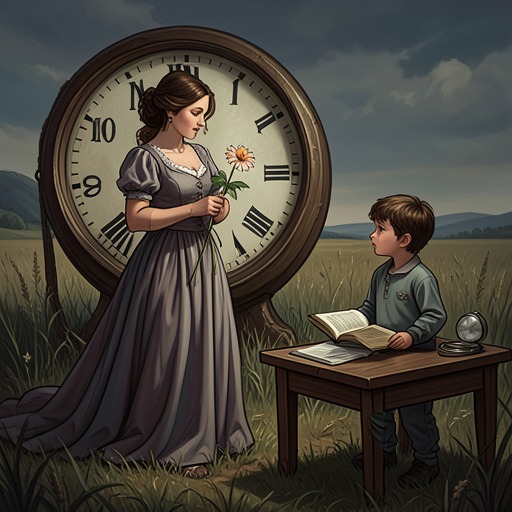
At the destination, a shaft of light falls through a circular opening in the dome onto a circular lake with dark, mirror-smooth water. Above it, a gigantic pendulum moves back and forth, glittering in the light without any visible support. Its motion has both an immense scale and an unhurried precision: as it nears the lake’s edge, a bud rises from the depths; the nearer it comes, the wider the bud opens, until it lies in full bloom on the surface.
Momo sees a flower composed of brilliant colours she has never dreamed of. As the pendulum moves away, the blossom fades and sinks; she is so moved by its passing that she could weep, but remembers her promise and remains silent. The pendulum returns toward the opposite shore, now a pace farther along, and another bud breaks the water. The scene’s pattern is not simply repetition: each flower follows the same relation to the pendulum, yet each bloom differs entirely from those before it. Momo watches flower after flower unfold and die, and each seems, while it lasts, the most beautiful of all.
The Music That Calls Each Hour-Lily
The visual spectacle gradually opens into a second kind of perception. Momo becomes aware that she can hear the shaft of light as well as see it. Its sound grows from an impression like wind in distant treetops to the roar of a waterfall or waves breaking on a rocky shore. Within that vast sound she perceives innumerable notes, continually changing pitch and weaving new harmonies. She recognizes it as the distant music she has sometimes faintly heard while listening to the silence of a starry night: the Music of the Stars.
The music is not merely accompaniment to the flowers. Momo senses that the resonant shaft of light summons each bud from the lake’s dark depths and shapes it into a unique blossom. The sound becomes intelligible in layers: first as notes like the voices of precious metals, then as more remote and powerful voices. The sun, moon, planets, and stars tell Momo their true names in a language she has never heard but can understand. Their names signify what they do and how they combine to make each hour-lily flower and fade. The scene thus connects the flower’s distinct beauty and brief life to the movement and contribution of the heavenly bodies.
Momo’s Own Time
When Professor Hora beckons, Momo runs to him and buries her face in his chest. Back in the small, clock-lined room, he lays her on the sofa. Momo struggles to describe what she has witnessed and settles on the thought that everyone’s time is so big. Professor Hora corrects her: it was not everyone’s time, but her own. There is a place like the one she visited in every living soul, he tells her, though it can be reached only by those he takes there and cannot be seen with ordinary eyes.
That correction changes the scale of the vision. The lake and its flowers display a cosmic order, but the time Momo has encountered is intimate and particular, belonging to one living person rather than to humanity collectively. The scene gives the abstract idea of personal time a form she can see and hear: a movement that calls forth something singular, allows it to flourish, and carries it away. Momo’s silent witness, the flowers’ repeated emergence and disappearance, and Professor Hora’s final explanation together make the visit both a revelation about time and a recognition of the depth of her own life.