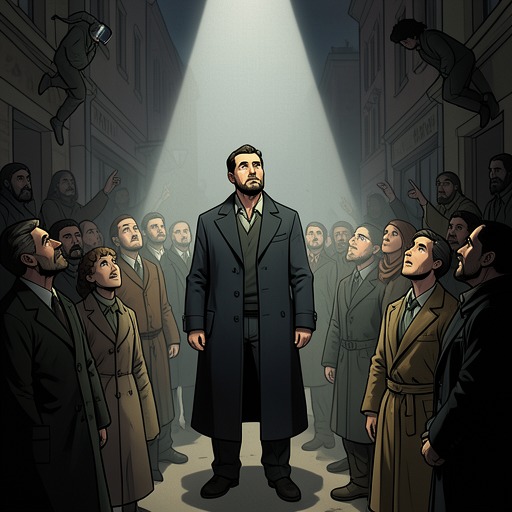
The Men in Gray Threaten Guido into Silence
MomoThe Men in Gray Threaten Guido into Silence is the turning point at which Guido Guide’s attempt to use his celebrity for the truth collapses under the threat of losing the success they helped create. He begins the scene resolved to expose the Men in Gray and enlist his audience in finding Momo; he ends it sobbing at his desk, choosing his career over that purpose. The coercion does more than stop a public disclosure: it completes the transformation of a genuine storyteller into the hoaxer the Men in Gray say they have made of him.
Background and Resolve
The threat follows a long estrangement from Guido Guide’s former life. At night, between silk sheets, he sometimes yearns for the happy times with Momo, Beppo Roadsweeper, and the children, when he was still a genuine storyteller. At first he made strenuous efforts to find Momo, who had never reappeared, but his packed schedule eventually displaced the search. Three secretaries negotiate his contracts, take down his stories in shorthand, manage publicity, and keep his engagement diary; the machinery of his success leaves him no time to return to the task.
One late night, while missing his old friends, Guido Guide resolves to use that success differently. He tells himself that, as a celebrity with millions of listeners and viewers, he is well placed to tell the truth. His plan is specific: reveal the Men in Gray, insist that the story is true, and ask his fans to help find Momo. The resolve is a bid to turn the public reach that has separated him from his former life into a means of recovering it.
By daybreak he is at his massive desk, preparing to put the idea on paper. Before he has written a word, the telephone rings. The voice on the line is peculiarly flat and expressionless; Guido Guide goes rigid with terror and feels, as the narration describes it, as if the marrow in his bones had turned to ice. The immediate interruption makes the scene’s reversal stark: his plan has barely taken written form before the Men in Gray move to suppress it.
The Threat
The caller tells him to abandon the idea for his own sake. When Guido Guide demands to know who is speaking, the voice insists that no introduction is needed and claims that the Men in Gray have owned him body and soul for a long time. They dismiss his scheme as unwelcome and order him to drop it. Guido Guide initially resists, declaring, “I’m not poor little Guido Guide any longer, I’m a celebrity. Try taking me on and see how far you get!” His boast makes fame sound like a shield against the very forces he intends to expose.
The reply turns that confidence against him. The voice laughs without mirth, and Guido Guide’s teeth chatter. The Men in Gray describe him as a nobody and a rubber doll whom they have blown up and can deflate. Their claim is that his present standing comes not from his own talents but from their intervention. They then recast his identity in terms of disguise: he once played Prince Girolamo disguised as the nobody Guido, whereas now he is a nobody called Guido disguised as Prince Girolamo. In this taunt, celebrity is not proof that he has become powerful; it is another performance whose conditions the Men in Gray control.
When Guido Guide calls the accusation a lie, the voice attacks his credibility rather than answering on equal terms. The Men in Gray argue that they have made him famous for tall stories, so he is not qualified to quote the truth to the public. The pressure is pointed: his chosen means of resistance is storytelling, but his professional reputation has been shaped to make the audience treat his account as comic invention. The Men in Gray threaten to make the public identity they helped build into an obstacle to being believed.
Surrender and Consequences
Guido Guide’s whispered question about what the Men in Gray have done with Momo brings the conflict back to the person his plan was meant to help. They tell him not to worry about her and insist that he can no longer help her, least of all by telling stories about them. If he goes ahead, they warn, his success will vanish as quickly as it came. They frame the choice as his, but make the terms plain: he may play the hero and ruin himself, or preserve his wealth and fame by leaving them alone. Asked whether he likes being rich and famous, he answers yes in a muffled voice.
The voice advises him to go on telling people what they want to hear. When the earpiece clicks and falls silent, Guido Guide hangs up, slumps over the desktop, and buries his face in his arms, racked with silent sobs. The gesture marks the defeat of his resolve more plainly than any further argument could: the man who was about to write an appeal for Momo cannot bring himself to continue.
Afterward, Guido Guide abandons the plan and carries on with his career, having lost the last scrap of self-respect. He knows that he is now telling lies rather than following the flight of his imagination. He hates the work, and his stories grow sillier and more sentimental; nevertheless, the public praises him for pioneering a new style of humor, and other comedians imitate it. He continues racing by car or plane from one engagement to the next, with his secretaries taking down old stories in new guises. The acclaim persists, but brings him no pleasure: he knows who is responsible for his success and feels that he has gained nothing and lost everything.
Significance
The scene makes the cost of the Men in Gray’s influence visible in a single failed act of disclosure. They need not prevent Guido Guide from speaking by force in public; instead, they use his dependence on a manufactured reputation and his fear of losing it. The threatened loss of fame succeeds where his fresh courage fails, and the career that might have helped him find Momo becomes the instrument of his silence.
The narration’s final contrast gives the change its sharpest form: “Guido the dreamer had, in fact, become Girolamo the hoaxer.” The line links his altered storytelling to the earlier dispute over who made him famous, while the continuing applause shows how the public can celebrate the very change that leaves him ashamed. The next account turns to Beppo Roadsweeper, who proves a harder problem for the Men in Gray. Against Guido Guide’s retreat, that transition underscores that the threat has silenced one former friend but has not resolved the wider struggle.