The Children's Demonstration Against the Men in Gray
MomoThe Children's Demonstration Against the Men in Gray is an organized attempt to expose the hidden theft of people’s time by bringing the truth before the whole city. Guido Guide proposes a public march and mass meeting as a way to make the Men in Gray visible; children carry the plan into the streets, where their numbers grow dramatically. Yet the adults the demonstration is meant to reach do not appear. Its outcome turns a hopeful campaign into a conspicuous failure, leaving its young participants to confront the limits of their influence over the city’s grown-ups.
The secret meeting and its audience
By three the next afternoon, the Amphitheater is filled with the voices of roughly fifty or sixty children who have come from near and far. They differ in size, family circumstances, and behavior: some are rich, some poor, some orderly, and others rowdy. Maria and other children bring younger family members with them, including toddlers who watch the unusual gathering in silence. Franco, Paolo, and Massimo are present, while many of the other children are newcomers to the Amphitheater with a particular interest in the matter under discussion.
The gathering has a private purpose. Claudio, who owns the transistor radio but arrives without it, takes a seat beside Momo and introduces himself as glad to have been invited. The presence of children who were not part of the Amphitheater’s older circle suggests that the issue has already begun to reach beyond Momo’s immediate companions. At the same time, Momo is saddened that none of her grown-up friends has come, apart from Beppo Roadsweeper and Guido Guide. The meeting’s broad range of young attendees contrasts with the absence of the adults whose attention the children will later try to secure.
When the last children have arrived, Guido Guide calls the room to order. He explains that people are ending up with less time even as they try to save it: the time they mean to keep has instead been taken from them. He identifies the perpetrators as a gang of time-thieves and asks the children to help stop them. After the children applaud, he says that Momo will describe her encounter with one of the gang and how the man exposed himself. Beppo Roadsweeper interrupts to warn that telling the story could put Momo and the children in danger. Several voices immediately insist that Momo should speak, and the whole gathering joins in chanting her name. The moment establishes both the risk Guido’s plan entails and the children’s eagerness to hear Momo’s account.
A strategy of public exposure
As the children consider what to do before the time-thieves discover their activity, Guido Guide reveals that he has already imagined and discarded hundreds of schemes. He presents the plan as dependent on everyone’s cooperation, and describes the children’s discussion as a test of whether anyone could devise something better. His proposal rests on a specific weakness: the Men in Gray draw power from working in secrecy and remaining unrecognized. Guido reasons that making the truth public would deprive them of that advantage.
The plan has two linked stages. First, the children will paint posters and banners and march through the streets, attracting as much attention as they can. Then they will invite the whole city to the old Amphitheater, where the facts about the Men in Gray will be revealed to a large audience. Guido predicts that thousands will come, that the disclosure will change the world, and that people will again have enough time because it will no longer be stolen. The children respond with excited cries, and he declares the plan unanimously approved. They agree to invite the city for the following Sunday afternoon but keep the plan secret until then. Their confidence rests on the hope that public knowledge can undo a power built on concealment.
The march through the city
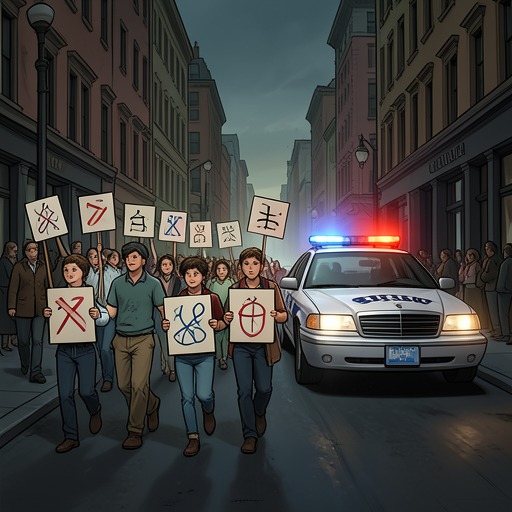
For several days, the Amphitheater becomes a center of discreet, energetic preparation. Paper, paint, brushes, paste, cardboard, poles, planks, and other materials appear, although the children do not say where they obtained them. Some make signs and banners; others compose slogans and paint them in careful lettering. Guido Guide also writes a song for the occasion. Its twenty-eight verses make the procession more than a display of signs: the children carry a repeated appeal to their elders as they move through public space.
When everything is ready, the children assemble at the Amphitheater and set off in single file. Guido Guide, Beppo Roadsweeper, and Momo lead them. The group waves posters and banners, clatters saucepan lids, blows penny whistles, chants slogans, and sings. The procession is sometimes broken up by police when it obstructs traffic, but the children regroup elsewhere and start again. They are not deterred by these interruptions. Their repeated return to the streets makes the march a sustained attempt to be noticed rather than a single passing spectacle.
The demonstration grows beyond the group that planned it. Children who see the march join even though they had not previously known about the affair. The numbers rise from the fifty or sixty attendees at the secret meeting to hundreds or even thousands in the streets, all urging adults to attend the meeting that is supposed to change the world. This growth demonstrates the children’s ability to spread the call among themselves. It does not, however, guarantee that the intended audience will listen: despite the crowds and noise, the children see no Men in Gray during their vigilance.
The failed meeting and its aftermath
The appointed gathering brings no grown-ups to the Amphitheater. Hundreds of children wait, but the public demonstration has passed almost unnoticed by the very people it was intended to reach. As evening falls, the children grow quiet and uncertain; when a distant church clock strikes eight, their doubt gives way to the recognition that the scheme has failed. One or two leave, then others follow without speaking, their disappointment too great for conversation.
Paolo eventually tells Momo that there is no use waiting and says good night before walking away. Franco leaves next, declaring that the children cannot count on the adults and that he has never trusted them. More and more children go home. By the time the last have left, Momo is alone with Guido Guide and Beppo Roadsweeper. The ending sharply reverses the promise of the plan: a campaign that had imagined thousands of adults gathering in response concludes with the young organizers waiting in an emptying Amphitheater.
Significance
The episode distinguishes two kinds of success. The children accomplish the immediate task of mobilizing other children: a small, invited group becomes a much larger procession, and the effort persists despite police dispersals. But the march does not achieve its central purpose of bringing the adults to hear the truth. Its failure exposes the distance between visibility and influence. The children can make themselves heard in the streets without making the people they seek to persuade respond.
The plan also turns on the idea that secrecy sustains the Men in Gray. Guido Guide treats public disclosure as a practical countermeasure, yet the adults’ nonappearance prevents the expected revelation before a citywide audience. The demonstration therefore does not resolve the conflict; instead, it leaves Momo and her companions with the consequences of an unsuccessful appeal. Its final image is not the triumph Guido had predicted, but the dwindling crowd and the three friends who remain.