The Stolen Hour-Lilies Return to People's Hearts and Time Resumes
MomoThe return of the stolen hour-lilies restores both time and ordinary life: Momo opens the vault, its captive flowers are released, and the city resumes as if its frozen hour had never passed. The ending makes the restoration visible to Momo as a vast, beautiful release, but almost invisible to the people whose lives have been returned to them. Their renewed freedom is real even though they do not know its cause.
Opening the vault
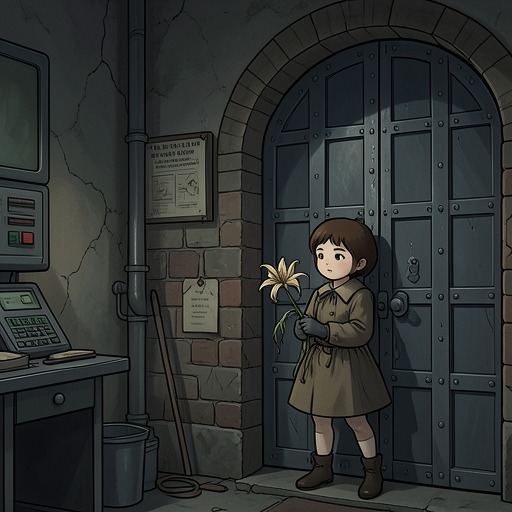
Momo is still staring at the place where the last time-thief vanished when Cassiopeia crawls into view. The tortoise’s shell signals that Momo will open the door, and Momo goes to it with the hour-lily she has carried through the crisis. Only one petal remains. She touches the door with the flower and opens it wide: the decisive action is small and direct, while what it makes possible is immense.
Inside, the vault is no longer cold, now that the time-thieves are gone. Momo sees innumerable hour-lilies arrayed on endless shelves, each different from the others, like crystal goblets. Their beauty does not soften what they contain: hundreds of thousands, indeed millions, of hours stolen from people’s lives. The scale of the theft is made concrete not through an account of individual victims but through the seemingly uncountable flowers gathered in one place.
The release of the stolen hours
The vault grows steadily warmer, until it is as hot as a greenhouse. At the moment the last petal falls from Momo’s own hour-lily, the flowers leave their shelves in clouds and swirl around her head. The timing links the end of her flower to the release of the accumulated store: her remaining petal marks the close of the action she has carried out, while the other lilies begin their return from captivity. Their movement transforms the vault from a place of containment into a passage back toward human life.
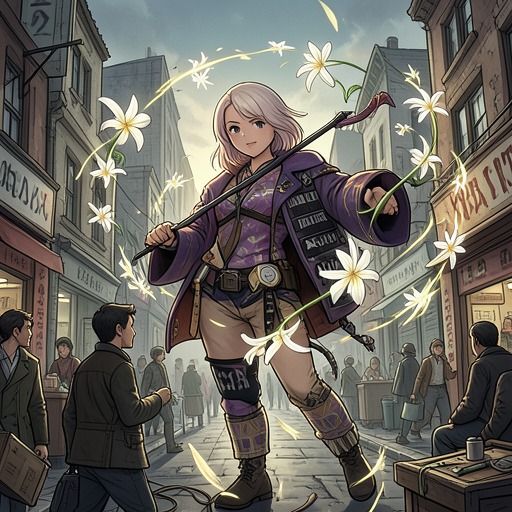
Momo is lifted by the rising cloud and borne through the dark passages, out into the open air and above the city. The flowers carry her over the rooftops in a growing cloud, then drift down across the frozen ground like snow. They dissolve as they return to their true home in people’s hearts. The image completes the reversal: what had been removed from human lives and held apart in the vault is no longer stored there, but dispersed back among the people from whom it came. Momo, who entered the vault to act, is carried along with the release rather than controlling its vast movement.
Time resumes
As the flowers return, time begins again in the same moment. The cars move, traffic police blow their whistles, pigeons resume circling, and a little dog continues what it had been doing beside a lamppost. These small continuities make the restart legible: the city does not awaken into a visibly different scene so much as pick up its interrupted motions. The pause lasted an hour, but nobody notices it, since nothing moved during the interval.
That apparent seamlessness conceals a profound change. People suddenly find that they have plenty of time to spare and are delighted by the difference, yet they do not realize that the time is their own, miraculously restored. The ending therefore separates consequence from understanding: the victims experience the benefit without learning how their time was taken or returned. The city’s resumed routine is not proof that nothing happened; it is the form the restoration takes for those who were frozen through it.
Aftermath and significance
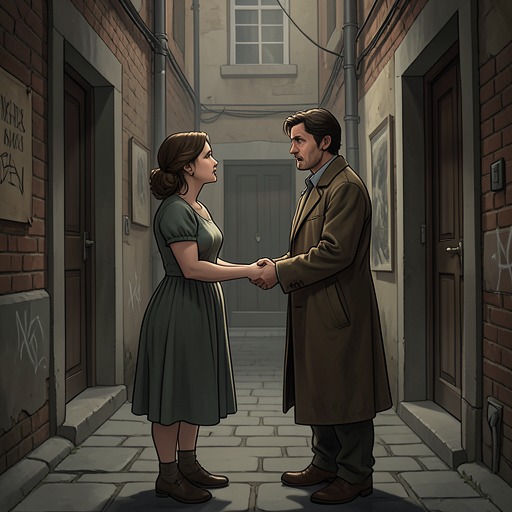
When Momo comes to her senses, she is back in the side street where she last saw Beppo Roadsweeper. He is there, leaning on his broom and gazing into the distance as he used to before the urgency of the search. He is no longer in a hurry and feels brighter and more hopeful. His changed manner gives the return of time an intimate counterpart to the public restart: restored time is registered not only in moving traffic, but in a person’s renewed ease.
Beppo wonders whether he may already have saved the hundred thousand hours he needed to ransom Momo. His thought connects the ending to the long effort that had kept him working and searching, even as the restoration has made that bargain unnecessary. The scene closes not with an explanation to the city, but with Beppo still interpreting events through the promise that had sustained him. In that contrast, the event’s victory is both complete and quiet: stolen time has returned, while the people who benefit from it remain unaware of the rescue and its cost.