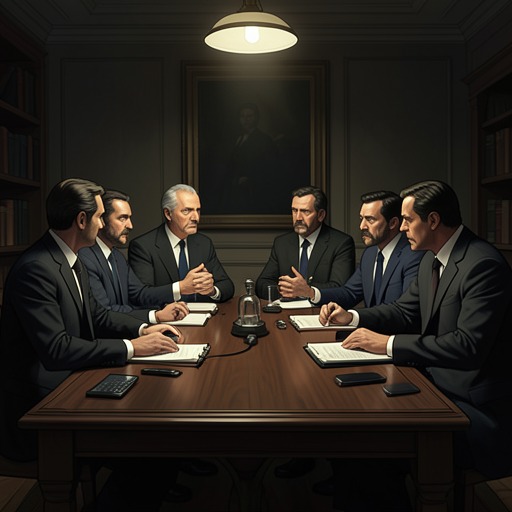
The Timesaving Bank's Emergency Conference
MomoThe Timesaving Bank's Emergency Conference turns the Bank's secret pursuit of Momo into a crisis of strategy: a manhunt has cost the directors a measurable fortune in time, yet they cannot agree on what Momo's escape means or how to contain her. Their meeting lays bare the institution's governing logic—every danger is assessed as a debit, even as fear forces its leaders to consider abandoning the thrift they preach. It ends not with a settled plan but with a proposal to make human accomplices do what the gray agents fear to do themselves.
Background and Setting
The conference takes place at the Timesaving Bank Headquarters after every available agent has been assigned to hunt for Momo. The institution is introduced as a gray-lit labyrinth of passages and corridors, where news travels in agitated whispers. Its directional board has been summoned to an extraordinary general meeting, a call that prompts speculation among the staff: some anticipate an emergency, while others imagine that new sources of time have been found. The directors are already in the boardroom, seated along a table that seems to stretch without end. Each has a steel-gray briefcase and a small gray cigar; they have taken off their bowler hats, revealing uniformly gray bald heads. Their collective dejection makes the meeting's purpose plain before the chairman begins.
The crisis grows out of the Gray Men’s larger project. They understand time as life and value minutes and seconds with an expertise likened to that of leeches in relation to blood. Their plans depend on secretly taking over people's time without attracting notice, identifying likely targets well in advance and waiting for the moment when each can be entrapped. The conference shows what happens when that quiet, calculated system is forced to reckon with an unpredictable obstacle: the directors can measure the cost of chasing Momo, but they cannot confidently explain how she escaped.
The Cost of the Manhunt
The chairman presents the search as a financial calculation. It lasted six hours, thirteen minutes and eight seconds. To that duration he adds the time the agents would otherwise have spent gathering time, arriving at a total loss of 3,738,259,114 seconds—more than a human lifetime. He points to a huge steel door fitted with combination locks and safety devices at the far end of the boardroom as he warns that the Bank's reserves are not inexhaustible. The hunt produced no return: Momo eluded the agents. The chairman therefore urges the directors to prevent any repetition and to shape future plans around saving rather than squandering time.
This accounting translates a failed pursuit into the Bank's own vocabulary. The agents' time away from their usual work and the foregone time-gathering are treated as separate debits, while Momo's escape is described as a costly result without compensation. Yet the arithmetic offers no remedy. The chairman can state the scale of the loss to the second, but the number does not tell the board how to find Momo or make her harmless. The exactness of the calculation sharpens, rather than resolves, the uncertainty.
Disagreement over Momo's Escape
A second director challenges the chairman's alarm. The Bank's reserves, he argues, are so vast that a loss many times greater would not endanger it; by the institution's standards, even a human lifetime is negligible. He agrees that the incident should not recur, but presents it as unprecedented and unlikely to happen again. More reassuringly, he claims that the operation achieved its real purpose: Momo has disappeared and fled beyond the borders of time, so the Bank is rid of her. A small amount of applause follows, but the next speaker cuts short the comfort of that conclusion.
The third director insists that Momo is no ordinary child and that her abilities remain a serious threat. Her disappearance cannot guarantee safety: she may re-enter the realm of time, and the board should not rest until she is in its power. A fourth speaker then redirects the debate from Momo to the possibility of outside assistance. He calculates that a living creature crossing the borders of time unaided would be a near impossibility, with odds of forty-two million to one, and concludes that someone must have helped her. He names Professor Hora. The name visibly unsettles the directors: some flinch, others jump up, and the room fills with renewed agitation.
The fourth speaker argues that, if Professor Hora helped Momo, he may have reason to send her back and arm her against the Bank. The directors, he warns, may ultimately have to risk everything they possess rather than cling to thrift. His warning reverses the chairman's lesson: saving resources may not be the prudent course if restraint leaves the Bank exposed to destruction. The fifth speaker objects that this is still speculation without a practical answer. The directors erupt into shouting, table-drumming and despair, a disorder sharply at odds with the measured calculations that opened the meeting.
The Proposed Response and Its Significance
A sixth speaker restores order by proposing that the directors avoid fighting Momo themselves. The fate of their late employee, Agent No. BLW/553/c, has shown, he says, that the Gray Men are poorly equipped for such a confrontation. They have human accomplices in plenty; with discreet and skilful use of those allies, they could dispose of Momo and the threat she represents without intervening in person. He presents this as both economical and safe. The meeting thus moves from a numerical reckoning, through disagreement and panic, toward a strategy that shifts the danger onto people outside the Bank.
That proposal fits the Bank's established method of hiding its operations within ordinary human life. Its agent recruited Mr Figaro by urging him to shorten customer appointments, reduce visits to his mother, give up music and reading, and bring other everyday activities under a stricter schedule. Mr Figaro followed the recommendations as if they were his own, but the time he saved never became time at his disposal. His days seemed to grow shorter, while his determination to save time only intensified. Across the city, advertising praised timesaving, work notices demanded greater speed, and standardized housing replaced older buildings; the result was a poorer, bleaker and more monotonous life. Against this background, the directors' appeal to human accomplices is not a departure from the Bank's practice but a widening of it: people already drawn into its time-saving order may also be used to pursue Momo.
The conference's dramatic turn lies in the gap between the Bank's confidence in calculation and its inability to understand what has happened. The chairman can total the loss, and another director can assign a probability to Momo's passage across time's borders, but neither figure explains the help she received or ensures that she will stay away. The directors' final proposal responds to that uncertainty by seeking indirect control. At the close of the meeting, it remains a proposal, not a demonstrated outcome; what has changed is the board's recognition that its own agents may not be enough.