Timesaving doctrine
MomoTimesaving doctrine turns the wish to have more time into a discipline that consumes the time and life it claims to protect. Promoted covertly by the Men in Gray, it teaches people to measure their days by efficiency, discard activities deemed unproductive, and defer living until some later moment. Its central reversal is that the more people save, the less they have.
Premise and Promotion
The doctrine rests on a distinction between clock time and lived time. Clocks and calendars can measure hours, but an hour may feel long or pass quickly according to how it is spent. The novel frames time as life itself, residing in the human heart; the Men in Gray understand this intimate value and exploit it with the calculation of specialists in blood. Their plans depend on keeping their presence and activity unnoticed while gradually taking over inhabitants’ lives.
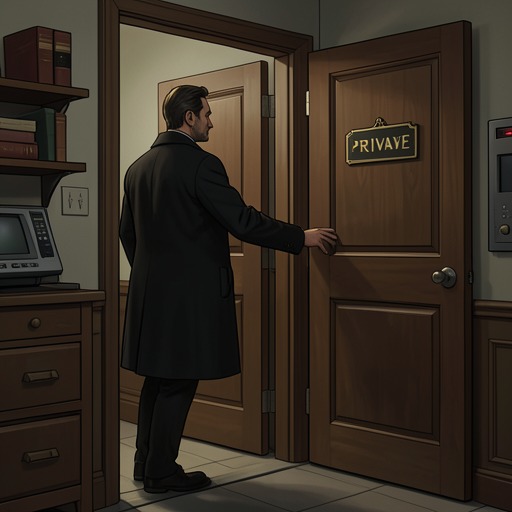
Their recruitment is personal and carefully timed. An agent approaches Mr Figaro with practical instructions that make the doctrine sound like common sense: work faster, limit each customer, avoid conversation, reduce time with his mother, give up singing, reading, and time with friends, and use a clock to monitor his apprentice. The proposed savings are not presented as time to enjoy in the present, but as a reserve for beginning a new life sometime in the future. That promise makes immediate relationships and pleasures appear to be obstacles to a freedom that never arrives.
From Advice to Routine
Mr Figaro adopts the program as though it were his own resolution. He first serves a customer in twenty minutes rather than the usual thirty, then imposes the same treatment on everyone. He hires two assistants in addition to his apprentice and watches them closely to prevent wasted moments; a notice in the barbershop announces that saved time will be doubled. His work becomes more tightly scheduled even as he ceases to enjoy it.
The changes extend beyond the shop. Mr Figaro sends Miss Daria a brief note ending their meetings, sells his budgerigar, places his mother in an inexpensive old folks’ home, and visits her only once a month. He has forgotten the gray stranger who gave him this program, but he retains the determination to save time and mistakes it for a choice made independently. The doctrine’s power thus lies not only in the agent’s advice but in how completely that advice is absorbed into ordinary decisions.
The promised surplus never appears. Mr Figaro grows increasingly restless and irritable, and the time he saves seems simply to vanish. His days become unmistakably shorter: weeks, months, and then years pass in succession. Even when he notices that time is flying, the realization strengthens rather than breaks his resolve to save more. The doctrine converts its own failure into another reason for intensifying the effort.
Social Reach and Consequences
The same logic spreads from private schedules into public policy. Advocates describe children’s play as wasted time and cast children as raw material for a future world dependent on computers and nuclear energy, which will supposedly need experts and technicians. The timesavers support this program, persuade the authorities to act, and help bring about the construction of Child Depots across the city. Children whose parents are too busy must be deposited there, while playing in streets, parks, or other public places is forbidden and can bring their parents a fine.
Momo’s friends are separated according to their districts and sent to different depots. Supervisors choose games for them, and every game must have a useful, educational purpose. The children learn the prescribed activities but lose the ability to take pleasure in small things, to be happy, and to dream. After weeks, they resemble miniature timesavers: sullen and resentful, they no longer know what to do even when left alone. The Men in Gray need not approach them directly; the surrounding rules and institutions have already enclosed their lives.
Imagination Against Efficiency
The doctrine’s suppression of play is thrown into relief by the children’s earlier games at the amphitheater. Momo’s presence helps them invent new games, not by supplying a plan but by enabling their own ideas to flourish. One proposed game begins with the children pretending the amphitheater is a ship. When Momo arrives, the make-believe voyage takes shape as the Argo expedition: the ship crosses dangerous seas toward the South Coral Sea, prepared to face shoals, reefs, sea monsters, and the unpredictable Travelling Tornado. Its imagined hull is made of adamantium, cast in one piece to withstand the hazards.
The contrast is not simply between one kind of game and another. The children’s self-created voyage expands through shared invention; its value does not depend on producing a measurable skill or useful result. Later, in a play class, Franco describes data retrieval as a useful game in which the children pretend to be punch cards carrying information about themselves. Under the depot system, play is retained in name but reorganized as instruction. What disappears is the open-ended imaginative freedom that let the children turn a stone amphitheater into a ship and invent the dangers of an unknown sea.
The Doctrine’s Reversal
Timesaving doctrine presents efficiency as a path to a richer future, yet its practice steadily impoverishes the present. Adults surrender conversation, affection, recreation, and the enjoyment of their work; children lose unscheduled play and the capacity to dream. People fail to notice at first that saving time means losing something else, while daily life becomes bleaker and more monotonous. The doctrine’s governing paradox is ultimately stated plainly: the more people save, the less they have.
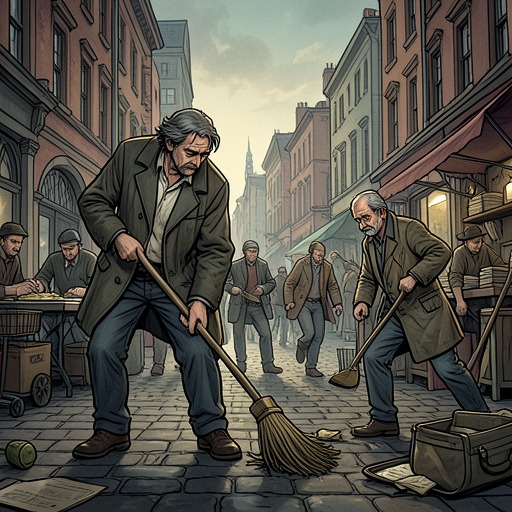
Its reach is also visible in Beppo Roadsweeper’s decision to abandon his former working rhythm. To raise Momo’s ransom, he sweeps hurriedly and without pride, despite feeling that he is betraying beliefs held throughout his life. He works day and night, sleeps only for a few minutes on a bench or curb when exhaustion overcomes him, and eats hurried snacks while moving. His case shows the doctrine imposing its measure even on someone who recognizes its cost: the need to help Momo drives him to use the only method he knows for saving time. Across such different lives, the creed converts time from a medium for living and relating into a resource to be guarded, scheduled, and spent in pursuit of a future that keeps receding.