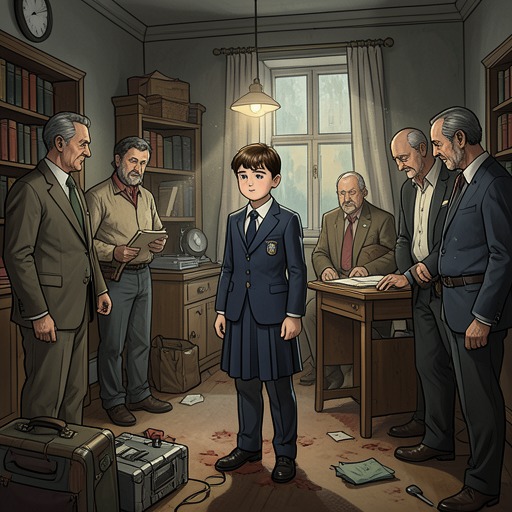
Dickie and Charlie
MovingDickie and Charlie’s relationship is shaped by a contradiction: Dickie helps determine where Charlie is educated, yet when that education exposes Charlie to abuse, he cannot recognize its seriousness. His influence first sends Charlie away to the Westminster Abbey Choir School and later secures him a place at Wyebourne College. In the confrontation that follows the Wyebourne scandal, Dickie treats abuse as an experience boys simply endure, while the revelation of his own childhood assault makes that dismissal both more comprehensible and more disturbing.
A decision shaped by Dickie’s affair
When Charlie was nine, Edwina did not want him to board. She took comfort in the school’s proximity to Kennington Road: she could take a bus and wave to him through the windows, and imagined she could break in and bring him home if necessary. Dickie encouraged her to accept the place. He and Edwina had only recently begun their affair, and Charlie had a habit of interrupting their lovemaking by barging in. Edwina later recognized that sending him away was convenient for Dickie, even though at the time she believed Dickie was acting in Charlie’s interests.
Dickie presented boarding as an opportunity Charlie should not be denied, arguing that boys were natural boarders and pointing to Lucas’s apparent ease with school life. Edwina let Charlie sit the entrance examination. His academic ability worried them, but his musical gift and singing helped his case; so did Edwina’s status as a widow. For four years, Charlie’s future seemed secure to her. She proudly introduced him as her son, the Westminster chorister. That pride later became part of her regret: she wondered whether her own vanity had helped carry him toward his eventual downfall.
From the choir school to Wyebourne
The choirboys left at thirteen, and Charlie had to move on to an ordinary school. The transition exposed how little the choir school had prepared him academically. None of London’s good day schools accepted him; his schoolwork was weak, and he could not write an examination paper legibly. One school reportedly rejected him because its staff could not read his name at the top of the paper.
Dickie then offered to use his connections at Wyebourne College, appealing to the advantages of being an old boy. Edwina was shocked when Charlie received a place. Dickie never explained how he had arranged it. When the scandal at Wyebourne later emerged, Edwina guessed that Dickie’s old-boy connection had helped place Charlie in an institution where he would be abused. She accused him of having known what was happening and of entrusting her son to a dangerous school. The narrative presents this as Edwina’s later conclusion, not as proof that Dickie knowingly placed Charlie in danger.
The confrontation over abuse
Edwina’s anger centers not only on the abuse itself but on Dickie’s role in sending Charlie to Wyebourne. She insists that the conduct was abuse because Mr Robbins had been in a position of care. Dickie instead minimizes it, saying he knew Mr Robbins at school and did not believe he would hurt anyone. His response rests on a broader assumption: in his experience, boys at boarding school were interfered with by someone, whether an older pupil or a teacher, and were expected to get over it. He even treats the experience as something that could make a boy more of a man.
The contrast between their positions is stark. Edwina names the imbalance of power and the harm done to her son; Dickie resists the language she uses and treats such experiences as ordinary. When Edwina later objects to Lucas remaining at a school that colludes with paedophilia, Dickie again tells her not to use the term so readily, arguing that Charlie had not been nine. His comparison makes age seem decisive while leaving the abuse itself unchallenged.
The childhood Dickie discloses
Years later, Dickie admits that he was nine when a prefect came into his dormitory, turned him onto his stomach, and gagged him with one of his own school socks. The revelation casts his earlier attitude into sharper relief. The age he invokes to distinguish Charlie’s experience from his own is the age he himself was when he was assaulted. His account helps explain how he could regard abuse as routine: he had absorbed a school culture in which boys were expected to endure it and move on. But explanation does not erase the consequences of his choices. He urged Edwina to send Charlie away, arranged his later admission to Wyebourne, and then failed to acknowledge the seriousness of what happened to him there.
The relationship is therefore defined less by a single act of hostility than by Dickie’s power over Charlie’s education and his inability—or refusal—to interpret that power as carrying responsibility. His childhood history complicates the judgment of him without resolving it. The same institution that taught him to normalize abuse also becomes the context in which he helps place his stepson, making the gap between Dickie’s experience and his response to Charlie central to their relationship.