Edwina and Lucas
MovingEdwina and Lucas’s relationship is defined by a persistent gap between Edwina’s efforts to welcome her stepson and Lucas’s refusal, as she remembers it, to accept her care. Their history is held in a room prepared specially for him: a private gesture that he barely acknowledged, and a domestic space that Edwina later struggles even to name. As she prepares to sell the family house, the room brings her resentment back into view, but also complicates it with the recognition that Lucas had reason to feel like an outsider.
Identity and the First Welcome
Lucas is Edwina’s stepson, the son of Barbara and Dickie. His place in Edwina’s household is never straightforward: he visits rather than living there full time, and enters a family whose routines and intimate familiarity already belong to Edwina and the twins, Rowena and Charlie. In her later reflections, Edwina understands that Lucas was ten when his father’s new marriage changed the family he had known. He was old enough to recognize that change, she thinks, but too young to understand it fully.
The bedroom set aside for Lucas represents Edwina’s attempt to make that arrival feel like inclusion. She learned that he was interested in the Apollo space mission and painted a lunar landscape on the walls, complete with an Apollo 11 rocket, astronauts, and a small Earth. A hand-painted tile on the door marked the room as his. The mural was not a casual decoration: Edwina had researched his interests and shaped a room around them, hoping to make a place for him in the house.
Lucas arrived carrying a small leather suitcase, dressed in grey flannel shorts. The twins ran in and out, excited by their mother’s work, while Lucas blinked at them and seemed not to notice the effort. Then, silently, he turned his back and shut the door on them all. The episode fixes the relationship’s early imbalance in a single gesture: Edwina’s invitation is conspicuous, but Lucas does not return it with warmth or even acknowledgment.
Part-Time Family Life
Lucas became a regular but part-time member of the household. He came for lunches, occasional weekends, and some of the holidays; when he left, Edwina recalls feeling relief. She believed he disliked what she did for him, whether it was the mural, her cooking, or the presents she bought. In her account, the problem was not a single failed welcome but the repeated experience of trying to please someone who seemed determined not to be pleased.
A Christmas present made that tension especially clear to her. Because astronomy was Lucas’s interest, Edwina gave him a telescope during the first Christmas after she married Dickie. Lucas tore part of the Santa-printed wrapping, pushed the partly unwrapped gift beneath the sofa, and looked bored until it was time to return to Chelsea. Edwina remembers her hands itching to slap him. The recollection exposes the anger beneath her attempts at generosity: she tried to offer care, but his rejection could make her feel not merely disappointed, but provoked.
Edwina’s account also locates the estrangement within the structure of the household. Lucas arrived in a home where the twins already knew its nooks, routines, and small advantages, from which pantry tin held the best biscuits to where to sit beneath the clothes pulley. He was not simply being offered a bedroom; he was entering a family whose shared knowledge had formed without him. Edwina later wonders whether living there full time might have helped him love them enough not to take the other side so often. The thought remains hypothetical, but it shows her beginning to consider how part-time belonging may have reinforced the distance she resented.
The Room as a Record of Estrangement
The room was one of the parts of the house Edwina had spent least time in. It had first been used for nannies and then, in its current arrangement, for Lucas. Dickie had hoped Lucas might return to stay, even if only for a night. Edwina could not openly say that she did not want him there under any circumstances, but she was relieved when he returned to Britain and stayed with Barbara instead. Her reluctance to host him sits beside the earlier work she had done to make him welcome: the two facts resist any simple account of her as either an embracing stepmother or a wholly rejecting one.
The room itself changes as the years pass. Its former rose-colored paint and lunar mural are covered by pale grey walls; the picture Edwina painted survives only in her memory and, as she imagines it, beneath the plaster. Other residents will occupy the house without knowing what happened there. The room also holds less visible traces of Lucas’s childhood: the bed was often wet, but no one was allowed to mention it, and spilled water or a leaking hot-water bottle served as explanations. Edwina remembers Rowena questioning the hot-water-bottle excuse because it was July. These details make the room a record not just of deliberate welcome, but of difficulties the household managed through silence.
Retrospect and the Name She Avoids
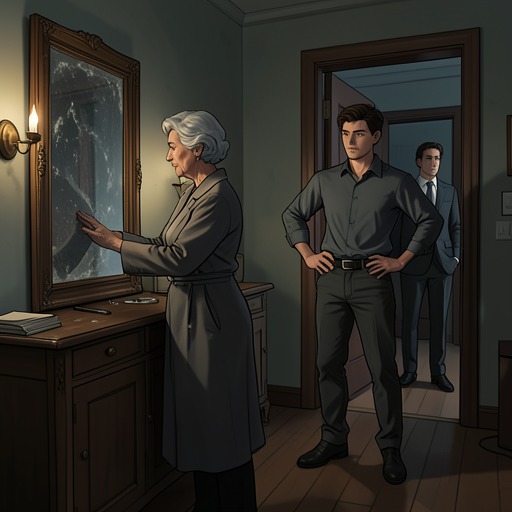
As Edwina prepares to sell the house, a boy asks what lies next door. She deliberately calls it the spare room, biting her lip before she can say Lucas’s old bedroom. She has not spoken his name for so long that saying it feels physically difficult. She does not want to think about him, especially after what he did, though the house makes that refusal hard to sustain: Lucas remains part of its accumulated history, from the room made for him to the messes and strained silences associated with his stay.
Edwina explains his hostility to herself as retaliation. In her understanding, he was paying her back for taking his father from his mother, breaking up his family, and ending his position as an only child. Yet she also acknowledges that she and Dickie had few guides to the effect of divorce on children; at the time, they did what they thought best. She wonders whether she should have tried harder and whether a fuller place in their household might have changed Lucas’s allegiance. This regret does not erase her anger, nor does it resolve what later happened between them. Instead, it leaves their history suspended between Edwina’s remembered acts of care, Lucas’s visible refusals, and her eventual recognition that the home she offered may never have felt fully his.