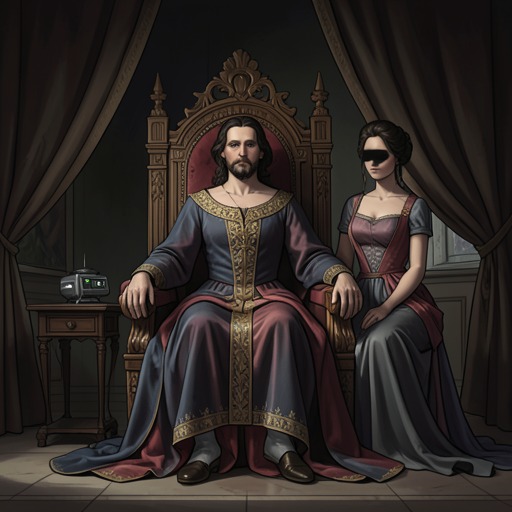
Reign of Emperor Zhou
MulanThe Reign of Emperor Zhou is presented as a disastrous period in which the emperor’s devotion to Daji turned extravagance and cruelty into forces that brought down his rule. Daji was the White Fox in a beautiful woman’s form, and her demands drained the kingdom while her appetite for spectacle helped provoke revolt. Although Zhou was killed and Daji appeared to die, she escaped; the history therefore links the end of his reign to a continuing threat rather than a clean resolution.
Daji and the Emperor
The history is recounted by the Jade Rabbit as an explanation of the White Fox’s past. Over centuries, the White Fox had taken many names and forms, refining her ability to appear as a woman of exceptional beauty and charm. Emperor Zhou succumbed to Daji soon after seeing her, made her his royal companion, and lavishly indulged her wishes. His attachment gave her unusual influence over royal resources and, ultimately, over the conduct of his rule.
The account makes that influence tangible through a succession of extravagant demands. Horses were driven to exhaustion each week to bring fresh fruit from the south. Charcoal for the heaters was mixed with costly honey, and fine silk was supplied for Daji to tear because she enjoyed the sound. These expenses were only a small part of the larger burden: people from four hundred villages were forced to build an enormous palace decorated with jewels and jade, together with a garden and a lake filled with wine. Roasted meat hung from the branches beside the lake for Daji to take as she passed by on a three-story boat of gold and marble. When a leaf fell before her, she insisted that it, and other fallen leaves, be replaced with silk leaves. The demands soon bankrupted the kingdom.
Extravagance and Cruel Rule
The Jade Rabbit’s account distinguishes the cost of Daji’s luxuries from the harm caused by her cruelty. Daji grew bored with the pleasures of the palace and sought increasingly severe diversions. After hearing the belief that a true sage had seven holes in his heart, she ordered the kingdom’s wisest men killed so that she could examine their hearts. On another occasion, after seeing an ant accidentally cooked in a pan, she persuaded Zhou to devise a similarly cruel punishment for his enemies. These episodes show a court in which the suffering of others became entertainment and the emperor used his authority to satisfy Daji’s whims.
Her demand to witness a real war brought that cruelty beyond the palace. Zhou declared war on a neighboring kingdom to please her. When Daji arrived after the fighting had begun, he halted the battle and ordered a road built to a cliffside vantage point. Only once she was settled there in a rosewood chair, attended by a handmaid and supplied with fruit, did he allow the fighting to resume. Daji watched until the spectacle bored her and she wanted to leave. Although his troops were winning, Zhou stopped them in the middle of the battle and withdrew. The episode makes the cost of his submission public: a war’s course and the lives at stake were subordinated to Daji’s changing appetite for entertainment.
Revolt and the End of the Reign
The meaningless deaths provoked widespread outrage. A few days later, when Daji called for another battle, larger and bloodier than the first, the kingdom revolted. A new emperor was declared, and troops from across the regions rallied against the capital. Commoners joined them at the city gates, while the Imperial Guard also turned against Zhou’s side. The revolt thus brought together soldiers, townspeople, and palace guards in opposition to a reign associated with both extravagant expenditure and needless bloodshed.
Without supporters and trapped in the palace, Zhou was killed by the new emperor’s son. Daji, apparently assisted by her handmaid, hanged herself. But the apparent ending proved false: when her body was retrieved the next day for burial, it had been replaced by a bamboo stalk. The White Fox had escaped once more, leaving behind destruction but no body to confirm her death. The detail turns the account of a fallen ruler into another episode in the White Fox’s long history of assumed identities and escapes.
Historical Memory and Significance
Mulan recognizes Zhou as the emperor whose rule had nearly destroyed the empire and connects the story to her own family: her father had helped bring his reign to an end. She had known Zhou was evil, but the Jade Rabbit’s account changes her understanding by identifying the White Fox as a cause of his wickedness. The Rabbit qualifies that judgment, describing Zhou as foolish rather than wholly wicked and noting that he had little goodness to begin with. He says that Zhou worshipped Daji with the devotion given to a goddess, suggesting why her escape and the destruction associated with her matter to the present story.
The reign’s significance lies in the combination of political collapse and unfinished danger. Daji’s extravagance weakened the kingdom; her cruelty and Zhou’s obedience made the ruler’s authority an instrument of suffering; and the war staged for her amusement helped expose the emptiness of his rule. Revolt ended Zhou’s reign, but it did not eliminate the White Fox. In the story’s present, Mulan’s family history and the Jade Rabbit’s explanation place her struggle against Daji in the wake of that earlier collapse.