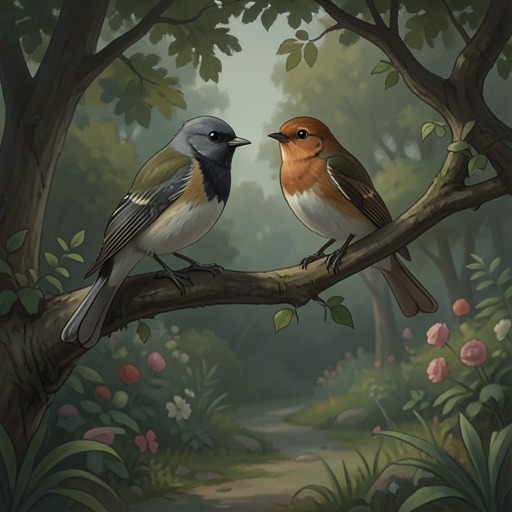
Blackbird
MunichThe Blackbird enters the narrative through a reported act of predation: a letter describes a nest emptied of its mother and four chicks, with feathers marking the path to the adult bird’s remains. Neville Chamberlain recognizes the behavior from his own observations at Chequers, bringing this precise account of bird life into a scene otherwise shaped by the approach of war.
A blackbird observed at the nest
The account reaches the reader as a letter to the editor printed in a newspaper. Chamberlain finds it while reading at breakfast and asks Hugh Legat to note the name and address of its writer, Mr G. J. Scholey of 38 Dysart Avenue, Kingston-upon-Thames, because he intends to write to him. The letter’s first-person observation is therefore relayed within the novel rather than shown as a scene witnessed by its characters.
Scholey describes watching a Blackbird sitting on eggs in a nest set into a steep bank. Each day, the bird allowed him to approach within a few feet. One morning it was gone; when he looked over the bank, he found four young chicks cold and lifeless in the nest. The shift from repeated, close observation to sudden absence gives the report its force: the bird’s loss is reconstructed from what it leaves behind.
Predation recorded through traces
A thin trail of blackish breast feathers leads down the bank to a small bush, where Scholey finds the mangled remains of the adult Blackbird. Mixed among its feathers are others that, in his account, could only have come from the breast and flanks of a Little owl. The letter offers no witnessed attack; instead, it assembles an explanation from the nest, the trail, the remains, and the contrasting feathers. Its natural-history detail makes violence legible through traces.
Chamberlain says he has observed exactly the same behavior by Little owls at Chequers. His recognition gives the printed report a personal point of contact, but the text does not establish that he witnessed this particular attack or that the bird in the letter was at Chequers. Legat adds that his maternal grandfather helped introduce the Little owl to the British Isles, shifting the conversation from this individual Blackbird’s fate to the bird implicated in it and its presence in Britain. Mrs Chamberlain objects that Neville is giving Legat more to do, while Legat answers with this family connection.
The bird table and the political scene
Later, as the Chamberlains resume their walk, Neville stops beside a bird table and lays out pieces of toast saved from breakfast. The scene does not identify a Blackbird there, so the gesture is not a continuation of Scholey’s account. It does, however, return the narrative to birds through a contrasting image: instead of the letter’s feathers and mangled remains, the Prime Minister carefully places food and steps back to watch.
The quiet act sits within an increasingly anxious political day. Legat feels awkward under Osmund Somers Cleverly’s watchful gaze; the trees are turning brown, fallen leaves lie on damp grass, and traffic sounds beyond the wall. Neville then says he would stand against a wall and be shot if that could prevent war, prompting Mrs Chamberlain to plead with him not to say such things. The Blackbird’s brief appearance thus belongs to a wider passage in which attention to ordinary living creatures and the act of feeding them stand beside, but do not dispel, human fears of violence.