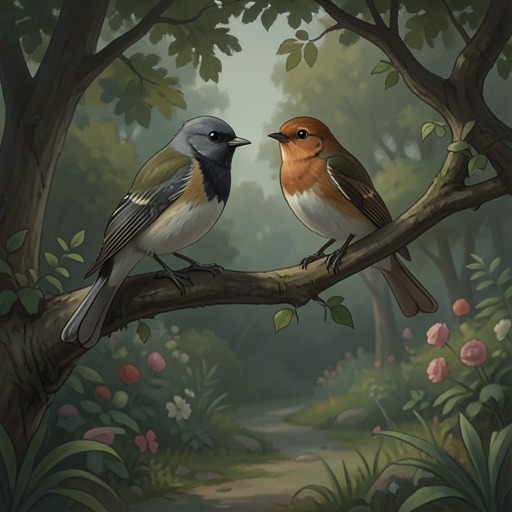
Little owl
MunichThe Little owl is both a predator in a reported account of a blackbird’s nest and an introduced bird whose spread across southern England prompts an unexpected exchange between Hugh Legat and Neville Chamberlain. Its brief appearance gives the breakfast scene a distinct natural history: a newspaper letter presents the cost of the bird’s presence for blackbirds, while Legat’s family recollection supplies a human origin for its arrival in the British Isles.
The account of the blackbird
The bird first appears in a letter to the editor by G. J. Scholey, whose address Neville Chamberlain reads aloud as 38 Dysart Avenue, Kingston-upon-Thames. The letter describes a blackbird observed in spring at a nest in a steep bank. For several days the sitting bird allowed the observer to approach within a few feet. One morning it was gone, and its four young were found cold and lifeless. A trail of blackish breast feathers led down the bank to a small bush, where the observer found the adult blackbird’s mangled remains. Among its feathers were others that the letter-writer identifies as coming only from the breast and flanks of a Little owl.
The account builds its claim through a sequence of traces rather than a direct sighting of the attack: the missing parent, dead chicks, feathers on the slope, and the remains beneath the bush. Its conclusion is therefore an inference made by the letter-writer, not a narrated observation of the Little owl killing the blackbird. Chamberlain nevertheless recognizes the behavior, telling Legat that he has observed exactly the same thing at Chequers. The parallel gives the newspaper report particular interest for him, while keeping the bird’s predatory act grounded in observed signs and comparison rather than a staged encounter.
An introduced bird and a family history
Chamberlain asks Legat to make a note of the letter-writer’s address because he intends to write to him. Mrs Chamberlain objects that Legat already has enough to do, but Legat answers with a fact about his own family: his maternal grandfather helped introduce the Little owl to the British Isles. Asked for details, Legat says his grandfather brought several pairs back from India and estimates that this happened around 1880. The exchange thus links the bird’s local presence to a specific human act of transport, although it does not identify the grandfather or give a more exact date.
Chamberlain responds by measuring the spread against that estimate. In barely more than fifty years, he observes, the bird has spread all over southern England, and he calls that something to celebrate. The remark treats the expansion as a striking achievement, while the letter has just shown its possible cost to another bird. Mrs Chamberlain’s reply—pointing out that it is not something to celebrate from a blackbird’s perspective—makes the contrast explicit. The scene does not resolve that difference in judgment: rapid spread can be a source of wonder to Chamberlain and a danger to the blackbird described in the letter.
Place in the breakfast scene
The Little owl turns a newspaper item into a brief, concrete exchange among the three people at breakfast. Chamberlain moves from reading the letter to asking Legat about its address, then to questioning him about the bird’s arrival and history. Legat, initially bewildered when asked to take a note, becomes a source of relevant knowledge through his family connection. Mrs Chamberlain’s protest about Legat’s workload and her blackbird-minded rejoinder keep the discussion within the domestic conversation rather than allowing it to become a formal natural-history account.
The bird also belongs to a scene concerned with attention to the day’s demands. After the conversation, the Chamberlains resume their walk and Chamberlain stops at a bird table, where he breaks up a piece of toast from breakfast and carefully lays out the pieces. The text does not say that the Little owl is at the table or connect it to the toast. Instead, the nearby detail places the earlier discussion of birds beside an ordinary act of feeding them, while Chamberlain broods over the day ahead. That contrast leaves the Little owl’s appearance with two scales of significance: a particular nest and its losses, and a wider, decades-long spread associated with a human introduction.