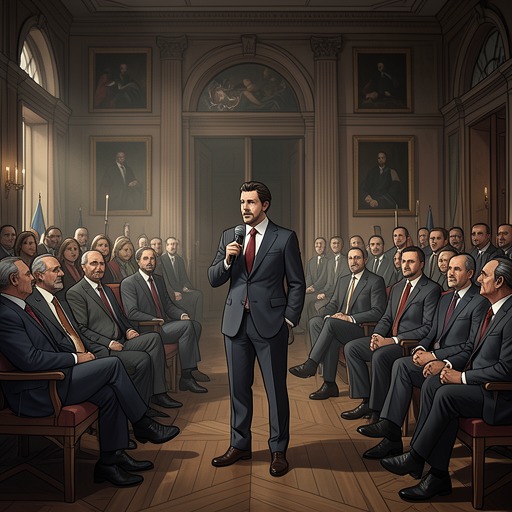
Britain abandons the plan to pressure Czechoslovakia by telegram
MunichBritain abandons the plan to pressure Czechoslovakia by telegram when the Cabinet rejects Sir Horace Wilson’s proposal that the Czechoslovak Government accept Hitler’s terms and surrender the Sudetenland under threat of invasion. The decision turns a proposed act of coercive diplomacy into an explicit refusal to urge another country to yield under force: Lord Halifax, Foreign Secretary, argues that Britain cannot demand a capitulation it believes wrong, especially without assurance that Germany would stop at the Sudetenland. Neville Chamberlain ultimately accepts that the telegram will not be sent.
The ultimatum and the proposed telegram
The proposal arose from a crisis in which time itself had become a weapon. Chamberlain told his ministers that the orderly transfer of the Sudeten territory, which the Czechoslovak Government had accepted subject to a plebiscite, had been overtaken by Hitler’s announcement that Germany would invade on Saturday. Chamberlain had also reported that Sir Horace Wilson met Hitler and warned him that Britain would support France if France fulfilled its treaty obligations to Czechoslovakia. Hitler’s response, as relayed from the British Ambassador in Berlin, was that he was prepared for every eventuality and expected Europe to be at war by the following Monday.
The Cabinet considered whether Britain should partially mobilise, an act that could demonstrate that the threat to fight was credible but might also push Hitler into war. Chamberlain stressed his judgement that Hitler could not tolerate losing face; those pressing for a firmer signal warned that peace efforts might otherwise be mistaken for weakness. That dispute formed the strategic backdrop to Wilson’s later proposal. The immediate question was not simply how to discourage an invasion, but whether Britain should use the last hours before Hitler’s deadline to press Czechoslovakia to comply.
Wilson drafted a telegram advising the Czechs to accept Hitler’s terms before two o’clock the following afternoon: they were to withdraw from the Sudetenland and permit Germany to occupy it. He presented the demand as the surest way to keep the United Kingdom from being entangled in a war that might expand into a much larger conflict. Asked what would happen if the Czechoslovaks refused, Wilson judged that they would not; even if they did, he argued, Britain would have discharged its duty and would no longer be under a moral obligation to intervene. The plan thus offered a clear diplomatic instruction and a claimed route out of war, but it depended on treating a threatened transfer of territory as a way to avoid responsibility for the consequences.
Objections inside the Cabinet
Chamberlain initially acknowledged the proposal’s simplicity. The response from Lord Halifax, Foreign Secretary, and Sir Alexander Cadogan, however, exposed what that simplicity left unresolved. Both rejected the idea of sending the telegram. They warned that telling Czechoslovakia to hand over its territory under threat of force would make Britain effectively an accomplice to Germany and would destroy its standing in the world, with the Empire also at risk. Lord Halifax, Foreign Secretary, added that the proposal would put France in an intolerable position. Wilson countered that France should have considered the consequences before giving Czechoslovakia a guarantee without consulting Britain.
Sir Alexander Cadogan challenged that argument directly. France, he insisted, could not be left to fight Germany alone; the crisis was not an industrial dispute that Britain could treat as someone else’s concern. Wilson answered that Lord Gort had just said France was unlikely to fight beyond limited raids and would remain behind the Maginot Line until summer. While the service chiefs began speaking at once, Chamberlain turned back to his speech. The debate had made visible the gap between Wilson’s calculation of immediate British exposure and the wider political costs that Halifax and Cadogan believed capitulation would impose.
The objections were sharpened when Lord Halifax, Foreign Secretary, set out why he could not support the proposal. He accepted that refusing to send it might bring grave consequences for millions of people, including people in Britain, and might make war certain. Even so, he said Britain could not urge the Czechs to do what the British Government believed wrong. He also doubted that the House of Commons would accept the telegram. Most crucially, Britain could offer no firm guarantee that the German Army would stop at the Sudetenland rather than continue to occupy the rest of the country. The proposed concession could therefore incur the moral and political cost of surrender without securing the limited outcome on which its case depended.
The decision not to send it
The shift in the room is marked first by silence. Chamberlain recognised that Lord Halifax, Foreign Secretary, had presented powerful arguments against his proposal, while still describing it as the last real chance available. He looked around the Cabinet and left space for a colleague to defend the plan; nobody spoke. He then said he was prepared to leave the matter there and told Sir Horace Wilson that the telegram would not be sent. The decision was not presented as proof that the danger had passed. Rather, the Cabinet declined to make Britain the instrument for urging Czechoslovakia to submit to Hitler’s demand.
The reaction was subdued: ministers shifted in their seats and adjusted their papers as they faced the prospect of war. Chamberlain then announced that he had received a reply from Hitler and proposed to read it to the Cabinet. In the sequence of the meeting, the cancellation closes off one proposed route—pressuring Czechoslovakia to yield—without resolving the crisis that made the telegram seem urgent. The sharp contrast between the telegram’s apparent simplicity and the uncertainty over Germany’s ultimate aims remains central: even a forced transfer of the Sudetenland could not assure that the threatened invasion would stop there.
Record and continuing crisis
The meeting’s handling also left a mark on the record of the decision. Hugh Legat had taken notes, but when Sir Osmund Somers Cleverly later asked for his minute of the Prime Minister’s meeting with the Chiefs of Staff, Legat replied that Chamberlain had decided he did not want the meeting recorded. The exchange places the abandoned telegram within an administration where information was closely managed: the argument had been consequential, but its formal record was not to be made in the usual way.
The crisis continued beyond the refusal. At seven minutes past two, Hugh Legat heard a telephone call from Sir Nevile Henderson in Berlin reporting that Benito Mussolini had sent Hitler a message through the Italian Ambassador. Mussolini promised that Italy would stand by Germany in the event of conflict, while asking Hitler to postpone mobilisation for twenty-four hours so the situation could be reconsidered; Hitler had agreed. This later pause did not undo the Cabinet’s decision or establish that the danger had passed. At the subsequent meeting in Munich, Sir Horace Wilson described Hitler as insisting that the crisis be settled by Saturday, either through an agreement requiring Britain, France, and Italy to guarantee the evacuation of the disputed territory or through a German march into it. The telegram had been abandoned, but the pressure of deadlines and the uncertainty about what Germany would do next remained.