First World War
MunichThe First World War shapes the novel less as a battlefield history than as a memory that keeps intruding on the 1938 crisis. For Hugh Legat it is bound to the last time he saw his father; for Neville Chamberlain it is the measure of an immense human catastrophe he hopes to prevent repeating; and for Ralph Wigram it is the backdrop to an early warning that Europe was moving toward another war. These different memories give the crisis both intimate weight and political consequence.
A childhood memory returned
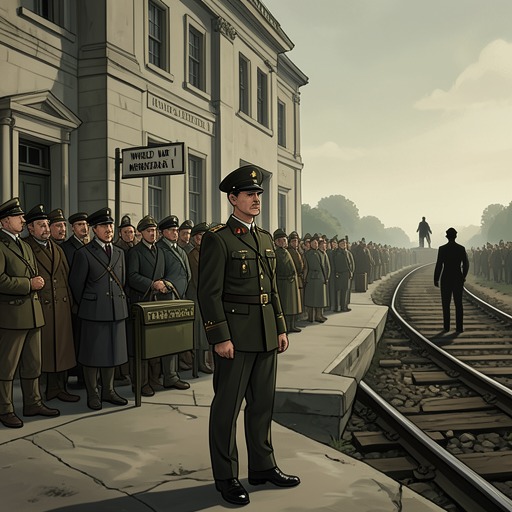
As Legat hurries through London, a crowd watches balloons rising into the sky. A man nearby remarks that the balloon has gone up, and the phrase takes Legat back to his father’s leave during the First World War. His father had used the same expression when he had to return to France. At six, Legat had understood it as if his father were going off to a party; it was the last time he saw him. The casual phrase, heard again amid the preparations for a new conflict, connects a present-day public spectacle to a child’s incomplete understanding of separation and loss.
The recollection is brief, but it changes the force of the scene. The balloons are at first a strange sight above London; through Legat’s memory, they become a sign of a war returning in another form. The novel does not supply further details about his father’s fate, leaving the remembered departure and its finality to carry the personal cost of the historical echo.
1914 as a political warning
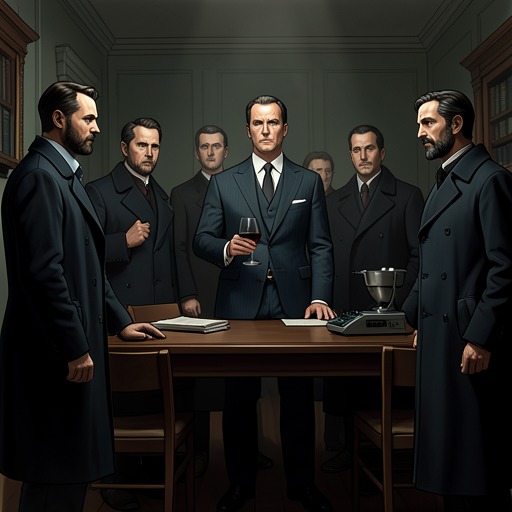
In a meeting with the Chiefs of Staff, Chamberlain describes the prospect of war as a return to August 1914. He fears that countries will be drawn into a wider conflict one after another, while the immediate dispute offers no straightforward Allied war aim. Britain and France had accepted an orderly transfer of the Sudeten territory to Germany, subject to a plebiscite, but Adolf Hitler’s refusal to wait and threat to invade altered the situation. Chamberlain argues that the three and a half million Sudeten Germans must have self-determination, so separating the Sudetenland from Germany could not itself be an Allied war aim. When Gort proposes the rule of law as the reason to fight, Chamberlain accepts the principle but wishes there were another way to uphold it.
The comparison with 1914 is also present in the debate over military signals. The Chiefs of Staff discuss partial mobilisation, which would begin before Germany’s and could demonstrate that Britain was prepared to fight. Chamberlain recognizes that the signal might deter Hitler, but also fears it could push him into war because he cannot tolerate losing face. The memory of the previous conflict therefore does not settle the question of action: it makes both the danger of weakness and the danger of escalation harder to ignore.
The cost behind Chamberlain’s determination
Chamberlain explains the personal source of his commitment to peace when he tells Legat that he was too old to fight in the First World War. He describes the agony of witnessing suffering while feeling powerless, and recalls that 750,000 men from Britain alone were killed. The losses extended beyond the dead to parents, wives, children, families, and friends; war memorials and the cemeteries in France kept that wider grief in view.
He says that after the war he resolved to do anything, and sacrifice anything, to prevent another catastrophe if he ever held the power to do so. His description of this commitment as sacred gives appeasement a personal and moral context in the novel: it is not presented simply as a negotiating tactic, but as a policy shaped by the memory of mass death. At the same time, the Cabinet discussion shows the strain within that purpose. Chamberlain accepts that Britain may have to defend the rule of law, even as he longs to avoid the war that doing so may require.
Wigram’s warning and the crisis of 1938
The earlier conflict also informs the way Legat remembers Ralph Wigram. In 1936, after Germany reoccupied the Rhineland, Wigram warned the prime minister that the Allies might be facing their last opportunity to stop the Nazis. The prime minister judged that even a small chance of war following an ultimatum was too great a risk for a country unwilling to face another conflict so soon after the last. Wigram returned home in despair. Nine months later he was found dead, aged forty-six; whether his death was by his own hand or resulted from complications of the polio that had crippled him remained unknown.
Legat recalls Wigram’s repeated warnings about Adolf Hitler and recognizes, in retrospect, how closely Wigram had anticipated the crisis. That memory gives the First World War a second political meaning: the trauma of the earlier conflict could restrain leaders from confronting aggression, even when a warning seemed urgent. In 1938, the resemblance to 1914 becomes concrete in the deadlines and threats. Chamberlain reports that Hitler expects the crisis to be settled by Saturday and predicts that the countries involved will soon be at war; later, a message relays that Hitler has agreed to postpone mobilisation for twenty-four hours after an appeal from Mussolini. The pause does not erase the danger. It makes the old question—how to prevent a local crisis from becoming a general war—press upon the present once more.