German anti-Hitler coup plan
MunichThe German anti-Hitler coup plan is a last-minute attempt to stop Hitler from ordering mobilisation against Czechoslovakia by arresting him before the order can take effect. Its defining tension is that the conspirators believe the German Army may oppose the regime, yet its oath of loyalty prevents it from making the first move. The plan therefore depends on a narrow opening: others must initiate an arrest, allowing the Army to intervene as though it were restoring order. It is both a practical operation and a test of how far military opposition can go without openly repudiating the oath that binds it.
Crisis and opportunity
The immediate pressure comes from Hitler’s announced intention to mobilise at two o’clock the following afternoon. In London, Neville Chamberlain’s office is already responding to the breakdown of talks: Osmund Somers Cleverly tells Hugh Legat that the Prime Minister will broadcast to the nation, while the Foreign Office is expected to report back. The urgency of these official preparations runs alongside a different, concealed response in Germany. The crisis is not only a diplomatic deadline; for the conspirators, it may be the one moment when opposition inside the Army can become action.
That opening is described by General Ludwig Beck, who tells Colonel Hans Oster and Hans Bernd Gisevius that he resigned as Chief of the General Staff a little under six weeks earlier in protest at the prospect of war with Czechoslovakia. He had kept that resignation private because he had promised Hitler not to publicise it, a promise he regrets having made. Even so, he remains in contact with former colleagues in the high command. He reports strong opposition there and believes that, if Hitler issues the mobilisation order, the Army may disobey and move against the regime. The plan rests on Beck’s assessment of what others might do, not on a guarantee that they will act.
Arrest and the oath
Oster treats Beck’s disclosure as changing the situation: the group must be ready to act decisively the next day, when the chance may be at its best. The proposed coup is deliberately reduced to a single immediate objective: arrest Hitler. Erich Kordt asks how it could be carried out, and the exchange exposes the distinction between having a political aim and possessing a workable means. Oster’s answer is not a broad programme for a successor government but a focused operation intended to prevent the mobilisation order.
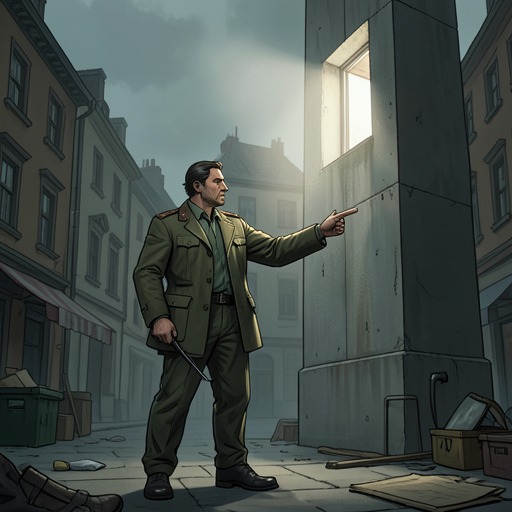
Beck identifies the central constraint. The Wehrmacht has sworn an oath of loyalty to Hitler, so the Army cannot be the first to move against him without violating that commitment. If a disturbance occurs in the Reich Chancellery, however, the Army could enter to maintain order; in that framing, intervention would remain compatible with the oath. The first action must therefore come from someone else. The language of order supplies the operation’s narrow legal and moral cover, while also revealing its dependence on a carefully staged distinction between initiating a coup and responding to a disturbance.
Oster has been analysing the practical requirements for weeks. He and Captain Friedrich Heinz estimate that surprise, together with an assurance that the Army will protect the arresting force from a rescue attempt by the Schutzstaffel, could make a small force sufficient. Their estimate is about fifty men. When Kordt asks where the men can be found, Heinz says they already have them: experienced fighters prepared to move the following day. This detail gives the plot a concrete scale, but does not eliminate its chief uncertainty. The arrest force may be assembled; its protection and success still depend on the Army’s response.
Evidence, decision, and preparation
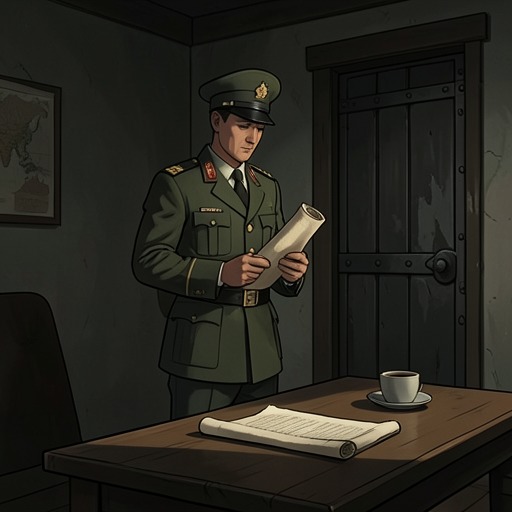
A copy of Hitler’s letter becomes a second instrument in the conspirators’ deliberations. After reading it, Oster concludes that it contains no hint of compromise, and Beck judges it tantamount to a declaration of war. Oster wants it placed in the hands of the Commander-in-Chief the next morning, in the hope that it will show that Hitler is not bluffing. The document is thus more than evidence for the group: they intend it to persuade a military leader to treat the danger as immediate. Its force in the scene comes from the certainty the conspirators draw from its uncompromising terms, even as their wider plan remains conditional on other people’s decisions.
The group postpones the question of what political system might follow the Third Reich. Oster argues that debating a monarchy, a democratic republic, or a combination of the two is premature while Hitler remains free to issue the order. The immediate priority is to stop mobilisation. If Hitler submits to custody, they will take him alive; if he appears likely to escape, Oster believes they must shoot him. Hugh Legat nods first in agreement. The others follow, including Hans von Dohnányi, while Beck agrees last and most reluctantly. Their decision fixes the operation’s limit: preservation of life is intended, but not at the cost of allowing Hitler to evade arrest and proceed with mobilisation.
The plan enters the immediate present
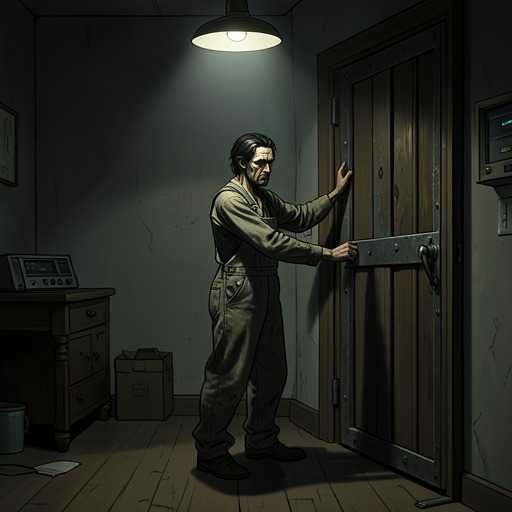
The conspiracy moves from discussion to physical preparation when Oster tells Kordt that it is happening and gives him two handguns. Kordt lays them on his desk; Hartmann takes one, checks its safety catch, and asks whether it is loaded. Kordt confirms that it is, then admits he has never fired a gun. The weapons make the previously theoretical operation tangible, but the exchange also shows the gap between possessing arms and being practised in their use. Kordt’s nervous giggling does not resolve that gap; it makes the danger and unfamiliarity of the undertaking visible.
Kordt is instructed to go to the Reich Chancellery as previously agreed. The pretext is a request from the British Embassy: Neville Chamberlain has written another letter to Hitler, and Sir Nevile Henderson wants to deliver it by hand. Since the request must be cleared by Joachim von Ribbentrop, who is with Hitler, Kordt is to report it to him. The diplomatic errand supplies a route into the Chancellery at the moment the conspirators intend to act. The plan therefore turns on access as much as force: the letter creates an official reason to approach Hitler, while the arrest operation remains concealed behind the routine of diplomatic business.
The surrounding British scenes emphasize how much information and authority are divided between offices. Miss Watson tells Legat that Cleverly has been looking for him; later, Cleverly rebukes him for placing family obligations ahead of the crisis and assigns him work connected with the government’s response. In another exchange, Cleverly asks about a minute of the Prime Minister’s meeting with the Chiefs of Staff; Legat says the Prime Minister did not want the meeting recorded, and Cleverly notices that he is carrying papers. These moments do not make the British office part of the German plot, but they echo its concern with who knows what, which documents survive, and who can enter a consequential room.
That parallel becomes more pointed when Lord Halifax, Foreign Secretary, objects to sending a telegram that would tell the Czechs to surrender territory under threat of force. He argues that such a demand would amount to capitulation, that the Czechs cannot be asked to do what Britain believes wrong, and that Britain cannot guarantee the German Army would stop at the Sudetenland. The disagreement demonstrates that the crisis is not resolved by a single, unified policy. Meanwhile, Neville Chamberlain prepares to leave for Munich, with Hugh Legat put in charge of the Prime Minister’s dispatch boxes and told to make contact with the office on arrival. The conspirators’ planned action and the diplomatic journey thus occupy the same narrowing interval. The evidence establishes their decision and preparations, but not the outcome of the proposed arrest; the plan remains poised between an imminent operation and a political crisis being redirected through diplomacy.