Nazi Lebensraum policy
MunichThe Nazi Lebensraum policy, as revealed in a secret strategic memorandum, casts territorial expansion as the necessary answer to Germany’s economic vulnerability and demand for food. Its proposed remedy is not simply the acquisition of population or a limited adjustment of borders: it is the seizure of agricultural space in Europe by force. The document identifies the incorporation of Austria and Czechoslovakia as an initial strategic gain and warns that Adolf Hitler intends to resolve Germany’s supposed spatial problem within a defined horizon. In the novel, the policy’s decisive significance lies in the contrast between this expansive plan and the public claim that Germany has no further territorial demands in Europe.
Economic Pressure and the Proposed Remedy
The memorandum begins from a diagnosis of increasing German food needs and an economy strained by the pace of rearmament. It also recognizes the Third Reich’s exposure to international trade sanctions and interruptions in supply. These pressures are made to support a radical conclusion: Germany’s problem cannot be resolved within its existing territory, and greater living space must be acquired. The document specifies that the needed space is to be found in Europe and that the purpose is agricultural use, not merely the absorption of additional people.
That reasoning gives the policy its internal logic while exposing its political character. Economic vulnerability and resource needs are presented not as problems to be addressed through trade or restraint, but as grounds for territorial expansion. The memorandum’s sequence—from food requirements, through the limits of the rearmament economy, to the need for land—makes conquest appear as a strategic remedy. Its final step is explicit: Germany’s problem can be solved only by force. The policy thus turns claims about material necessity into a rationale for war.
A Timetable and a Military Programme
The document does not describe expansion as an abstract aspiration without a deadline. It records Hitler’s unalterable resolve to solve the problem of space by 1943–45 at the latest. When Hugh Legat reads the date on the memorandum—5 November 1937—he recognizes how recent it is: less than eleven months have passed. The projected timetable makes the paper especially urgent in the context of the crisis. The danger is not confined to an indefinite future; the stated horizon reaches only a few years ahead.
Austria and Czechoslovakia occupy a central place in the programme. Their incorporation into Germany, the memorandum argues, would bring a substantial politico-military advantage: shorter and better frontiers, forces released for other purposes, and the capacity to form as many as twelve new divisions, at a rate of roughly one division per million inhabitants. The proposed acquisitions are therefore tied to more than territorial enlargement. They are also presented as a means of improving Germany’s strategic position and increasing its military strength.
The second part of the memorandum records objections raised by senior figures at the earlier discussion. Blomberg, Fritsch, and Foreign Minister Neurath had expressed alarm about whether the strategy could be carried out: France’s army was too strong, Czechoslovakia’s border defences too formidable, and Germany’s motorised divisions too weak. By the time Legat reads the paper, those three men have been removed from their positions and replaced by Keitel, Brauchitsch, and Joachim von Ribbentrop. The contrast makes the memorandum evidence not only of an expansionist aim but also of the removal of prominent officials who had questioned its practicability.
From Secret Memorandum to Diplomatic Warning
The policy’s implications enter British decision-making through competing assessments of what Britain could justify and sustain. After Colonel Mason-MacFarlane has reported, Chamberlain asks how the British public could be persuaded to continue a winter war if the Czechs collapsed before the end of October. He points to the sacrifices such a conflict would demand and asks what they would achieve, given that the British government had already conceded that the Sudeten Germans should not have been placed in a Czech-dominated state. The strategic warning later revealed by the memorandum therefore meets an immediate political obstacle: the question of whether Britain could secure public support for war over this issue.
Lord Halifax, Foreign Secretary, adds that the Dominions will not support a war over so narrow an issue, that the United States will not enter it, and that Ireland will remain neutral. Sir Alexander Cadogan points to the Soviet Union’s treaty with Czechoslovakia, but Chamberlain stresses the geographical difficulty: Soviet intervention would require passage through Poland or Romania, which, in his assessment, would bring those countries into the war on Germany’s side. He also rejects the prospect of relying on Stalin as an ally in a campaign to uphold international law. These exchanges show how the prospect of resisting Hitler is weighed against the danger of a wider conflict and the absence of dependable allies.
Sir Horace Wilson proposes sending the Czechs a telegram urging them to accept Hitler’s terms before the two o’clock deadline: withdraw from the Sudetenland and allow its occupation. He argues that this is the surest way to keep Britain from being drawn into a war that could grow enormously. Lord Halifax objects that telling the Czechs to surrender territory at once under threat of force would amount to complete capitulation. He accepts that refusing to send the telegram might make war certain, but maintains that Britain cannot urge the Czechs to do what it believes wrong. He also doubts that the House of Commons would accept the demand and emphasizes that Britain cannot guarantee the German Army would stop at the Sudetenland rather than occupy the whole country.
Legat’s Evidence and Chamberlain’s Choice
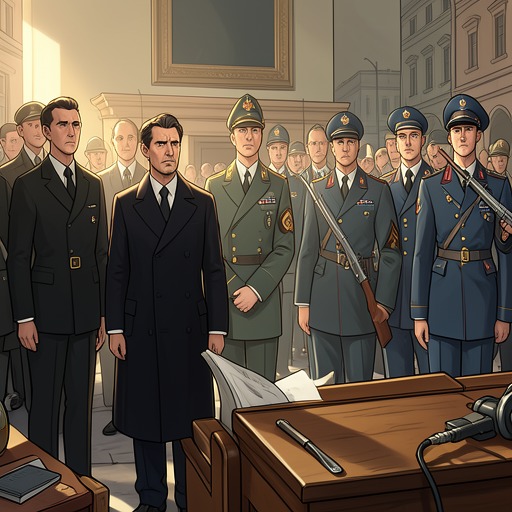
The memorandum becomes a direct warning when Paul von Hartmann presents it to Chamberlain. Hartmann argues that it proves Hitler is lying when he says Germany has no further territorial demands in Europe. He describes a war of conquest for German living space, says it will begin within five years at the latest, and insists that the incorporation of Austria and Czechoslovakia is only the first step. He also connects the removal of the commanders and foreign minister who had expressed reservations to the prospect that the Army might act against Hitler if Britain and France stood firm. His appeal is not only to recognize the evidence, but to refuse to sign the agreement that night.
Chamberlain acknowledges Hartmann’s courage and sincerity but rejects the proposed course. He argues that the British and French peoples cannot be expected to fight to deny self-determination to ethnic Germans wishing to leave a foreign country. He treats Hitler’s future threats as something to be tested over time, and defines his own priority as averting war in the short term while attempting to build a lasting peace. Rather than accepting the memorandum as a reason to abandon the conference, he folds it up and advises Hartmann to return the document to its source.
That refusal leaves the policy’s warning in sharp tension with the immediate diplomatic choice. The memorandum describes expansion as a planned and forcible response to Germany’s claimed need for space; Chamberlain responds through the limits of public consent, the Sudeten Germans’ stated right of self-determination, and the urgency of preventing war. The novel does not make the secret document invisible to British leaders: it places the evidence before the Prime Minister and shows why he nevertheless declines to let it determine his decision. The policy’s narrative force lies in that collision between a documented programme of expansion and a political strategy organized around postponing conflict.