Pilgrimage
NemesisPilgrimage is the novel’s central image for a journey undertaken not primarily for pleasure or sightseeing but for the recovery of truth. The word first defines Elizabeth Temple’s secret purpose, then illuminates Jane Marple’s participation in Jason Rafiel’s carefully arranged tour. Historic houses, gardens, roads, invitations, and apparently accidental meetings become stages in a moral investigation: movement through the countryside carries the travellers away from ordinary identities and toward an unresolved crime.
The Word and Its First Meaning
When Jane Marple and Elizabeth Temple discuss the tour, the visible purpose is the visiting of historic houses and gardens. Jane admits that she expects to enjoy the gardens most, although the houses will offer her new experiences through their variety, history, furniture, and pictures. Yet Elizabeth rejects the ordinary description of the journey. Asked whether she has come to see houses or gardens, she replies that the trip is not exactly a sightseeing tour for her.
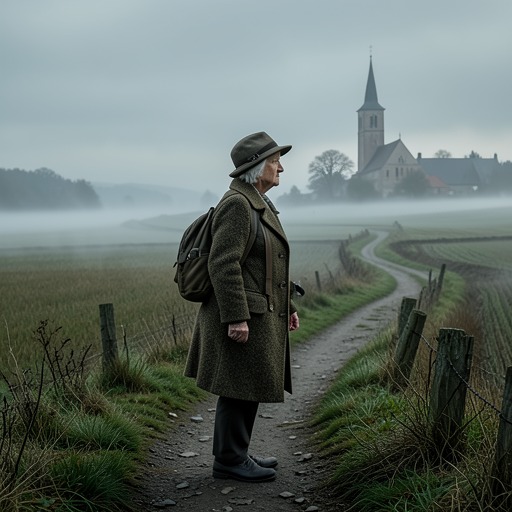
Jane’s response turns the exchange into an act of interpretation. She does not claim knowledge based on what she has been told about Elizabeth or on Elizabeth’s public reputation as the head of a famous school. Instead, she studies Elizabeth’s appearance and identifies her as a pilgrim: someone whose outward manner suggests a purposeful journey toward a particular spiritual or personal destination. Elizabeth confirms the judgment without explaining its object. Her brief agreement gives the word unusual force because it establishes pilgrimage as a private mission concealed beneath a public itinerary.
Rafiel’s Tour as a Designed Quest
The tour itself is presented as an elaborate gift. After Jason Rafiel’s death, a company writes to Jane on instructions given by him, offering details of a two- or three-week journey beginning in London. Rafiel has selected a region Jane has apparently not visited, arranged the best accommodation and available luxury, and chosen a route combining scenery and gardens. The arrangement appears considerate, even indulgent: the tour is described as attractive and not too exhausting for elderly travellers.
Its hospitality is also a mechanism of direction. The coach provides alternative itineraries, one for the young and active and another for travellers with painful feet, arthritis, or rheumatism who would rather avoid long walks and steep hills. Jane’s route is therefore not merely a line across the map; it is a controlled network of choices, accommodations, and encounters. Rafiel uses the harmless appearance of organized tourism to place Jane where he wants her, while allowing the meeting to seem casual.
This design is confirmed when the three sisters living near an old manor house approach Jane. Lavinia Glynne explains that an old friend had written to them weeks earlier and instructed them to note the date of the Famous Houses and Gardens Tour. He had said that a great friend or perhaps a relation would be travelling on it. The invitation that follows is one of the first signs that Jane’s pilgrimage has been plotted in advance by a dead man who continues to direct her movements.
From Leisure to Investigation
Jane eventually explains that Rafiel’s lawyers told her of his proposition, but his first letter explained nothing. The later letter from the touring company said that Rafiel had reserved the trip before his death as a surprise present, claiming that he knew she would enjoy it. Jane accepts the gift while recognizing it as the first step in an instruction. She expects that some further indication, hint, clue, or direction will appear during the journey.
The invitation from the three sisters seems to provide that indication. They had been told that Jane should stay with them for two or three days because she was not fit to attempt the difficult ascent to a memorial tower that formed the principal feature of the previous day’s excursion. Jane refuses to treat this as mere kindness. Rafiel, she reasons, was not a man who distributed benefits without purpose, and the accommodation must have been intended to bring her to that place.
The result initially frustrates the logic of a conventional quest. When Professor Wanstead asks what she found there, Jane answers that she found nothing beyond the three sisters. They appear ordinary, amiable, somewhat poor, and unlike one another, and they do not seem to have known Rafiel well. Their house and their presence therefore function less as an immediate revelation than as a threshold in the investigation. The pilgrimage proceeds through uncertainty: each destination may be a clue, but some apparent clues yield only the need for further scrutiny.
Elizabeth Temple’s Unfinished Pilgrimage
Elizabeth’s own pilgrimage becomes more ominous after her death. Jane tells Professor Wanstead that Elizabeth’s presence on the tour was not simply a wish to visit historic homes and gardens. Elizabeth had explicitly described her purpose as a pilgrimage, but she never disclosed where she was going, whom she intended to visit, or what truth she hoped to recover. Jane believes that Elizabeth might have explained it if she had lived a little longer and had not been so weak; death came before that disclosure.
The word consequently links intention with interruption. Elizabeth is not merely a fellow tourist whose private motives add colour to the party. Her pilgrimage represents an incomplete act of recognition, and her death transforms the unanswered question into part of the case Jane must understand. The journey’s apparent leisure is set against the violence of the boulder attack, which Jane states was not an accident. The pilgrimage therefore carries the danger of someone reaching a destination or discovering a connection that another person is determined to conceal.
Jane later repeats Elizabeth’s unusual description to Archdeacon Brabazon. He recognizes that the word may be significant and considers whether the pilgrimage Elizabeth mentioned might have been her visit to him. His uncertainty demonstrates how the concept spreads through the novel: pilgrimage refers to a destination, but its true meaning depends on the relation between traveller, object, and hidden past. A visit can be a social call on the surface and an act of investigation underneath.
Truth, Memory, and Moral Direction
The strongest sense of Pilgrimage emerges from the purpose Jason Rafiel assigns to Jane. Rafiel’s representative recounts that the dying man wanted Michael Rafiel released from confinement and vindicated. Rafiel believed that if another man had killed the girl, the truth should be brought to light and justice done for Michael. Because he was seriously ill and had only weeks left, he offered a large fee for a search for the truth and empowered his chosen helper to assist him.
Rafiel’s plan turns pilgrimage into delegated moral action. He cannot complete the search himself, so he sends Jane through a sequence of places and encounters selected before his death. He specifically refuses to give his helper Jane’s address, preferring that they meet in surroundings of his own choosing. The tour is to provide a harmless setting in which the encounter will appear accidental. In this structure, travel is both concealment and revelation: it disguises the investigation as tourism while making the investigator’s arrival at crucial places seem inevitable.
The concept also preserves an important contrast between sightseeing and seeking. A tourist receives impressions from buildings, gardens, and scenery; a pilgrim carries a question that changes the meaning of every stop. Jane may admire peonies and old furniture, but she also watches the passenger list, listens to explanations, and tests the significance of invitations. Elizabeth’s pilgrimage ends before its destination is spoken, whereas Jane continues along the route Rafiel designed. Together, their journeys make the word a symbol of unfinished knowledge pursued through movement, danger, and moral responsibility.