The Three Sisters Motif
NemesisThe Three Sisters Motif is a central interpretive pattern in the novel, linking the three women at The Old Manor House with literary and mythic images of female collectivity, prophecy, menace, and hidden knowledge. For Jane Marple, the phrase initially sounds innocuous, yet its recurrence transforms an ordinary household into a charged moral landscape. The motif does not make the sisters supernatural; instead, it dramatizes how an atmosphere of sorrow, fear, secrecy, and violence can gather around an apparently respectable family and make normality itself seem threatening.
The Phrase and Its Literary Echoes
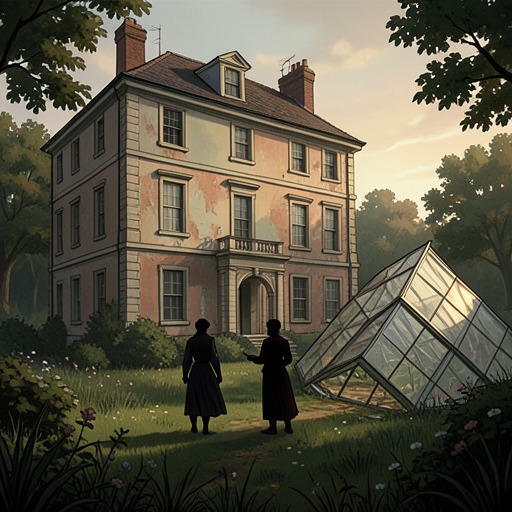
The motif first arises when Jane Marple surveys The Old Manor House, a neglected property inherited by three sisters after the death of their uncle. The house retains traces of former grace but has not recently been loved or maintained. Its occupants are Clotilde Bradbury-Scott, Anthea Bradbury-Scott, and Lavinia Glynne: three unmarried or widowed women who have grown older as their incomes have diminished and domestic labour has become harder to secure. The absence of anything belonging to a child reinforces the impression that this is not a growing family but a closed household organized around the sisters themselves.
Jane Marple immediately connects the arrangement with The Three Sisters, though she cannot recall whether the relevant Russian author is Chekhov or Dostoyevsky. The comparison is deliberately imperfect. These women are not yearning to leave for Moscow; they appear settled, even resigned, to remaining where they are. That contrast matters because the literary association supplies an expectation of longing and frustrated escape, while The Old Manor House supplies a more oppressive stillness. The sisters do not openly dramatize their unhappiness. Their well-bred manners and gracious conversation conceal rather than dispel the strain Jane Marple senses beneath ordinary platitudes.
The phrase also evokes Macbeth. Jane Marple distinguishes the sisters from theatrical versions of the Three Witches, whose exaggerated costumes and movements make them look like pantomime creatures. Her preferred witches would be ordinary old Scottish women who looked at one another slyly, allowing menace to exist just behind their ordinariness. This aesthetic principle becomes the motif’s governing logic: evil is most disturbing when it does not announce itself as monstrous. It inhabits familiar rooms, conventional conversation, respectable manners, and the everyday conduct of people who seem merely eccentric or distressed.
The Motif at The Old Manor House
Jane Marple’s response to the sisters is sensory and atmospheric before it is deductive. She feels that The Old Manor House is marked by deep unhappiness, a depression so intense that it is almost frightening. Anthea repeatedly glances to the right, the left, and over her shoulder, as though someone were always watching her. Clotilde appears handsome, strong, and emotionally intense; Jane Marple imagines her as a possible Clytemnestra, capable of planning and carrying out a husband’s murder in a bath, although Clotilde has never been married. Lavinia, by contrast, is plain but pleasant-looking and is presented as the active domestic member of the household.
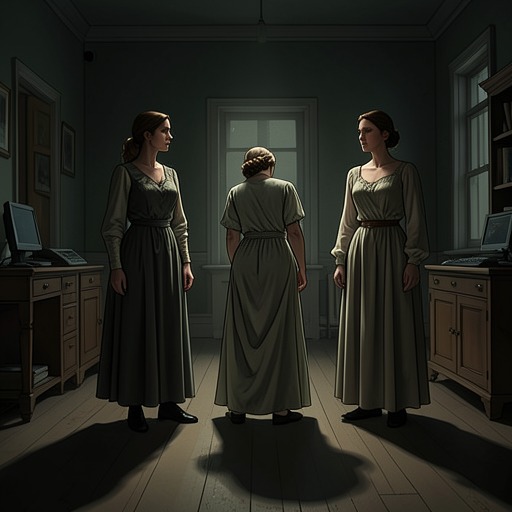
The three women therefore produce different versions of the same unsettling pattern. Clotilde projects force and passionate control. Lavinia suggests ordinary domestic competence combined with unhappiness and a desire to escape. Anthea appears vague and scattered, yet her wandering eyes and sudden backward glances imply a frightened awareness of something others cannot see. The sisters’ differences prevent the motif from reducing them to identical figures. Their symbolic unity coexists with psychological asymmetry, and that asymmetry becomes important when Jane Marple asks which of them might know the truth and which might pose a danger.
When Jane Marple returns to the house, the phrase comes back to her before any new fact does. She closes her eyes to identify what she feels in the building and again encounters not simply sinister energy but profound unhappiness. Clotilde’s visible tears when Verity Hunt’s death is mentioned persuade Jane Marple that Clotilde’s attachment to Verity Hunt had been genuine, even though Clotilde remains frightening in her emotional intensity. Anthea, meanwhile, seems frightened of something, perhaps of her sisters, perhaps of her own impulses, or perhaps of a past institutional life. The motif thus holds affection, suspicion, dependency, and fear in the same domestic space.
From Literary Association to Moral Atmosphere
In conversation with Professor Wanstead, Jane Marple explains that her first judgment was not a logical deduction but an emotional response to atmosphere. She describes The Old Manor House as containing several simultaneous conditions: sorrow, deep unhappiness, fear, and a struggling atmosphere of normality. Lavinia Glynne contributes the last of these. As a widow who receives Jane Marple kindly and behaves pleasantly, she seems entirely ordinary, though not truly happy. Her unhappiness appears less like grief than the result of living in surroundings and circumstances unsuited to her character.
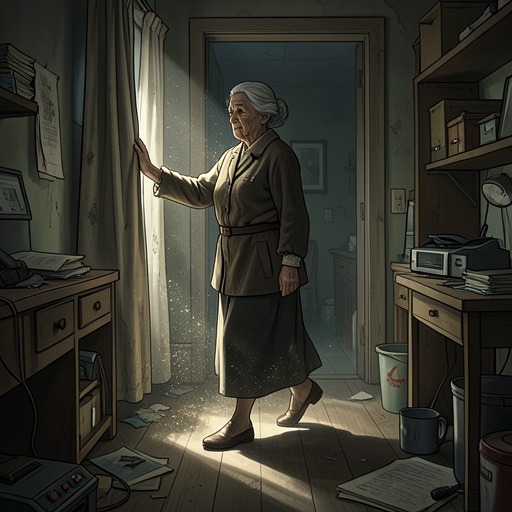
That apparent normality becomes crucial when an aged housemaid tells Jane Marple about the earlier killing of a girl by her boyfriend and about other local girls who had suffered violence or sexual assault. Jane Marple must revise her first impression that the coach party is unrelated to her search for a killer. The three sisters are no longer merely a literary curiosity or an eccentric household. They occupy a house located within a history of violence, and Jane Marple must consider whether one of the people sent there could be connected with that violence.
The motif then expands beyond The Three Sisters and Macbeth to the image of the Three Fates. Clotilde, Lavinia, and Anthea become figures through whom Jane Marple tries to understand who might control life, death, concealment, and consequence. She does not claim that any sister is inherently evil. Rather, she senses that they live in an atmosphere where evil has happened, left its shadow, or remains a threat. The motif therefore describes contamination by history: the house seems to remember what its occupants cannot or will not openly say.
Family Secrecy and the Buried Crime
The sisters’ relationship gives the motif its practical force. Clotilde tells Jane Marple that Lavinia wishes to leave and return to a life abroad, perhaps at Taormina, where she had been happy with her husband. Clotilde also says that Lavinia is definitely afraid of Anthea, while insisting that Anthea is merely silly, eccentric, jealous, and subject to nervous fits of temper. The denial is itself unsettling because it acknowledges fear while attempting to normalize its source. Clotilde’s suggestion that the house might be sold indicates that the family structure has become difficult to sustain, yet the sisters remain bound together by shared history and silence.
Jane Marple later interprets Anthea’s fear as evidence that she knew something about Clotilde’s actions. Anthea may not have understood immediately that death had occurred, but she saw Clotilde building a mound at the end of the garden and covering it with flowering shrubs, presenting concealment as a place of beauty. The domestic and the macabre are fused: gardening, beautification, and family property become instruments for hiding a body and preserving an outward appearance of normal life.
The hidden crime is the murder and concealment of Verity Hunt. Jane Marple reasons that Clotilde, intensely attached to Verity Hunt, killed her, disfigured the body, and buried it beneath turned earth, leaves, and branches. Clotilde then placed Verity Hunt’s handbag and the little chain she wore around her neck with the remains, and may have dressed the body in Verity Hunt’s clothes. She also spread rumours that Nora Broad had been seen in Michael Rafiel’s car and suggested that Verity Hunt had broken off her engagement because of his infidelity. The Three Sisters Motif consequently moves from symbolic unease to a structure of culpability: one sister acts, one sister knows, and another remains trapped within the fear produced by what the household conceals.
Narrative and Thematic Significance
The motif creates suspense by sustaining uncertainty between ordinary explanation and sinister interpretation. Jane Marple repeatedly tells herself that she is imagining things, yet each return to the phrase produces another layer of perception. The sisters’ manners are normal, their circumstances are socially intelligible, and their house is merely neglected; nevertheless, the accumulated signs make normality feel like a performance. The reader is invited to occupy the same unstable position as Jane Marple, oscillating between psychological explanation, family dysfunction, and the possibility of deliberate evil.
The motif also functions through intertextual compression. The Russian Three Sisters contributes frustrated stasis; Macbeth contributes ordinary women carrying menace beneath familiar appearances; Clytemnestra contributes the image of female power turned toward calculated murder; and the Three Fates contribute an association with destiny and the distribution of life and death. None of these references is reproduced literally in the sisters’ lives. They are transformed into a vocabulary through which Jane Marple tests the emotional and moral meaning of what she sees.
Most importantly, The Three Sisters Motif makes the household’s secrecy relational rather than individual. Clotilde’s possessive attachment to Verity Hunt, Anthea’s fear, and Lavinia’s wish to escape form a pattern of dependence and avoidance. The sisters are not simply three suspects placed beside one another; they are a closed emotional system in which knowledge, silence, and fear circulate. By the time Jane Marple calls them three weird sisters, the phrase has become less a supernatural label than a warning about how domestic intimacy can preserve evil, conceal its evidence, and force the innocent or frightened to live inside its continuing shadow.