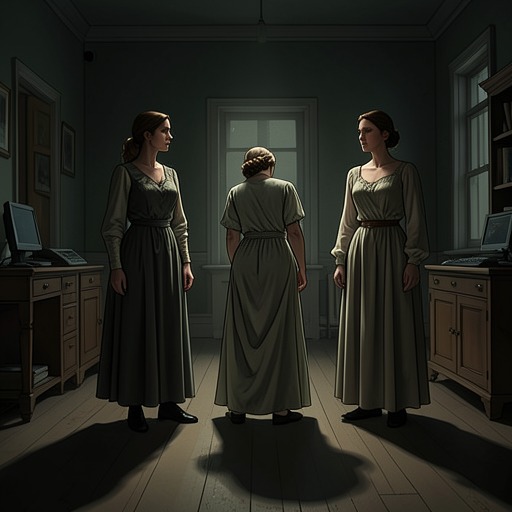
The Three Sisters
NemesisThe Three Sisters is both the name associated with The Old Manor House and the interpretive phrase through which Jane Marple begins to understand the household. It initially describes three respectable, unmarried or widowed women living together in a neglected family house, but gradually becomes a symbolic pattern of menace, sorrow, fear, and concealed violence. The expression matters because it converts an ordinary social arrangement into a literary and psychological riddle: the sisters seem commonplace, yet the atmosphere around them suggests that evil has happened there, left its shadow, or remains a threat.
The Household Behind the Phrase
The phrase first acquires its force when Jane Marple looks over The Old Manor House. The garden is neglected, little money has been spent on it, and the once-good furniture has received little polishing or attention. The house appears to have been built with grace and beauty and once cherished, but it no longer seems loved. There is no sign of a child: no discarded ball, old perambulator, small chair, or little table. The absence confirms the peculiar self-containment of the place. This is simply a house with three sisters, isolated from the usual traces of family continuation.
Those sisters are Clotilde Bradbury-Scott, Anthea Bradbury-Scott, and Lavinia Glynne. Clotilde is handsome, Lavinia plain but pleasant-looking, and Anthea marked by a twitching eyelid, large grey eyes, and an unsettling habit of looking to either side and then suddenly behind her, as though someone were always watching. Their differences make the phrase more than a label for three similar women. It gathers three contrasting emotional and social types into one enclosed system: Clotilde is forceful and commanding, Lavinia the active domestic presence, and Anthea apparently vague, frightened, and unstable.
Clotilde explains that the house is a family property inherited first by a great-uncle and then by an uncle, who left it to the three sisters after his only son was killed in the war. They are, apart from distant cousins, the last of the family. The inheritance therefore gives the phrase a dynastic undertone. The Three Sisters are not merely housemates; they occupy the remnant of a family line, preserving a property whose material decay parallels the unresolved emotional history within it.
Literary and Dramatic Associations
Jane Marple repeatedly hears something sinister in the expression. She wonders whether it sounds Russian and recalls, without certainty, the title of a work by Chekhov or Dostoyevsky. Yet these sisters are not like literary women yearning to leave for Moscow. They appear content, or at least resigned, to remain where they are. The contrast is important: the familiar cultural reference is present, but its expected longing for escape has been replaced by enclosure and stagnation.
The phrase also recalls the Three Witches of Macbeth. Jane Marple does not literally identify the sisters with witches; indeed, she initially admits that they seem too ordinary for such a comparison. Her imagination instead relocates menace inside normality. She remembers believing that the witches should be represented as ordinary old Scottish women who look slyly at one another, with a sense of menace just behind their ordinariness. This imagined production becomes a model for reading the sisters. Their danger, if danger exists, would not announce itself through spectacle. It would appear through manners, glances, silences, and the unease produced by a perfectly conventional conversation.
The expression consequently operates through intertextual pressure. Russian sisters, Shakespearean witches, and the Three Fates are not identical figures, but their convergence makes the domestic trio feel archetypal. Jane Marple calls the sisters three Fates when she tries to assess which of them could be a killer and what kind of killing might have occurred. The phrase enlarges the house into a stage on which destiny, guilt, and consequence seem to be distributed among three women, even before the facts are known.
Atmosphere, Fear, and Suspended Judgment
The Three Sisters is also Jane Marple’s shorthand for an atmosphere that she cannot initially explain logically. During her first visit, the conversation is pleasant and natural, consisting largely of platitudes, yet she feels strain and something unnatural beneath the surface. She repeatedly asks herself why things thought of in threes seem sinister. Looking at Anthea, she finds it difficult to reconcile the woman’s ordinary, untidy, scatty appearance with the impression of menace, and tells herself that she is imagining things.
The suspicion becomes sharper the following day. In a church and churchyard that appear peaceful, Jane Marple finds it difficult to believe in the reality of evil. Then she remembers the feeling she had at The Old Manor House: a deep depression, despair, and desperate grief, concentrated particularly in Anthea’s fearful habit of looking over her shoulder. The phrase now points toward knowledge withheld rather than supernatural power. The three sisters know something, but Jane Marple does not yet know what they know or how each sister is positioned in relation to it.
When Jane Marple returns to the house, The Three Sisters again becomes the first thought that comes to her. The atmosphere is not simply sinister; it is one of deep unhappiness, almost frightening in its intensity. Lavinia appears comfortable and emotionally reserved, as though a life of stress and difficulty has taught her to reveal little. Clotilde has the powerful appearance Jane Marple associates with Clytemnestra, but Jane Marple is convinced that Clotilde’s tears when Verity Hunt’s death is mentioned are genuine and that Clotilde had been intensely attached to her. Anthea, by contrast, remains doubtful: her wandering eyes seem to perceive something beyond the visible room, and Jane Marple wonders whether she is frightened of an institution, of her sisters, or of what she herself might do or say.
Clotilde’s account gives the phrase a further relational meaning. Lavinia talks of leaving the house and living abroad, perhaps at Taormina, where she had once been happy with her husband. Clotilde says Lavinia may dislike living with Anthea and is definitely afraid of her. Anthea is described as silly, queer in her ideas and statements, prone to nervous fits of temper, sudden dislikes, and jealousy when attention is given to others. Clotilde even considers selling the house and leaving it altogether. The sisters therefore inhabit the same home while experiencing it differently: for Lavinia it is a place from which escape is desired, for Anthea a place of fear, and for Clotilde a space she still attempts to control.
From Expression to Hidden History
When Henry Clithering asks what Jane Marple learned from her visit arranged by Jason Rafiel, her first answer is simply, “Three sisters.” Asked whether they were “Three weird sisters,” she replies that they ought to have been, but did not seem to be. They appeared ordinary, amiable, financially strained, and not particularly interesting; they did not seem well acquainted with Jason Rafiel, and conversation with them yielded little. The phrase thus records an investigative failure as well as a discovery. Jane Marple has not obtained evidence directly from the sisters, but she has recognized the shape of a concealed situation.
The missing history comes instead from an elderly servant, who recounts the local story of a girl killed by her boyfriend after falling in love with him. The story connects the house with Verity Hunt’s murder and with the involvement of Jason Rafiel’s son, Michael Rafiel. It also includes exaggerated accounts of other local girls subjected to violence or sexual assault. The Three Sisters therefore stands at the threshold between gossip and truth: the household is surrounded by a narrative that may be distorted in its details but accurately preserves the presence of a terrible crime.
In Jane Marple’s later explanation to Edmund Wanstead, the phrase becomes the organizing principle of her reconstruction. Entering The Old Manor House, she sensed sorrow, deep unhappiness, fear, and another atmosphere that she could only describe as normality. Lavinia supplied the normality: she was a pleasant widow whose unhappiness seemed to arise from being temperamentally misplaced in the house rather than from the central tragedy. The old housemaid’s account then forced Jane Marple to reconsider the coach party and ask whether one of the killers might be present in the house itself.
The three names—Clotilde, Lavinia, and Anthea—become, in this account, names of “three weird sisters” and “three Fates.” Jane Marple does not claim that all three are evil. Rather, they live in an atmosphere where evil has occurred, where its shadow remains, and where another danger may still be developing. The phrase is therefore less an accusation than a structure of suspicion. It holds together incompatible impressions: happy and unhappy, suffering and frightened, ordinary and ominous.
The Phrase and the Crime’s Pattern
Clotilde’s imagined likeness to Clytemnestra prepares the reader to consider a woman capable of deliberate violence, although Jane Marple first imagines the crime as the killing of a husband in a bath. Later, the same association is redirected toward the murder of Verity Hunt. Jane Marple’s reconstruction is that Clotilde, intensely attached to Verity, accepted and surrendered to evil after Verity’s relationship with Michael Rafiel became a threat to Clotilde’s possessive bond with her.
According to that reconstruction, Clotilde arranged an expedition far from home with another village girl, Nora Broad, after gaining influence over her. She selected the place beforehand, strangled Nora, disfigured the body, and concealed it beneath turned earth, leaves, and branches. She then placed Verity’s handbag and a chain associated with Verity with the body, possibly dressing it in Verity’s clothes, so that the remains would be identified as Verity’s. She spread rumours that Nora had been seen with Michael in his car and may have suggested that Verity had broken off their engagement because of his infidelity.
Anthea’s place in the phrase is different. She was present when Clotilde created a mound at the end of the garden, ostensibly to be covered with flowering shrubs and made into a place of beauty. Jane Marple thinks Anthea first knew only that Clotilde was making the mound, then gradually understood that it concealed a death. Lavinia was absent at that time, still abroad and married. The three sisters therefore embody three forms of relation to the crime: Clotilde as its alleged agent, Anthea as the fearful witness who comes to understand it, and Lavinia as the sister separated from the house during the crucial period.
The Three Sisters finally names a domestic structure maintained by silence, dependency, fear, and control. Its apparent ordinariness is not disproved by the horror surrounding it; instead, ordinariness is the very medium through which the horror survives. The expression gives Jane Marple a way to register what formal deduction initially cannot: a neglected house, three women with incompatible emotional positions, and an atmosphere in which grief and normality coexist because the past has never ceased to govern the present.