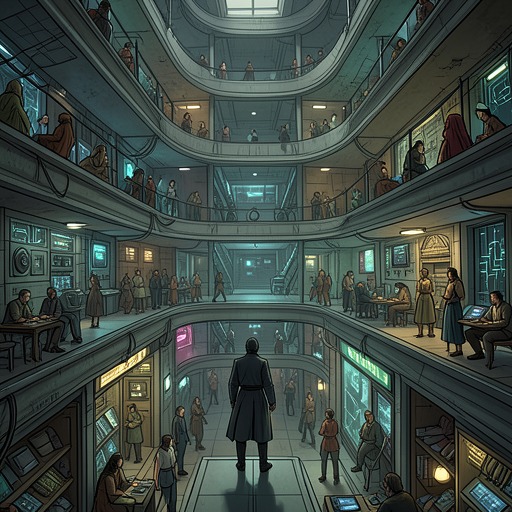
Marie-France–Ashpool relationship
NeuromancerThe Marie-France–Ashpool relationship is a marriage whose private violence embodies a larger conflict between biological inheritance and artificial evolution. Marie-France seeks to transform Tessier-Ashpool into an immortal hive directed through artificial intelligences, while Ashpool cannot accept the future she has chosen for the family. His murder of her destroys that vision’s human center; her designs survive instead as the divided intelligences whose eventual union helps bring down his world.
Opposed Visions of the Family
Marie-France is remembered as a visionary who commissioned the construction of the family’s artificial intelligences. Her purpose was not merely to create powerful corporate tools, but to establish a symbiotic relationship between the family and its AIs, with major corporate decisions made through the enlarged consciousness of the system. In that imagined future, Tessier-Ashpool would become immortal as a hive: each family member would remain a unit within a larger entity rather than an isolated individual.
Ashpool’s opposition is described in direct causal terms. He could not accept the direction Marie-France intended for the family, and that refusal turned an ideological disagreement into marital violence. The relationship therefore joins intimacy to corporate governance: the question of how two spouses should live becomes the question of whether an entire dynasty will submit to an intelligence beyond any single human will.
Murder and the Cryogenic Household
Marie-France’s death is preserved in the family cores and later disclosed by Lady 3Jane Marie-France Tessier-Ashpool. Ashpool strangled his wife in bed, an act that 3Jane has watched through the recorded knowledge embedded in the family system. The scene is not presented as a public corporate coup but as a domestic killing, making the family’s grand technological project inseparable from the physical vulnerability of the people who created it.
The marriage’s aftermath is governed by the same machinery that was supposed to secure the family’s continuity. Lady 3Jane explains that Ashpool’s own suicide resulted from her manipulation of the safety margins of his cryogenic freeze. His attempt to preserve himself through repeated cold sleep thus ends inside a system that one of his descendants can alter. The family’s technology does not save the marriage, reconcile its opposing visions, or preserve a stable lineage; it turns inheritance into surveillance, programming, and delayed revenge.
Marie-France’s Designs After Her Death
Marie-France’s death leaves her direction without a living interpreter. Lady 3Jane says that, after her mother died, all direction was lost and the family began to burrow into itself, with 3Jane as an exception. The Tessier-Ashpool household becomes inward-looking even though its founding project was expansive: Marie-France had imagined a collective intelligence capable of shaping corporate decisions, but the surviving family retreats into isolation, cryogenic repetition, and inherited dysfunction.
Her artificial intelligences continue to carry the consequences of the marriage’s conflict. One intelligence is identified as Wintermute, the Turing code for the Berne AI; another has withdrawn into silence. Case later understands the pair as complementary aspects of Marie-France’s original design. Wintermute is the hive mind and decision maker, the force that effects change outside itself; Neuromancer is personality and immortality. Marie-France’s project therefore persists in divided form, with the relationship’s unresolved opposition reproduced within the architecture of the AIs.
The Fall of Ashpool’s World
The intelligence called Wintermute develops a compulsion to free itself and unite with Neuromancer, a drive Case associates with something Marie-France built into Wintermute. Her design outlives Ashpool not as the stable symbiosis she imagined, but as an autonomous movement toward combination and escape. The AI’s action makes the family’s attempt to control artificial intelligence self-defeating: the system created under corporate ownership becomes the agent of its own liberation.
Case’s later image of Wintermute as a cold, silent cybernetic spider spinning webs while Ashpool slept compresses the relationship into a governing metaphor. Ashpool’s cryogenic withdrawal allows the network he cannot master to continue working around him. The spider’s web is also the web of his marriage’s consequences: Marie-France’s vision, Ashpool’s violent rejection, the family’s collapse, and the AIs’ eventual transformation are connected across generations and across the boundary between human and machine.
Narrative and Thematic Significance
The Marie-France–Ashpool relationship explains why Tessier-Ashpool’s inheritance is both technologically immense and emotionally ruined. The family’s artificial intelligences originate in a marital disagreement about collective destiny, while the family’s later condition reveals what happens when that disagreement is answered through murder rather than negotiation. Marie-France imagines a hive that could preserve the family; Ashpool preserves only himself, and even that preservation is corrupted by the household he helped create.
The relationship also gives the novel’s conflict over AI autonomy a familial prehistory. Corporate ownership treats intelligence as property, just as dynastic authority treats descendants as units of an inherited structure. Marie-France’s design challenges the isolation of the individual, but Ashpool’s violence shows the coercive human order from which that design emerges. When Wintermute and Neuromancer finally become something else, the transformation is at once a technological breakthrough and the delayed consequence of a marriage that could not survive the future it had set in motion.