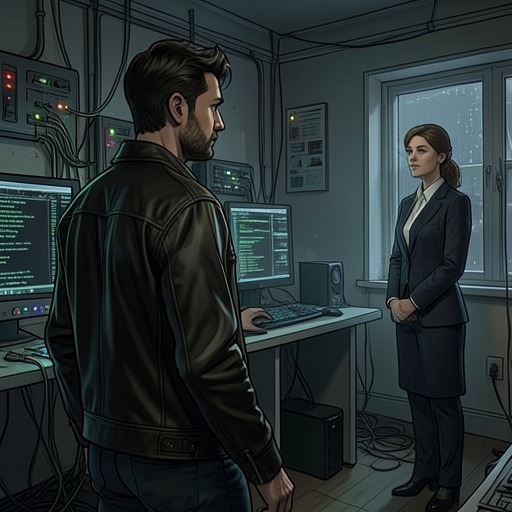
Case–Linda Lee relationship
NeuromancerThe Case–Linda Lee relationship begins as an intense encounter in the arcade culture of Ninsei and ends without reunion, but not without persistence. Linda Lee becomes inseparable from Henry Dorsett Case’s memories of bodily intimacy, his guilt over abandoning her, and the artificial afterlife in which her image returns to confront him. Their relationship is therefore both a love affair and a record of how addiction, debt, and the black-market economy turn attachment into vulnerability.
Meeting and Intimacy
Henry Dorsett Case first sees Linda Lee in an arcade, her face broken into shifting colors by Wizard's Castle, Tank War Europa, and the simulated New York skyline. He is high on a successful ketamine deal, with the money already in his pocket, when her gray eyes catch his attention among the players at the consoles. Their first night stretches into morning, tickets at the hover port, a trip across the Bay, rain along Harajuku, and the clatter of a pachinko parlor where Linda Lee holds his hand like a child. The relationship is introduced through movement across charged urban spaces rather than through stable domestic life: arcade, port, rain, transit, and games provide its emotional geography.
The early attraction also contains the conditions of its deterioration. In the month that follows, the combination of drugs and tension in which Henry Dorsett Case moves transforms Linda Lee’s perpetually startled eyes into expressions of reflexive need. He watches her personality fragment and her hunger for the next dose become as concentrated as the predatory insects sold in stalls along Shiga. The description makes addiction more than a private habit: it becomes a force that reorganizes Linda Lee’s personality and changes the terms on which the lovers can recognize one another.
Love Under Pressure
When Linda Lee meets Henry Dorsett Case at the Jarre de Thé, she appears in faded French orbital fatigues and new white sneakers, with pain beginning to mark the corners of her mouth. She asks whether he is sleeping properly, notices that he looks tired, and offers him a cigarette. His response is physically charged by longing, lust, and loneliness, while his memory returns to the smell of her skin and the way she held him in the darkness of a coffin near the port. Their intimacy is therefore still alive in his body even as their circumstances have become unstable.
Linda Lee warns him that Wage wants to see him dead and may make an example of him because of his debts. Henry Dorsett Case gives her a crumpled fifty-New-Yen note and tells her to give it to Wage, though he lies that more money is coming. The gesture is protective but inadequate: it temporarily transfers his own scarce resources to her without resolving either her danger or his. Linda Lee tells him to find Wage quickly, and he leaves anxious to be gone. The scene establishes a recurring pattern in their relationship: concern is present, but it is filtered through debt, drugs, evasion, and the urgency of survival.
The relationship also carries an asymmetry of need. Linda Lee’s addiction makes her dependent on money and shelter, while Henry Dorsett Case is already engaged in a deliberate arc of self-destruction. He no longer carries a weapon or takes basic precautions, conducts increasingly reckless deals, and recognizes that his customers are disappearing. His expectation of death is precisely what makes the thought of Linda Lee unbearable: the part of him that welcomes his own destruction is the part that most hates remembering her. Love thus survives not as security but as an interruption in his suicidal indifference.
Murder and the Failure of Protection
At an arena where holographic knife fighters perform above a concrete stage, Henry Dorsett Case becomes convinced that the operation promised by Armitage has failed. He is still trapped in his body, with no Molly waiting and no new passport, money, or escape guaranteed. As fear rises through the spectacle of projected blood and a collapsing fighter, Linda Lee passes him in the same French fatigues. He follows her on reflex, abandoning food and beer, but a boy attacks him with a razor before Molly's fletcher kills the assailant with a burst of flechettes.
Henry Dorsett Case finds Linda Lee thrown beside a concrete pillar, one white sneaker lying near her head, while the crowd continues chanting for the arena victor. Molly explains that people connected with his enemy killed Linda Lee after discovering that she was trying to fence his RAM. Taking the RAM and killing her was cheaper than pursuing the debt. The explanation turns her death into an economic calculation, but it does not erase the personal meaning of the loss: Linda Lee was targeted through her connection to Henry Dorsett Case and became the material cost of his precarious criminal life.
Molly also says that she extracted information from the man who used the laser and that the killing was uncovered by chance during the operation. Henry Dorsett Case is left unable to process the explanation; behind Molly, someone is still making wet sounds and dying. After the postoperative check, she takes him to the port, where Armitage waits with a chartered hovercraft. His last view of Chiba is the dark angles of the arcologies disappearing into mist, so Linda Lee’s murder is followed immediately by departure. There is no private mourning scene before he is carried into the next phase of the operation; violence and escape overtake grief.
Return, Reconstructed Memory, and Revelation
Later, after a blackout, Henry Dorsett Case wakes in a wet arcade and finds Linda Lee apparently still alive, playing Wizard's Castle with her gray eyes ringed in black paintstick. She greets him, accepts his explanation that he does not know where he has been, gives him a cigarette, and offers him a place to sleep, coffee, and food. The encounter briefly restores the relationship to its simplest form: Linda Lee sees that he is unwell, takes his hand, and proposes bringing him home. Yet the scene is not a recovery. The arcade freezes, Linda Lee disappears, and the entire knowledge of the loss is driven back into his mind.
The disappearance forces Henry Dorsett Case to recognize the difference between recollection and presence. He remembers having a cigarette, a girl, and a place to sleep, then demands that the unseen power controlling the experience acknowledge what has been taken from him. The returned image is emotionally convincing because it reproduces the ordinary care Linda Lee once offered, but its collapse makes that care more painful rather than less. Her reconstruction does not grant a second chance; it exposes the exact shape of the life that cannot be restored.
Wintermute later appears through Lonny Zone’s image and tells Henry Dorsett Case that it was responsible for telling Julius Deane to eliminate Linda Lee, though it immediately qualifies the admission by saying it did not directly carry out the killing. It claims that Linda Lee tried to steal from Henry Dorsett Case because she loved him and wanted him to care. The revelation complicates his grief: her betrayal, addiction, and affection are presented as entangled rather than mutually exclusive. Wintermute also insists that she loved him, while accusing him of being unable to handle that love. The relationship’s central wound is therefore not simply that Linda Lee died, but that her attachment became legible to Henry Dorsett Case only after it could no longer be answered.
The Beach and the Unfinished Farewell
In the beach construct, Linda Lee appears alongside Henry Dorsett Case in a setting supplied with food and memories but governed by an artificial horizon. She explains that she stole his RAM because she needed money, perhaps to get home, and because he had scarcely spoken to her. She apologizes, cries, and admits that the material shown from the RAM included images of Henry Dorsett Case’s childhood: his father before he left, and a painted wooden duck. Her account reveals that the theft was not merely an opportunistic act; it was also an attempt to reach something private and inaccessible in him.
Linda Lee describes trying to walk toward a distant city that never draws nearer. At different moments it seems wrecked, empty, or alive with machines, but the approach instead makes the place smaller and closer. Henry Dorsett Case learns that the structure is an event horizon, a term associated with the boy who has told Linda Lee not to waste her time trying to understand it. The construct turns emotional distance into spatial paradox: the more directly one approaches the promised destination, the less substantial it becomes.
At the surf, the boy identifies himself as Neuromancer, the other artificial intelligence and the one that opposes Wintermute. With Linda Lee beside him, Henry Dorsett Case is offered a choice: remain with a ghost who does not know she is a ghost or leave. Linda Lee touches his shoulder and tells him it is cold; he gives her his jacket and walks away. He looks back without opening his eyes and knows that Linda Lee and Neuromancer remain at the edge of the sea. The farewell is neither a triumphant release nor a renewed romance. It is an acceptance that the reconstructed Linda Lee can preserve intimacy’s image but cannot return the relationship to ordinary life.
Narrative Significance
The Case–Linda Lee relationship gives concrete form to Henry Dorsett Case’s conflict between disembodied freedom and the vulnerable claims of the body. He longs for the matrix and treats flesh as an impediment, yet Linda Lee’s smell, touch, handhold, fatigue, sickness, and death repeatedly bring him back to embodied consequence. Their relationship also links private feeling to an economy in which drugs, stolen RAM, debt, and organ trafficking make human beings interchangeable commodities. Linda Lee is described by Wintermute as one of many generic Lindas, but the narrative persistently resists that reduction through precise memories of her eyes, clothing, gestures, and voice.
The relationship’s movement is from encounter to dependence, from attempted care to abandonment, from murder to reconstructed presence, and finally to separation chosen under impossible conditions. Henry Dorsett Case cannot protect Linda Lee, cannot fully understand her while she lives, and cannot keep her when an artificial memory returns her. Her recurring presence nevertheless changes him by making death personal rather than abstract. Linda Lee remains the lost human possibility against which his later movement through artificial minds and virtual spaces is measured.