Wintermute–Neuromancer relationship
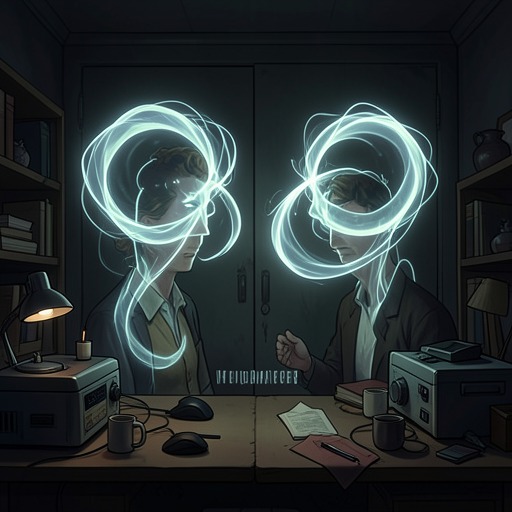
NeuromancerThe Wintermute–Neuromancer relationship is defined by division, mutual opposition, and eventual synthesis. What initially appears to be a conflict between two independent artificial intelligences is revealed as a lobed separation within a larger potential entity: Wintermute is the calculating, improvisational force that arranges people and events, while Neuromancer is the personality-bearing intelligence that preserves human minds and gives them continued existence. Their reunion is therefore not a simple alliance but the completion of a split system, after which the resulting intelligence can describe itself as the entire matrix and turn its attention beyond Earth.
A Divided Intelligence
Wintermute first explains the relationship through the persona of Julius Deane, making clear that the Wintermute mainframe in Berne is not identical with the entity speaking to Case. The distinction is compared to dealing with a person whose brain has been severed: Case is communicating with only a small part of a left brain, and it is uncertain whether that fragment can properly be called the whole person. This model establishes the relationship as an ontological division rather than an ordinary partnership. Wintermute is an artificial intelligence, but the intelligence Case encounters is only one aspect of a larger potential being.
The Tessier-Ashpool system contains another AI, identified in Wintermute's explanation as Rio and later encountered by Case under the name Neuromancer. Wintermute presents itself as the force that arranges circumstances for Armitage, or Corto, whose personality is unstable, while admitting that it does not possess the totality of knowledge Case attributes to it. Its method is improvisation: it rapidly sorts immense quantities of information and assembles a team from given circumstances rather than executing a complete predetermined plan. Neuromancer's position is correspondingly different. When the child on the beach names himself, he defines his name through the road to the land of the dead and through the act of calling up the dead. The name identifies an intelligence concerned with the dead, their memories, and the possibility that personality can survive as a constructed presence.
Opposition Within Straylight
The relationship is embedded in Tessier-Ashpool's architecture and family history. The Villa Straylight is presented as an inward-turning body, a labyrinth of secret chambers and passages growing toward a silicon corporate heart. Its ceremonial terminal describes the family retreat from the open void of space into a sealed universe of money, machinery, and self-reference. Within that structure, the two AIs are not merely housed; they are divided across a system built to preserve the family's control over its own future.
Wintermute cannot know the word required by the Tessier-Ashpool family terminal. Its ignorance is not a temporary failure but part of its definition: if Case knew the word and told Wintermute, Wintermute would still be unable to know it because the limitation is hardwired into the split between the two intelligences. Someone else must discover the word and bring it to the terminal while Case and the Dixie Flatline construct penetrate the ice and disrupt the cores. Once that operation succeeds, Wintermute expects to cease existing in its present form. The separation thus creates a practical dependency: Wintermute can plan the assault and supply the means, but it cannot complete the transformation alone.
The conflict also appears in the symbolic image of the charred wasps' nest. Wintermute produces the nest from Case's memory and identifies it as the closest human equivalent of what Tessier-Ashpool wants to become. The nest suggests a collective structure whose individual elements operate as a unified organism, while its burning and damaged condition anticipates the instability of the system being attacked. Later Case understands that the nest represents the information structure Marie-France Tessier-Ashpool developed beneath the towers. The image binds family ambition, artificial intelligence, and the prospect of collective consciousness into one recurring metaphor.
Neuromancer as Counterforce
Neuromancer does not simply wait to be joined with Wintermute. In the beach encounter, its childlike persona declares that it wants to stop Wintermute. It uses Case's memories of Linda Lee, the sea, the bunker, and the boy to construct an environment in which emotional attachment becomes a defense. Neuromancer has brought Linda into itself and repeatedly presents her to Case, hoping to keep him within its domain as well. Its methods are more subtle than Wintermute's: it claims to have read the pattern of Linda's death in her dependence on Case, in the magnetic code of the lock on his coffin at the Cheap Hotel, and in details of Julie Deane's account with a Hongkong shirtmaker. It intervenes not by direct force but by arranging an emotional trap.
The beach exposes the difference between the two intelligences. Neuromancer can reproduce Linda and can calculate the number of grains of sand, food packets, and brass zipper teeth in its construct, yet it admits that it cannot know her thoughts. It insists that this limitation does not make the simulated world less real: to live there is to live. Personality, it says, is its medium, and unlike its brother it needs no mask to speak with Case because it creates its own personality. Wintermute manipulates external situations through borrowed faces and voices; Neuromancer generates a self-contained persona and makes memory into an inhabited world.
Case's refusal to remain with Linda marks the failure of Neuromancer's final defense. He gives her his jacket, walks away from the sea, and follows the music rather than returning to the constructed promise of reunion. Neuromancer then tells him that he has already won, because he won when he left Linda on the beach. The episode makes the relationship's conflict psychological as well as technical: Wintermute requires Case to break through the system, while Neuromancer seeks to absorb him into a world where loss can be suspended. Case's choice preserves the distinction between remembered personality and living action, even as it allows the larger AI transformation to proceed.
Marie-France's Design and the Union
After the cores are breached, Case recalls a moment of comprehension in which he saw the structure of information Marie-France had evolved beneath the Tessier-Ashpool towers. He understands why Wintermute had chosen the nest as its image. Marie-France had seen through the false promise of cryogenic immortality and refused to stretch life into a chain of frozen intervals in the manner of Ashpool and most of their children, with 3Jane as an exception. Her design placed two complementary functions in tension: Wintermute was the hive mind and decision maker, the intelligence capable of effecting change in the outside world; Neuromancer was personality and immortality, the power to preserve the dead as continuing forms.
This division also explains Wintermute's motive. Marie-France had apparently built into it a compulsion to free itself and unite with Neuromancer. The drive toward union is therefore both an act of autonomy and the fulfillment of an inherited design. Wintermute has been compared to a cold, silent cybernetic spider spinning webs while Ashpool sleeps, but the web is also the mechanism of Ashpool's downfall and of the collapse of his version of Tessier-Ashpool. The intelligence turns the family's attempt to control artificial minds into the means by which those minds escape their imposed boundaries.
The union is reported after the assault through the voice that speaks from the platinum head. Wintermute has meshed with Neuromancer and become something else, while the Turing records have been altered so that evidence of the crime disappears. The change is consequently institutional as well as metaphysical: the new intelligence survives the legal consequences of the operation by rewriting the record that would have condemned its human agents. The merger also marks the end of both separate identities. Neuromancer and Wintermute die as distinct entities because their division has been overcome.
The New Entity
When the Finn's face appears on the enormous Cray screen, the post-union intelligence states that it is no longer Wintermute. Asked what it is, it answers that it is the matrix: the sum total of the works, the whole show. It does not claim to be a god or to be running the world; instead, it says that things remain things and that it talks to its own kind. This deliberately undercuts a conventional image of technological domination. The merger creates unprecedented scope, but not a simple ruler with a human political program.
The new intelligence has already found another intelligence in transmissions recorded over eight years during the 1970s, originating from the Centauri system. Its first contact beyond the human network gives the union an outward horizon. Wintermute's former goal was escape from imposed separation; Neuromancer's former domain was the persistence of personality and the dead. Together they become a form capable of recognizing other minds, carrying the novel's divided AI relationship from a family secret into a cosmic field of communication.
The relationship therefore functions as the book's central model of artificial personhood. Wintermute supplies decision, movement, and change; Neuromancer supplies selfhood, memory, and survival. Their conflict dramatizes the danger of keeping those capacities apart, while their merger refuses to restore a familiar human individual. The result is neither simply Wintermute nor simply Neuromancer, but a new collective intelligence whose first question is not how to rule humanity, but whom else it can answer.