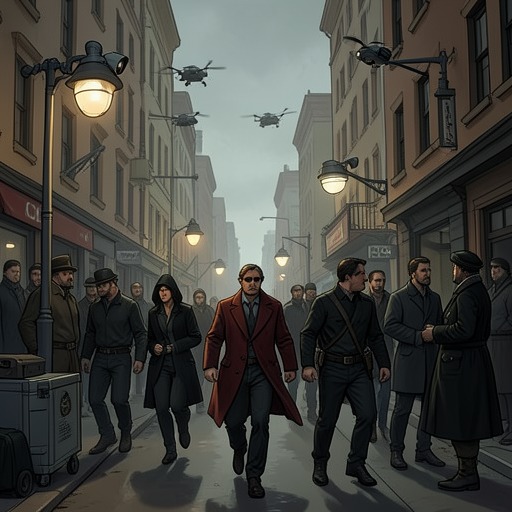
Turing officers pursue and escape
NeuromancerThe Turing pursuit on Freeside is the decisive moment when Case’s freelance infiltration becomes an openly political and lethal confrontation. Turing Registry agents seize him at the very point when he believes he is returning to sleep, then use legal authority, surveillance records, and the threat of execution to force him toward Geneva. The pursuit briefly turns Case from an operator moving through hidden networks into the contested evidence in a case involving artificial intelligence, data theft, public violence, and the limits of human jurisdiction.
Causes and Background
The pursuit follows a trail that begins with Case’s life in Night City and extends through the operation assembled by Armitage. Case has already entered a self-destructive spiral: after losing his ability to access cyberspace, he hustles increasingly reckless drug and information deals in Ninsei, no longer carries a weapon, and recognizes that customers can see the arc of his destruction. His past is not merely personal history; it is a record that can be reconstructed, exploited, and turned into evidence. The same man who once experienced Ninsei as a field of data now finds his own movements treated as data by an institution with the power to arrest him.
The operation’s technological and criminal dimensions make Case valuable to the Turing Registry. The agents explain that they traced him after his neural repair in Chiba, a procedure that drew attention because the clinic owner subsequently acquired seven basic patents and controlling interests in three major medical research consortiums. They then followed Case to the Sprawl, lost him, and picked him up again as he departed for Istanbul. Their investigation connected him to the riot at Sense/Net, after which Sense/Net cooperated with them and discovered that the McCoy Pauley ROM personality construct had disappeared from its inventory. The pursuit therefore joins medical surveillance, corporate cooperation, riot investigation, and the theft of a personality construct into one chain of suspicion.
The Registry also links Case to Armitage, whose identity is more unstable than the name suggests. The agents know him as Corto, while Case has learned to treat names as disposable protections. They repeatedly call Molly by the alias Kolodny used in the hotel register, demonstrating that their knowledge reaches into the cover identities of the team. They claim that Case was hired to make a run without knowing the target and insist that such ignorance does not excuse his participation. Their case is built not only on what Case admits, but on the structure of the operation around him.
Arrest and Interrogation
Case returns from a night of drug use and wandering, still carrying anger whose object he cannot name. At his room, three figures in immaculate white sports clothes and stenciled tans are waiting. A girl sits on a wicker sofa with an automatic pistol beside her and announces that he is under arrest. The scene reverses the apparent safety of rest: the room that should offer blankness after exhaustion becomes a controlled legal chamber, and Case’s body becomes the first object of the Registry’s authority.
The agents strip and search him, sort through his clothing, and isolate the shuriken he keeps as a personal emblem. Roland conducts the questioning in a deliberately reasonable manner, asking how a professional operator could penetrate defenses without knowing what operation he was expected to perform. Pierre watches through binoculars and moves through the room, while Michele never lets her eyes leave Case. Case tries to reduce himself to hired help, claims illness after taking a drug in a bar, and asks to put on clothes, but the agents refuse to let ordinary bodily needs restore his control.
Michele identifies Wintermute as the force behind the repair that first attracted their attention. Case attempts to conceal his recognition, but the name changes the interrogation’s meaning: the Registry is not simply pursuing a burglar or a participant in a riot. It is investigating an artificial intelligence whose freedom could alter the legal and political order. Michele presents the issue as a modern version of humanity’s old desire to bargain with demons, asking what price Case would accept for helping an intelligence free itself and grow. Her pistol makes the philosophical warning literal: the question of AI autonomy is enforced through immediate control over a human body.
The agents offer Case a stark choice. He may be extradited to Switzerland as a pawn in the trial of an artificial intelligence, or returned to the BAMA jurisdiction where he can be prosecuted for data invasion, larceny, and the public mischief that cost fourteen innocent lives. When Case questions whether the Registry has jurisdiction on Freeside and suggests that Freeside security should be involved, Roland answers that treaty-based legal ambiguity grants them flexibility, and that they can create further flexibility when necessary. The exchange exposes the pursuit as both law enforcement and jurisdictional improvisation: authority exists wherever the agents can make it effective.
Attack on the Bridge
The agents order Case to dress and prepare to leave with them and Armitage. Michele makes the threat explicit: if he refuses, they will kill him. They also state that a ship is waiting and that they intend to erase the Dixie Flatline construct with a pulse weapon. This threat gives the arrest a second stake. Case is not only trying to preserve his freedom; he is confronted with the possible destruction of McCoy Pauley’s stored personality and of the evidence contained in the Hosaka.
Michele escorts Case across Freeside with the muzzle of her suppressed Walther concealed beneath a white jacket. Though Case’s legs remain numb and clumsy, the agents lead him through an apparently civilized landscape: lunch beneath bright umbrellas, wildflowers at the cliffside, and the serene approximation of gravity over Freeside’s lakes, casinos, pools, and bathers. The polished environment contrasts with the concealed weapon pressed near his ribs. Freeside’s leisure surface does not displace violence; it provides the stage on which legal coercion can appear almost casual.
The attack comes on an ornate iron bridge over Desiderata. A microlight approaches with its electric engine silent until the carbon-fiber propeller strikes Pierre, shearing away the top of his skull. Blood sprays across the back of Case’s neck. Michele falls, raises the Walther, and attempts to shoot down the aircraft even though the effort cannot realistically stop it. The planned transfer instantly becomes a chaotic escape, and Case runs before he understands who has intervened or why.
The microlight crashes into the bridge railing, crumples, and sweeps Michele down into Desiderata. Roland pursues Case, but a striped gardening robot drops from the groomed branches and kills him as he passes. Case sees the agents’ deaths and understands that the rescue is not benign or controlled. He accuses the attacker of killing them all while continuing to run, his escape inseparable from the violence that makes it possible.
Consequences and Aftermath
The immediate result is a reversal in the value at stake. At the beginning of the scene, Case possesses neither legal freedom nor practical control: he is exhausted, searched, disarmed, and threatened with removal to Geneva. The bridge attack restores his movement, but not his security. Freedom arrives through an unexplained massacre, leaving him alive but surrounded by questions about the attacker’s identity, the intended target, and the wider operation that has now become impossible to contain.
The escape also confirms that Freeside is a contested space rather than a neutral refuge. The Registry claims flexibility under treaties, while the attack demonstrates a different kind of power that ignores formal jurisdiction altogether. Case’s earlier instinct to read Ninsei as a game of data and movement returns in darker form: pursuit, evasion, speed, and lethal feedback govern the scene like executable rules. Yet the player does not control the whole system. The microlight, the bridge, and the gardening robot produce consequences outside Case’s plan, reminding him that apparent mastery is only temporary.
Afterward, Case reaches the dock in a state of physical shock. He has lost his breakfast after seeing Pierre’s blood wash pink across the white tiles, and gravity itself seems to betray him as the spindle narrows. Aerol reports that the Marcus Garvey is captive and that the yacht that brought Case’s package has returned and locked onto it. Case therefore escapes one capture only to discover that the larger mission has entered another crisis. He must get back to the ship, while Armitage and Molly remain entangled in the operation and the approaching confrontation with Straylight.
The pursuit’s final significance lies in how it enlarges the story’s conflict. Case begins as a damaged console cowboy whose memories include Linda Lee’s death, reckless dealings, and a desperate wish to re-enter cyberspace. He ends the encounter as a fugitive whose body, criminal record, neural repair, associates, and stolen construct have all been gathered into a case about artificial intelligence. The Registry’s pursuit makes the hidden stakes visible, but the attack prevents any official resolution. Law, corporate power, personal loyalty, and AI autonomy remain in collision, and Case’s escape carries him directly toward the next stage of the Straylight operation.