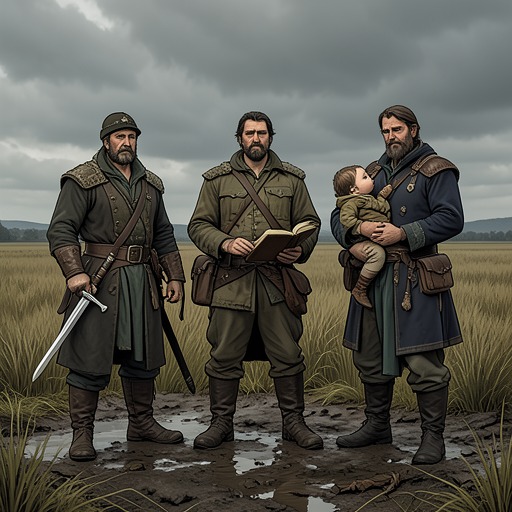
“Strong girls do not depend on hands.”
Nevertheless“Strong girls do not depend on hands.” is Mabel Peloponnese’s declaration of self-reliance at a moment of romantic loss. The line gives words to a disposition formed through her resistance to the roles assigned to her, yet its echo in the scene is complicated: as she is left alone, Yelsew places a hand on her shoulder and guides her inside. The expression is both a claim to strength and a measure of what strength cannot prevent her from feeling.
Wording and Meaning
The expression appears alongside a second, closely related assertion: “Strong girls do not even have time to feel sorry for themselves.” Together, the lines turn resilience into a rule of conduct. A strong girl is expected not to rely on another person’s hand and not to pause in self-pity. The language is absolute, making self-sufficiency sound less like a choice than a demand imposed on someone who has little room to stop or lean on others.
The image of a hand carries particular weight in the scene. Mabel sees Navi’s back when she believes she should be holding his hand; he has turned away after their painful separation. The phrase therefore connects physical contact with emotional reliance: the absent hand represents the intimacy she has lost, while her declaration insists that she must go on without it.
Earlier Context: Refusing Prescribed Roles
Mabel’s self-reliance has a history in her refusal to conform to the expectations placed on girls in Navon. While other girls might attend village fairs, shop for food or dresses, or learn sewing and cooking as preparation for marriage, she spends her days in the fields with her father. She returns with dirty clothes and messy hair, and the narrative contrasts her golden skin and wild, burnt hair with the appearance expected of peasant girls. Her father and Mabel do not mind her difference; Darice, by contrast, worries that fitting in would make life easier.
After her parents die, Mabel turns away from returning to the palace and goes to the military base, where young people from across Navon are being recruited. Though she is the only girl there, she wants to belong to something that matters. When the commander assumes that hardship or money might explain her application and offers help, she declines that explanation and says she wants to be a soldier. His answer—that she would have to be a man—makes the barrier explicit. Her determination is not simply a refusal of domestic life; it is a demand to choose her own work despite a rule that excludes her.
Work, Exclusion, and Self-Reliance
The obstacles persist after Mabel enters military service. She pays five silver coins for leather pants and a vest—three times the cost of a dress—so she will not have to wear her conspicuous dresses in camp and give the soldiers another reason to ridicule her. Yet the promise that she will prove herself is false: she is not properly introduced to the troops and serves as a squire, polishing and checking weapons, inspecting armor and cavalry equipment, and following the commander to meet practical needs. Nasty comments about her being a woman continue. The expression’s insistence on self-sufficiency thus sits within a setting where Mabel must repeatedly demonstrate resolve while others restrict the role she can perform.
A later job arranged by Navi sharpens that contrast. Rather than work with weapons or in the field, Mabel is sent to a village tailor for domestic work. She protests that she is bad with needles, cannot stay still, and hates being indoors. The episode recalls the domestic skills associated with conventional womanhood in her childhood, but it does not suggest that she has simply accepted that role: she says plainly that the work does not suit her. Her self-reliance includes naming the mismatch between what others arrange for her and what she knows about herself.
The Separation Scene
The line’s defining occurrence comes when Navi turns away from Mabel. He leaves slowly, with the scene presenting his departure as painful to him as well as to her, but his responsibilities to the nation outweigh the ordinary intimacy they might otherwise share. Mabel is left to deal with what he has left behind. She thinks that she has always known he would break her heart and that this is what he has just done; against that recognition, the two assertions about strong girls frame the response she demands of herself.
The scene does not leave the principle uncomplicated. When Mabel turns back toward the tavern, Yelsew is waiting at the door. He does not joke or try to explain her pain; he places his hand on her shoulder and guides her inside. The gesture follows immediately after Mabel’s claim that strong girls do not depend on hands. Rather than canceling her resolve, the juxtaposition makes visible the difference between insisting on independence and being entirely without care. Her words preserve her agency in heartbreak, while Yelsew’s quiet assistance shows that accepting a hand need not erase it.