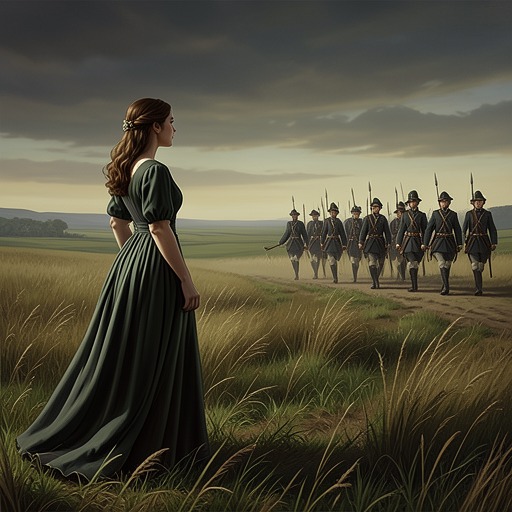
The Ballad of Mulan
NeverthelessThe Ballad of Mulan functions as a recurring epigraphic frame for Mabel Peloponnese’s story, not as a claim that the novel simply retells an earlier tale. Its repeated appearance invites comparison between a familiar female-warrior motif and a plot in which military service, forbidden participation, disguise, political obligation, romance, and captivity take distinct forms. The force of the reference lies in that combination of recognition and difference: the title supplies a narrative inheritance, while the events surrounding it make the inheritance newly consequential.
Recurrence and Placement
The title appears repeatedly across the book, from its early chapters through the final stretch and the material immediately preceding the epilogue. Its recurrence gives the reference structural weight: this is not a single allusion left behind after the opening, but a frame renewed as the story advances. The final appearance close to the epilogue also makes the allusion part of the book’s closing architecture, even though the available evidence does not establish that the epilogue resolves the story through a conventional return home.
Two brief textual fragments sharpen the effect of the framing. One is the rhythmic “Click, click. Click, click.” Another describes a Khan raffling those who will go to war. Together, these fragments place sound and the organization of military service beside the recurring title. They suggest that the frame reaches beyond a general resemblance between women and warriors: it also evokes the repeated, institutional demands through which a person is drawn into war. The fragments are too brief to establish a complete account of the source tale, but they make the allusion concrete rather than merely decorative.
The Inherited Motif and Mabel’s Story
The novel’s clearest point of contact with The Ballad of Mulan is the female-warrior motif. Mabel seeks a place in a royal army whose rules restrict women’s service; she later travels with the army disguised as Linickel and enters the dangers of military life directly. The epigraphic frame therefore accompanies a conflict between a woman’s capacity to act and the social and military rules that would exclude her. The reference gains force from the friction between the inherited figure of a woman entering war and Mabel’s particular struggle to be recognized, concealed, or constrained within her own political world.
The parallel does not erase the novel’s specific circumstances. Mabel’s path includes combat, the consequences of killing, and captivity; it is also entangled with her relationship with Navi and with obligations to the kingdom. These elements turn the female-warrior image into a point of departure rather than a ready-made solution. The repeated title encourages readers to recognize a tradition, while Mabel’s changing position within the army and the wider conflict makes clear that her experience has its own costs and attachments.
Repetition with Difference
The reference also draws attention to what the novel expands around military service. Mabel’s story is not confined to entering the army: it includes disguise, romantic separation shaped by political duty, and capture by an enemy. These developments place the warrior motif within a larger narrative of personal ties and public conflict. The recurring epigraph can thus be read as a question the book keeps reopening: what does the familiar image of a woman who goes to war mean when service is contested, love cannot be separated from state responsibility, and survival does not guarantee an uncomplicated homecoming?
That difference matters more than a claim of direct equivalence. The available fragments do not supply enough of the ballad’s text to support a line-by-line comparison, and the novel’s repeated use of its title should not be mistaken for proof that every stage of Mabel’s plot reproduces the older story. Instead, the frame makes comparison an ongoing reading practice. Each recurrence recalls the female-warrior tradition, while the novel’s distinct turns—military exclusion, assumed identity, combat, political separation, and captivity—alter the expectations that tradition might bring with it.
Narrative Significance
As a framing device, The Ballad of Mulan links individual action to a story-pattern larger than Mabel without reducing her to an emblem. The title places gender and military duty in the foreground, and its recurrence keeps that lens active across a narrative that also gives weight to relationships and political consequences. The fragments of clicking and wartime recruitment add a compact sense of repetition: war is not only a heroic threshold but an organized demand that returns and claims people.
The reference’s most useful meaning, therefore, is not that Mabel is simply another version of a legendary warrior. It is that the novel asks readers to hold inherited recognition beside new circumstance. Mabel’s military path recalls a female-warrior motif; the barriers she encounters, the relationships she cannot detach from public duty, and the captivity that interrupts her agency give that motif a different shape. Repeated at the book’s threshold points and near its epilogue, the title remains a frame for comparison rather than a promise that the story will repeat an old ending.