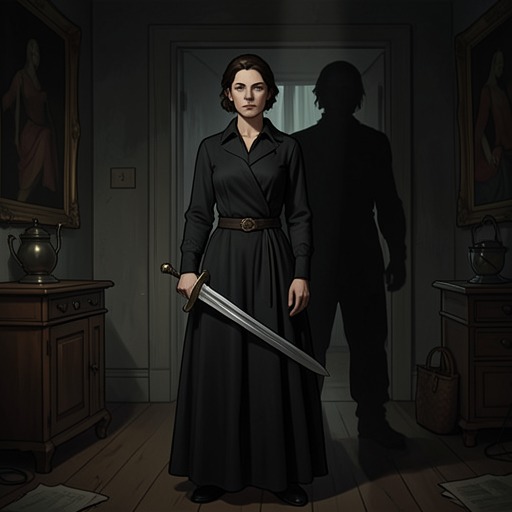
Choose to Do Something That Matters
NeverthelessChoose to Do Something That Matters is a maxim Amyntas gives Mabel Peloponnese when she asks whether he would still be proud if she wanted a life girls were not expected to choose. His answer joins unconditional love to a demand for agency: “But you can choose to do something that matters rather than expecting that people do it for you.” Mabel later carries that lesson into her decision to become a soldier, making the phrase a guiding principle for action rather than a promise that action will be easy or welcomed.
The Maxim and Its Origin
Mabel asks Amyntas why he taught her skills she was not supposed to need and helped make her someone she feels she cannot be. Before those questions, she tests whether her father’s pride depends on her fulfilling a conventional role. He assures her that he would be proud of anything she did, but directs her toward choosing consequential work rather than relying on others to do it. His answer does not resolve her questions about how he shaped her; instead, it gives her a standard for deciding what to do with what she has learned.
The principle is therefore both encouragement and responsibility. Amyntas does not tell Mabel that the world will make room for her, or that meaningful choices will spare her hardship. He asks her to choose and act. That distinction becomes important as she encounters institutions that treat her choices as improper or unnecessary.
Mabel Makes the Choice
After Navon is attacked, Mabel runs toward her home carrying a stolen sword. On the way, she sees residents being assaulted, including a woman forced from her house and an old man attacked. She feels she should help them but continues because she has a particular destination: she finds Amyntas has been murdered before she can speak with him again. His death makes the lesson painfully immediate. The person who taught her to act is no longer there to advise her, and the devastation around her gives her decision a public as well as personal context.
At the recruitment field, Mabel says she is there to sign up for Navon’s royal army. The commander assumes she needs money and offers help, but she explains that she wants to be a soldier, despite being told that soldiers must be men. Later, when she tells Navi Spyridaki she fears the soldiers are not prepared to stop Balthasar’s men, she invokes her father’s teaching directly. She wants to take part in the effort and also needs a job; she rejects the alternative palace roles Navi offers because fighting is the skill she knows.
Her choice is not made in ignorance of danger. When men threaten her, she remembers her mother’s warning that the world is not safe for women and wonders whether she will have to hurt someone for the first time. She uses her father’s sword to defend herself. During the fighting, she later kills a soldier, an act she had not planned when she left Navon with Shai’s band. Her thoughts place responsibility for the war on Balthasar, while the encounter leaves her confronting the reality that choosing to fight also means causing another person’s death.
Agency Against Authority
The story places Mabel’s determination beside Navi’s struggle to exercise authority. Advisers dismiss him as too young and inexperienced to manage Navon’s political affairs; Navi responds by ordering them to report to him and to pursue alliances on the terms he sets. Though they comply, their obedience is reluctant. His position as heir gives the order force, but the scene also shows him having to claim the responsibility others would deny him.
Navi’s authority remains contested even within his family. He has control over political affairs but has not been appointed to command the army, a role he wants and his father withholds because he does not want Navi on the battlefield. When Mabel questions Navi’s military readiness, he answers by invoking her exclusion: she is not part of his army and, as a girl, is not entitled to demand an explanation. He expels her from the army and orders her to stay away from him. The contrast sharpens the maxim’s limits: personal resolve can prompt action, but it cannot by itself remove the rules and hierarchies that decide whose actions are accepted.
At the later defense of Navon, Navi stands before the army as its prince, and its commander expresses pride at seeing a prince in front of an army. His presence gives public form to a responsibility he had previously sought but been denied. Mabel, meanwhile, faces a different test of the same principle when villagers are directed to shelter women and children inside the castle walls while men fight. She hesitates to leave the soldiers, changes into her armor, takes her sword, and goes to defend the city, although it is not her assigned duty.
Meaning in Action
Mabel’s choices give the maxim a recurring shape: she seeks enlistment rather than accepting assistance designed to keep her outside the army; she intervenes in danger rather than treating her exclusion as a reason to stand aside; and she returns to defend Navon rather than taking shelter when the city is threatened. Her actions are not presented as effortless triumphs. She is refused, faces danger, and experiences the cost of killing, yet she continues to measure herself by whether she has taken part in something worth protecting.
When Mabel defeats and captures an enemy commander, she declares him her prisoner and says she will take him to the army as a hostage rather than kill him. The moment joins decisive action to restraint: choosing to act does not mean choosing violence without limits. Across the story, Amyntas’s advice thus develops from a father’s answer to a daughter’s fear of disappointing him into a principle tested by gender restrictions, political authority, war, and the obligations she accepts toward other people.