Mabel Is Attacked and Rescued by Shai's Band
NeverthelessMabel Is Attacked and Rescued by Shai's Band turns a journey in which Mabel is dangerously exposed into the beginning of a consequential alliance. Six men catch up with her after following her from a tavern. She fights back with her father's sword, but the attack overwhelms her until armed strangers arrive and drive the group away. The rescue does not restore a simple sense of safety: the newcomers are formidable, and their appearance raises its own questions. Yet they offer something Mabel needs—a way to seek her brother without doing everything alone.
Background and Setting
Mabel's vulnerability is shaped by the routes she has to travel and the limited protection those routes provide. Navon's castle stands high among trees, with a stone bridge at its front as the passage to the palace. Leaving the castle for the village is itself an effort: the stables hold horses, but Mabel does not think she can simply take one, so she sometimes walks the long road beside the river and valley. These details distinguish the protected seat of power from the wider landscape through which she must move on her own terms.
The immediate danger arises after Mabel intends to follow a general's party. She knows that this plan depends on staying alive, especially because the men who had watched her outside the tavern may reach her. The attack thus grows from a specific exposure: she is traveling apart from reliable companions while trying to pursue her own objective. The episode does not present the danger as something she invited by leaving a room or being outside. Mabel recalls her mother's warning that the world is not safe for women, and recognizes that changing her conduct would not necessarily have prevented the men from targeting her.
The Attack and Mabel's Resistance
The assault begins abruptly. One of the six men rides beside Mabel and knocks her from her horse; she falls onto her arm and is briefly unable to move as the men dismount and surround her. Once she can act, she reaches for the sword she carries from her father. Its history matters: it belonged to him, but Mabel now bears it herself, making the weapon both a practical means of resistance and a link to her family.
The first blow is not a planned victory. As Mabel tries to rise, she strikes one man's nose with the sword's handle; he had simply been in her way. His anger turns the confrontation into a personal challenge, while the others close around her. Mabel evades his attempts to hit her and answers with blows of her own. Her resistance shows speed and determination, but it does not make the encounter equal. Another man attacks her from the side, and the first returns, knocks her down, and continues the assault. The change in the scene is stark: an individual contest that Mabel has briefly managed to resist becomes a situation in which several armed men control the space around her.
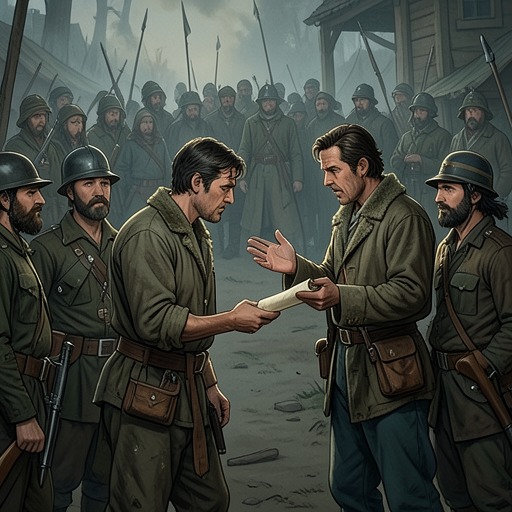
The attack is interrupted when a second group arrives on horseback. The assailant stops, and the other men stop as well. Mabel remains on the ground and reaches again for the sword, still unwilling to assume that the newcomers are safe. One of them tells her she will not need it then, but the reassurance does not make her drop the weapon. That hesitation preserves the scene's uncertainty: intervention has halted the immediate assault, yet Mabel has no reason to trust strangers merely because they have appeared at the right moment.
The Rescue and Its Limits
The newcomers do not kill the attackers. Their leader orders them to leave, threatening that they will die if they refuse; the men mount and go. One of the rescuers objects that they should have killed such men earlier so there would not be another encounter. The leader answers that they cannot kill every man who behaves that way, or no one would be left. His response gives the rescue a practical, unsentimental limit: the immediate threat is removed, but the pattern of danger remains. Another member warns the departing group that they will not be spared a third time, suggesting this is not the first occasion on which the newcomers have intervened against them.
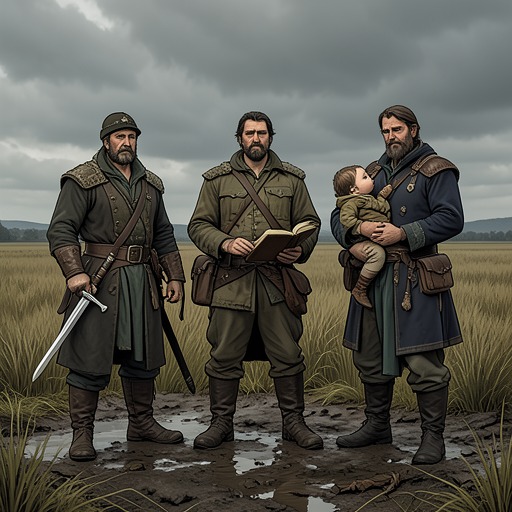
Mabel asks who the strangers are. Gaspar introduces himself, while the leader explains that the men are his brothers and says they will escort her back. He later describes their work as a mixture of bounty hunting, mercenary service, and bureaucratic tasks people pay them to perform, including rescuing people, capturing murderers, and recovering stolen money. Their arrival therefore does more than supply sudden protection: it introduces an organized group whose work includes intervening in disputes and locating people or property. Their authority is informal and forceful, not an extension of the protection Mabel might expect from the castle.
From Rescue to Cooperation
The escort does not immediately settle Mabel's fear. The leader offers help, but she doubts that he can provide it. His explanation of the group's work gets her to stop trying to leave, and the conversation turns toward her search for her brother. Mabel tests the offer by asking whether help will cost her, drawing on an earlier exchange in which she had already wondered about payment. The leader says it may cost nothing, depending on whether she comes with them, and asks her to join their return journey.
Mabel accepts. Her decision is not presented as uncomplicated trust: she has just endured an attack, and she recognizes that handling the search alone may not be wise. She judges that these men know the area and that a better offer is unlikely to appear. In particular, she no longer considers Navi a dependable source of help; she believes he does not know the place or her brother and has failed to keep his promises. Choosing the newcomers is therefore also a practical reassessment of whom she can rely on. What begins as a rescue becomes a voluntary step toward cooperation, with Mabel choosing the people and means that seem most useful to her objective.
Journey, Space, and Narrative Significance
The episode belongs to a larger movement from Mabel's familiar village toward unfamiliar political and social territory. She had not left her village until three months earlier, and the narrative notes that she has already been in taverns several times within that short span. On a later journey, she and her companions ride through a narrow canyon and climb to a forest tavern where outlaws hide beyond the king's reach. This elevated refuge contrasts with the castle's own height and defenses: both are reached through constrained approaches, but the forest site is useful precisely because it lies outside the king's eyes. The rescue begins Mabel's connection to people who inhabit that less regulated world.
Later crossings sharpen the story's recurring contrast between routes and safety. A long bridge on another journey is wide enough for three horses side by side or two carriages, yet its height over the water frightens Mabel. At the border of Tzara, a massive wall conceals the city and protects its villages and plantations; the narration describes entry into the royal city as harder than leaving it. These are not part of the roadside attack, but they extend the spatial pattern the episode introduces: a route can offer passage without guaranteeing security, and barriers can protect some people while restricting others. In the rescue scene, Mabel's father's sword gives her a means to resist, but the arrival of Shai's group changes her prospects more decisively. The scene moves her from isolated self-defense toward a search undertaken with allies, without pretending that either the wider danger or the risks of reliance have disappeared.