Mabel and Sven fight
NeverthelessMabel and Sven fight is a turning point in Mabel’s attempt to enter the King’s Army: she proves that she can act decisively in a confrontation, but the prince’s response pushes her farther from the training ground rather than recognizing her as a soldier.
Background and Stakes
Mabel arrives at the army from a life that has already set her apart from the roles expected of women in Navon. While other girls might be at village fairs, helping their mothers with sewing and cooking, or shopping for household supplies, she is most at home in the fields with her father. Her peasant background and unconventional appearance mark her as an outsider, but her more decisive difference is that she does not want to be shaped into the expected pattern of a wife.
After her parents die, Mabel goes to the military base where young people from across Navon have been summoned. Many recruits are uncertain, inexperienced, or afraid; she, too, is new to military life, but wants to belong to something that matters. The commander assumes that her request to enlist may be about financial hardship and offers help from the king. Mabel rejects that explanation: she wants to be a soldier. The answer she receives is that a soldier must be a man.
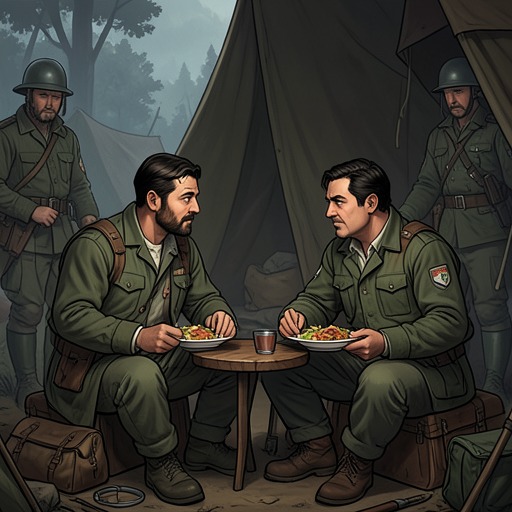
Her place in the camp reflects that exclusion. Mabel spends five silver coins on leather trousers and a vest, three times the cost of a dress, hoping to avoid giving the soldiers another reason to mock her. Yet changing her clothes does not change her status. She is not properly introduced to the troops or placed among them; she polishes and checks weapons and armor, attends to cavalry equipment, and follows the commander so she can meet practical needs. The fight unfolds inside this contradiction: Mabel is present in a military setting, but the army has not accepted her as one of its fighters.
The Confrontation in the Arena
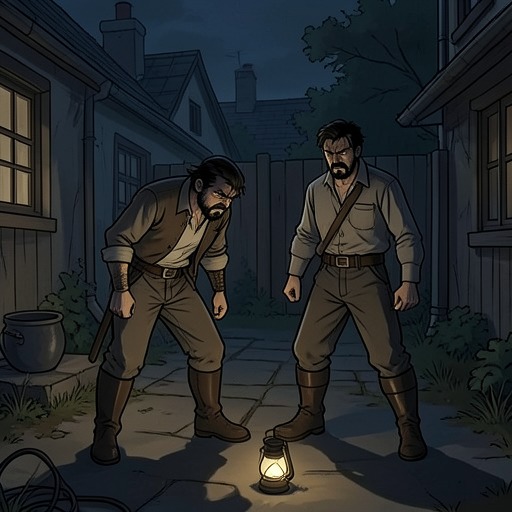
During a lunch break, Mabel returns to collect weapons left scattered in the arena. She regards leaving them there as unacceptable even though the soldiers will use them again. The arena, empty when she first notices it, now contains Aury and Sven. Sven has pushed Aury to the ground; Aury lacks the training Mabel has received and is frightened. Mabel feels intimidated too, and she has never fought anyone in a formal contest. Still, she cannot bring herself to stand aside while her friend is being mistreated.
Mabel challenges Sven and moves before he can answer. Her confidence is not effortless: she draws on her father’s instruction to focus her strength in her leg, and her early attacks do not settle the contest. Sven pushes her down and gains an advantage. Mabel adapts rather than retreating. When she finds an opening, she uses it to make him back away, then brings him off balance and takes him down. The exchange is improvised and hard-won, not a demonstration of assured superiority; the narration emphasizes that Sven was caught off guard and that a later fight might not be so easily won.
With Sven on the ground, Mabel retrieves her sword and holds it close enough to make clear that the contest has turned in her favor. She feels more powerful than before, but the moment is immediately complicated by the arrival of an audience. The arena is no longer private: the kitchen staff have gathered to watch, and Navi is there as well. Sven kicks the sword away. Mabel’s brief advantage is therefore not a secure victory or an official recognition of her ability; it becomes a public incident to be judged by those who control her position in the camp.
A Friend Defended, Authority Challenged
Mabel explains that Sven had been bothering Aury and that someone needed to stop him. Navi questions why she had to be that person. Her answer—that no one else would act—turns the confrontation into more than a dispute between two recruits. She has intervened out of loyalty to Aury, but her retort also accuses the surrounding soldiers of cowardice. The action tests both her willingness to protect a friend and her refusal to accept the passivity expected of someone whom the army will not treat as a fighter.
Navi does not respond by welcoming Mabel into training. He says he is not worried about her, but wants her to stay out of his way and not pose a risk to his men or herself. He orders her to leave the training camp and join the kitchen staff, assigning her responsibility for the soldiers’ food. Mabel protests that the decision is unfair, especially after Sven has been allowed to push her down and might do so again. Navi invokes his authority as prince; the disagreement is no longer about who prevailed in the arena but about who has the power to decide where Mabel belongs.
Reassignment and Significance
Navi makes the reassignment sting by referring to Mabel’s earlier concern about the soldiers gaining weight and noting that she will no longer need to wear her trousers in the kitchen. His response treats the clothes she bought for camp as unnecessary and recasts her intervention as a reason to remove her from the fighters. The practical consequence is immediate: instead of gaining a place among the soldiers through her conduct, she is separated from the training ground and put in charge of food.
The promise of a kitchen post does not become her lasting assignment. Later, Navi arranges a domestic job that is neither kitchen work nor work with weapons: tailoring. Mabel objects that she is poor with needles, cannot stay still, and dislikes being indoors. That later placement extends the same conflict in a quieter form. Navi can redirect her work, but the roles chosen for her continue to conflict with her own sense of what she is suited to do.
The fight therefore marks both capability and exclusion. Mabel protects Aury, uses what her father taught her, and defeats Sven through observation and improvisation. Yet her success does not dissolve the gender barrier she encountered when she tried to enlist. Instead, the prince uses his authority to move her away from the arena. The scene’s reversal is sharp: Mabel demonstrates that she can act in a fight, while the institution answers by assigning her a domestic role. Her intervention matters to Aury, but it also makes plain how little the army’s rules allow that courage to count as proof of belonging.