Tzara Invades as Navon Musters to Resist
NeverthelessTzara Invades as Navon Musters to Resist is the moment when a threatened kingdom begins converting warning into defense. Shai brings his men and promises that the exiles will come as well; Navi Spyridaki agrees to let them enter, orders the village moved to safety, and takes command of a force prepared to meet the invasion. The preparations expose the limits of Navon’s old political arrangements, while Mabel Peloponnese’s decision to stay and fight makes the defense a matter of personal conviction as well as royal duty.
Causes and Political Background
Navon’s danger has roots in a political order that left the kingdom exposed. For generations, it had fought battles on behalf of other kingdoms, including those in which Mabel’s father served. Many Navonians deserted rather than fight wars they considered unrelated to their own country. Desertion carried an extreme penalty: the deserter was branded with a hot iron, expelled permanently beyond the kingdom, and faced death if caught back on Navon soil. The policy deprived Navon of soldiers while separating former soldiers from the society they had once served.
The arrangement had depended on alliances, but now Tzara threatens Navon directly, while a former ally is too afraid of Tzara’s retaliation to stand by the kingdom. Neighboring states also take advantage of Navon’s vulnerability. In Navi’s council, he favors offering Navon’s best goods in exchange for political alliances, but the counselors resist concessions that could impose long-term costs. He regards special privileges traded for protection as unfair, yet the kingdom has little leverage. The invasion therefore tests more than its defenses: it tests a state weakened by dependence on other powers and by the loss of its own manpower.
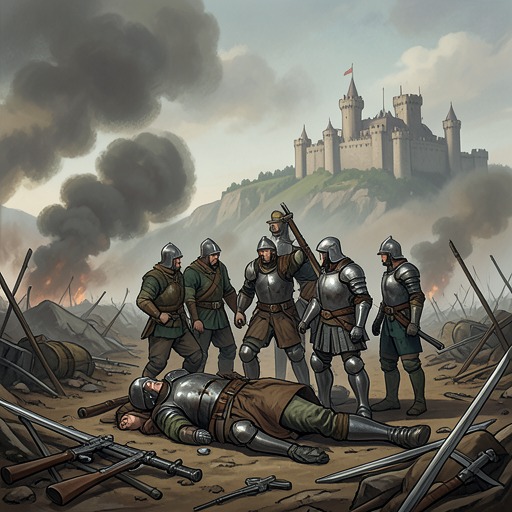
Navon’s terrain offers some protection, though not certainty. Its castle stands on a hill among trees, and an approaching enemy would have to cross mountainous forest; the stone bridge at the front provides the passage to the castle. That defensible setting frames the coming confrontation, but the kingdom cannot rely on its walls and geography alone. It needs people willing to fight—and, by the time Shai arrives, help from people Navon has treated as outsiders.
Shai’s Warning and the New Coalition
The crisis becomes immediate when both doors of the throne room open to admit Shai. He tells Navi that Tzara will cross Navon’s borders and that there is little time. He has brought his own men, and the expatriates will come too. Navi responds by agreeing to tell the guards to let them through, a practical decision that also marks a change in the kingdom’s relationship with those it has excluded.
That offer of help has developed through negotiation rather than sudden loyalty. Shai’s band has been described as a group that takes on paid tasks—rescuing people, capturing criminals, and recovering stolen money—and Shai had proposed that they could fight for Navon. When Navi asks what the expatriates want in return, Shai says they are not doing it for money. Their willingness to risk themselves for the kingdom contrasts with the older alliance system, in which Navon supplied men to defend other people’s lands. The danger now makes a different kind of alliance possible: one formed with people who have lived beyond Navon’s protection and whose assistance is not simply another purchased privilege.
Navi asks how Shai knows the invasion is coming. Shai explains that his people have scouts and allies, and that the threat is certain. The exiles are thus not only additional fighters; their networks provide intelligence the kingdom needs. Shai’s arrival brings warning, manpower, and a direct question about what the ruler will do with both.
Mobilization and Civilian Protection
Navi’s first stated measure is to bring the whole village to the castle and move its residents out of the way before the battle. He recognizes that the process will take time, but intends to call the army and find the soldiers immediately. The order makes civilian safety part of the defense plan rather than an afterthought. Shai, however, is concerned with one person in particular: he asks where he can find Mabel and insists that she must be alive when the fighting is over. Navi promises to have someone look for her.
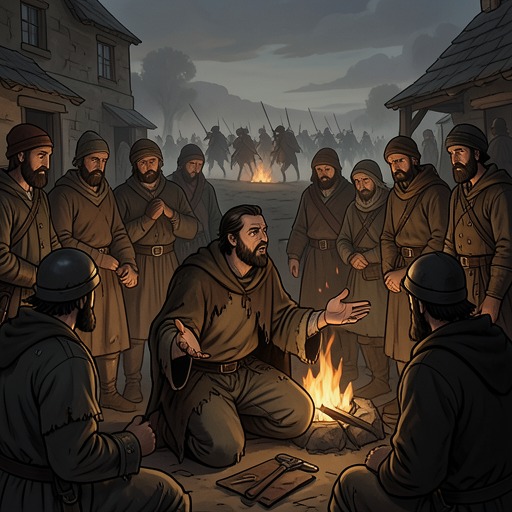
The evacuation begins in the middle of the night. Villagers wake to shouting and confusion and initially fear another attack by Tzara. Instead, they find Shai’s men helping them leave their homes and guiding them toward the castle for shelter. The scene reverses the expected image of the exiles as a threat to Navon: during the emergency, they are the ones conducting residents to safety.
The defense plan distinguishes between those sent inside the castle walls and those expected to fight. Women and children are to enter the castle; men are told to stand and defend the kingdom. Mabel understands the arrangement but cannot accept its implication for her. She has stood with the soldiers, and leaving them at the most frightening moment feels like abandoning them to die. Her reasoning widens beyond military obligation: she believes there are more good people than bad, and that their existence makes the world worth saving. The villagers proceed in their sleeping clothes, with no time to change; Mabel watches them go, but does not join the procession.
Mabel and Navi Choose Their Posts
Instead of entering the castle as instructed, Mabel returns to her house, puts on her trousers and armor, takes her sword, and prepares to defend her city. She knows that fighting is not her assigned job, but chooses it nonetheless. The decision brings the personal and political stakes of the mobilization together: Navon’s rules divide people into those who may fight and those who must be protected, while Mabel measures her place by the loyalty she feels toward the soldiers and the people in danger.
Navi also leaves the castle when he should be entering it. As villagers seek shelter, he encounters the king, who greets him but plainly wishes he could stop him. The king does not ask him to turn back: defending the kingdom is, in this crisis, part of what is expected of its ruler. Navi’s own concern remains divided. Before leaving, he searches the crowd for Mabel and tries to reassure himself that she must be among those taking shelter. His uncertainty follows him into the defense, where concern for her sits beside his responsibility for Navon.
Once outside, Navi joins the army. The gates close behind him, shutting him out from the chaos of the evacuation; he understands his movement toward danger as a defense of home. The force waiting for him numbers eight hundred men, armed and positioned in abandoned houses and alleys. Knowing the area gives them a possible advantage over the invading troops, and the soldiers hope the fight will bring them glory. Shai stands beside Navi as the army prepares to conceal itself in the empty buildings.
The Standoff Before Battle
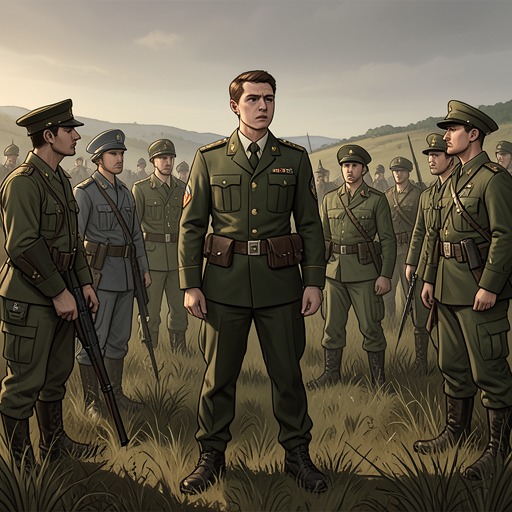
The soldiers acknowledge the unusual sight of a prince standing before an army. Navi answers that these are hard times, and the men wait for his commands. His presence turns royal authority into a visible obligation: the prince does not direct the defense from the safety of the castle but takes his place with the force expected to resist the invasion.
The episode ends before the clash itself. The army is concealed, the villagers are being sheltered, Mabel has armed herself, and the exiles have been admitted as allies. Navi’s final readiness is an invitation for Tzara to come to them, not a report of victory. That pause gives the mobilization its force: Navon has not yet secured its survival, but its people and former outsiders have begun to act together against a threat the old alliances failed to prevent.