The Library
NightbitchThe Library is the recurring institutional anchor of Nightbitch's transformation, the place where her rational fears about turning into a dog first meet the folkloric evidence that reframes her condition, and later the site where she must perform ordinary motherhood while concealing her animal self. It functions as a threshold between the human world she is losing and the mythic inheritance she is recovering. In a novel built on the collision between domestic routine and monstrous becoming, the Library is the one civic space that appears in both registers: first as a refuge for her unraveling mind, then as a stage for her most anxious performance of normalcy.
A Refuge from Unreason
The Library first appears as the destination of a desperate, unwashed woman who has not showered since the weekend and is now midweek, her hair an inexplicable blend of oily roots too thick even to run her fingers through and ragged, wavy ends curled like dry grass and rustling about her face in a frizz of autumnal foliage. Dark circles beneath her eyes resist every form of concealer, which she now explains as genetic, though neither her father nor her mother had this same feature; the effect makes her look as though she had been punched hard in both eyes, or else had leukemia. Kept awake the night before by the worry of a tail growing from her body, she decides the reasonable course is to go to the Library and get books to quell her incessant theorizing and diagnoses. The Internet, she reflects, is a horrid place, with its endless information, infinite search terms, images and videos and articles, databases, discussion boards, and quizzes to see whether one has leukemia. Her search for the phrase looks like I was punched hard in both eyes had produced not only a list of seven common eye injuries but also endless scholarship on traumatic brain injury, concussions, and chronic headaches, then allergies, sensitivities and inflammations, and finally autoimmune diseases, sick women with no discernible diagnosis, pains and bruises and aches and anxieties without cause, women who hurt in any number of ways and, at a loss for someone to turn to, turned to each other, each one staring into her own white square of light. She does not want to be one of the sick, scared mothers on the Internet in the middle of the night, discussing the hairs springing from their cysts, threads unspooling from their pores, microplastics uncurling from a pimple. The Library, by contrast, is an unfraught nexus of all things researched and thought through, of stuff that had been written and rewritten, fact-checked, considered by any number of smart and unsmart folks before an investment had been put into such thoughts and words. It is a balm; she can almost feel her heart slowing as she and the boy near it, and she breathes deeply of the completely unscented air once inside.
The Discovery of Folklore
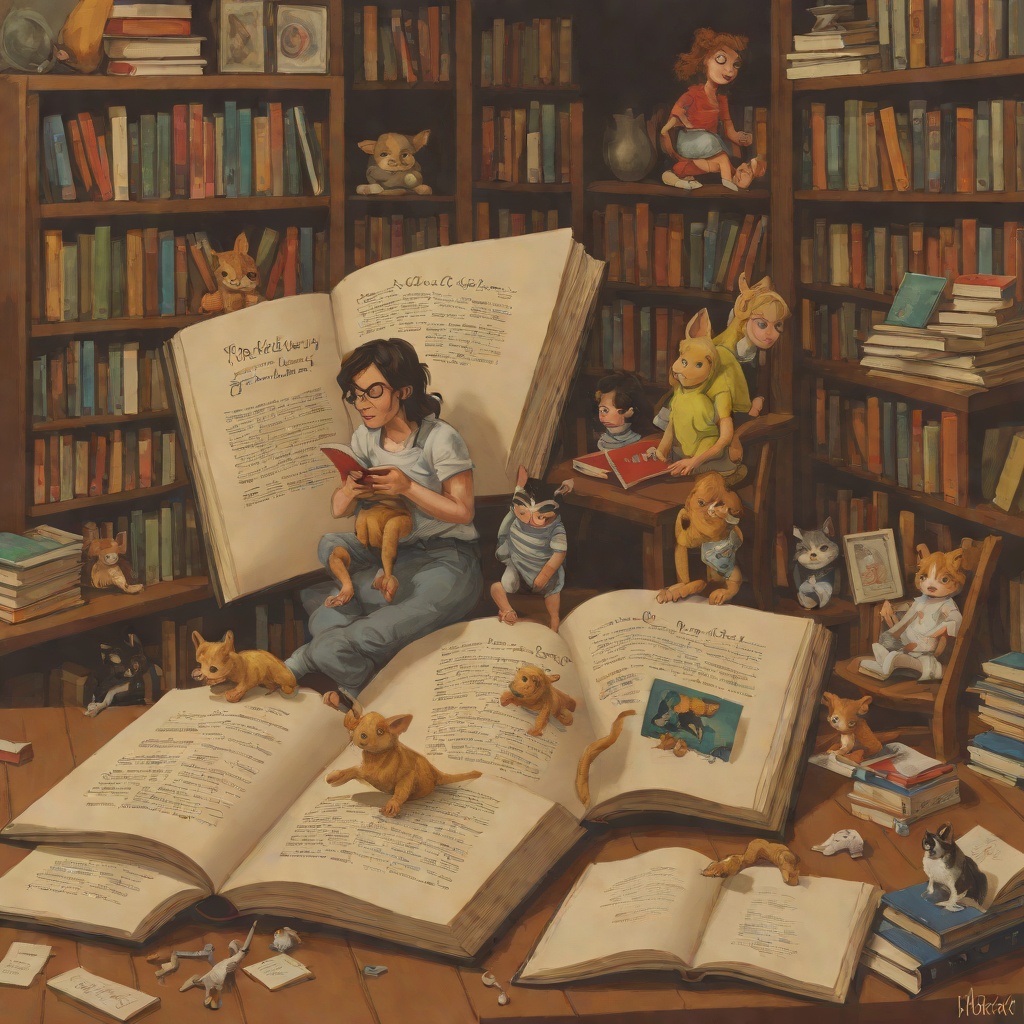
Inside the Library, her search takes a decisive turn. She retrieves one medical text about cysts, in particular those called dermoid cysts, which contained within them on rare occasions hair, teeth, eyes. She wants to see every abhorrent thing a body could grow, and imagines teeth popping from the cyst on her back as if produced by assembly line, one by one in steady succession. But the other book she finds is the one that matters. Searching the stacks in haste, for the boy is melting down on the second floor right at the place in the Dewey decimal system where one finds Folklore and such, in the 350-to-412 aisle, she locates the tattered spine of a volume at 398.3 WHI. The boy wails GooooooooOOOO! as she grabs it, her back aching as she peels him off the floor and totes him down the stairs to the toy trains in one corner of the children's room. From her seat, as her son toots and chugs, now happy, she sees the dreaded Book Babies happening in the little activity room. The book she has retrieved is the folkloric text that will give her condition a name and a lineage, connecting her transformation to a tradition of magical women rather than to pathology. The Library, which she entered seeking medical reassurance, instead hands her the mythic frame that will define her new identity.
The Problem of the Mothers
The Library is also where her discomfort with other mothers becomes concrete. She does not enjoy the company of moms, she reflects; if she happened to meet an interesting, hilarious, beautiful, sharp woman with whom she hit it off and then discovered this woman was a mother, that was fine, more than fine, even wonderful, a woman she could bitch with about kids, a woman who didn't mind getting a little tipsy on rosé on a Tuesday afternoon. But to begin a friendship merely because of shared motherhood she finds repugnant. Being in a room full of mothers and their wards is most dispiriting, each woman clutching her crumpled plastic baggies of snacks, on the way to sniff a diaper to check if the child needed a change, or wielding a tissue like a weapon as she stalked a child to wipe its nose. This aversion sets the stage for her later, more fraught encounters with the other mothers at the Library's Book Babies sessions.
The Performance of Normalcy
After her first night of romping through the neighborhood, shitting and killing and howling, Nightbitch must rise just days later to take her child to something as quotidian as story time at the public Library. She wonders how she is doing this, examining her hands on the steering wheel, the only physical remnant of her transformation a dark swath of skin on her forearm, a birthmark of sorts, which she has an urge to lick but resists. Though much of her fur is now gone, the tail lying somewhere in the underbrush, her claws receded back into her fingers, she still feels very much the pulse and pant of the animal she has become. Her sense of smell distracts her that morning, causing her to clean more and more obscure corners of the kitchen in an effort to get rid of every last trace of mold and onion and meat. She longs to tend to her son the way she feels she should, licking him and biting at his feet lovingly, yowling as they played, and feeding him raw meat. Yet she is also inside her full human-mother being, back to the usual worries and insecurities, the thoughts of career success, the burden of failure, the marital resentments, feminist rage. All of this is back, yet somehow transformed; she feels she can abide it as long as she still has Nightbitch. At Book Babies, mothers and children crowd into the Library's back room, where a chirpy librarian shows them books and puppets and sings songs, after which toddlers crawl and walk and teem over one another, a squirming mass of fists and baggy diapers and too-big heads. Sure enough, there are Jen and Babs and Poppy, engaged in their usual happy, animated conversation. Nightbitch sits in the only open space still available on the floor, closer to Jen than she would like, for she is not sure what to say or how to be. She nods formally, awkwardly, when she catches Jen's eye, then flushes red. She wonders how preposterous it is even to entertain that these women had visited her house, ripped her clothes from her body, then left behind a pile of dead vermin for her enjoyment. She is just going to sit there and participate and be a normal mom, she tells herself. That is it.
The Library as Threshold
The Library thus holds a double significance in Nightbitch's story. It is the place where her rational mind, desperate for a medical explanation for the coarse black hair sprouting from the base of her neck, is instead redirected toward folklore and myth, the 398.3 WHI shelf marking the exact point where her condition ceases to be a pathology and becomes a tradition. It is also the place where she must most strenuously perform the ordinary motherhood she is secretly abandoning, sitting cross-legged among the very mothers whose company she finds repugnant while concealing the animal transformation that has remade her. The Library is neither fully refuge nor fully prison; it is the civic space where the human and the animal, the rational and the mythic, the private and the social all intersect, and where Nightbitch must hold all these contradictions together in a single, flushed, awkward sitting on the floor.