The Schedule
NightbitchThe Schedule is the name given to the rigid, self-imposed routine that Nightbitch adopts in a desperate attempt to manage the overwhelming chaos of stay-at-home motherhood. It is both a practical tool and a psychological prison, a structure she builds to impose order on her days even as it systematically drains the life and thought from her. The Schedule is the novel's central emblem of the domestic trap, the mundane machinery of childcare that grinds down her ambitions and her sense of self, and it is against this relentless clockwork that her feral transformation into a dog must be understood. It is the very antithesis of the instinctual, untamed existence she eventually embraces, making her rebellion not just against her husband or society, but against the tyranny of the timetable itself.
Origins and the Choice of Happiness
The Schedule is born not from a place of calm organization but from a moment of profound crisis and capitulation. After Nightbitch tells her husband she thinks she is turning into a dog, he laughs, and his only response is to suggest she "get on top of your week" and "draw up a schedule," telling her that "Happiness is a choice." Though she wants to slap him, she tries to take his advice to heart, convincing herself that he only wants what is best for her. And so, on a Monday, with her husband gone again for work, she resolves to choose happiness. She is determined to stop her obsessing, to halt the daydreams about turning into a dog (even as the coarse patch of hair on her neck lengthens and spreads), and to suppress the worst-case scenarios and hypochondria. She makes a weekly schedule and meal-plans, believing that if she can just structure her time, she can beautifully merge motherhood and art and find the happiness she is supposed to feel. This act of self-discipline is a direct response to her husband's dismissal of her fears, a performative submission to the idea that her unhappiness is a personal failing rather than a systemic one.
The Tyranny of Routine and the Grinding Down of Self
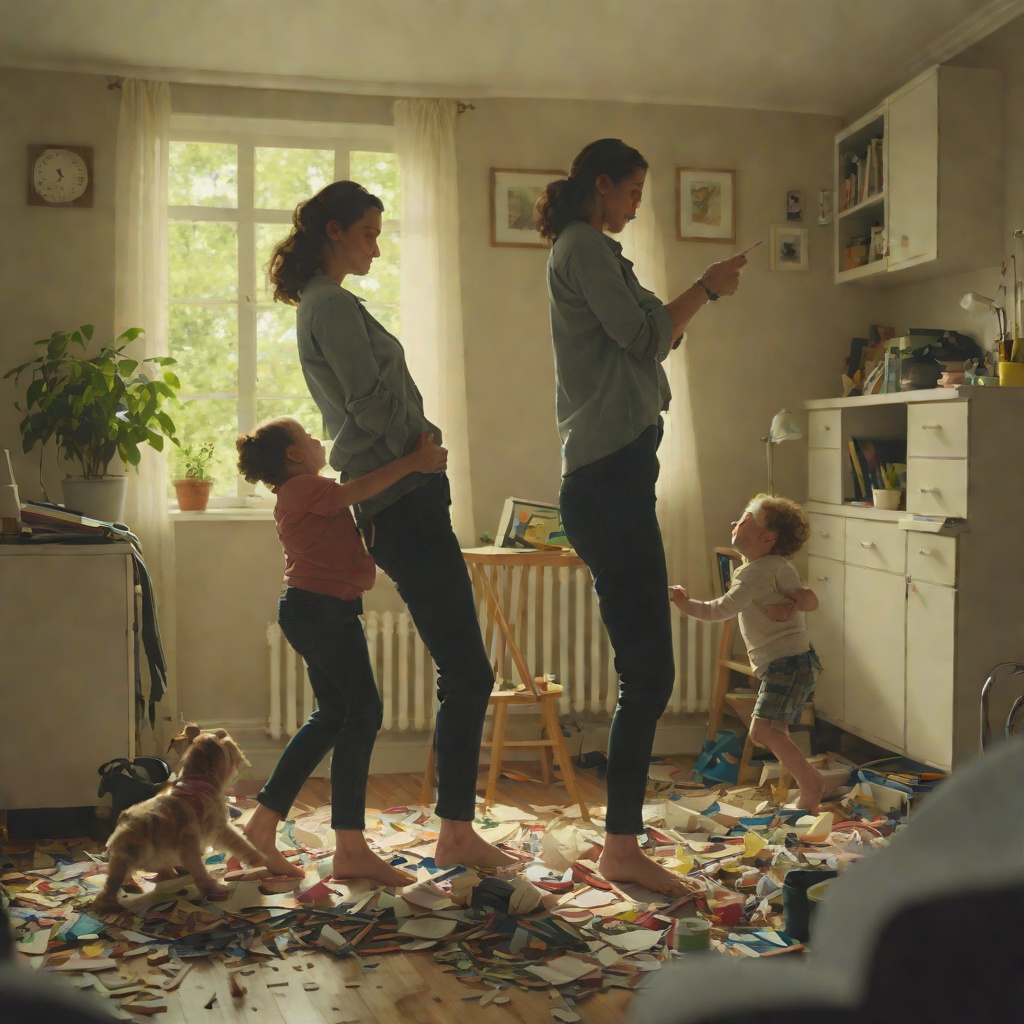
The Schedule, once implemented, becomes the very engine of her misery. It is a relentless sequence of obligations: time for breakfast, time for a walk, time for lunch, time for nap, time for snack, time for pooping, time for dinner. This endless cycle of "this and then that and then this again" empties every thought from her head, leaving only physical sensations of exhaustion, a pain in her lower back, greasy hair, and a bloated feeling from eating too many fish-shaped, sodium-laden crackers. The monotony is mind-numbing, and her mental activity slows the moment she wakes each morning, beginning with high hopes of art projects and energy, only to be ground down to rote considerations of what to eat and what to clean. She speaks in toddler talk and constantly asks questions about poop, her intellect and identity dissolving into the repetitive demands of the day. The Schedule is not a framework for a fulfilling life but a slow agony, a daily ritual of self-erasure that reduces her to a function rather than a person.
The Schedule as a Symbol of Systemic Oppression
The Schedule is not merely a personal failure but a manifestation of the larger societal forces that Nightbitch comes to see as a conspiracy designed to put a woman in her place. Her sense that society, adulthood, marriage, and motherhood are "masterfully designed" to keep a woman down takes on a new, unwieldy heft after her son arrives and grows even heavier after she quits her job. Stripped of her career, her comely figure, her ambition, and her familiar hormones, the anti-feminist conspiracy seems not only plausible but nearly inevitable. The Schedule is the daily instrument of this conspiracy, the tool that keeps her trapped in the grocery store, in the kitchen, in the endless loop of chores. Even when she tries to escape this thinking through positive thought and the choice of happiness, she spirals into an even worse mood, because the Schedule itself is the trap. It is the concrete, hourly expression of the societal expectation that she be less of an animal in order to be happy, that she pull herself together and stop being embarrassing.
The Schedule's Persistence and the Failure of Control
The Schedule persists as the backdrop of her life even as her transformation accelerates, a stubborn remnant of her human attempts at control. The week passes as weeks do, with The Schedule, the doggy games, and then the mundane chores of groceries, dishes, dinner, and bath time. By Friday, she is bone-tired, tired down to her bones and then inside them. The Schedule does not protect her from her growing urges; it merely contains them within its rigid framework. She awakens one morning with the urge to run through a tall meadow and battle with a groundhog, and so takes a double dose of Calm Now, a herbal supplement, to suppress the impulse. But the Schedule's demands continue regardless: the boy wants her to pull him in a wagon endlessly, to watch him ride his pedal-less bike around and around the cul-de-sac. The circular route of his bike, the dappled butterfly shadows on the sidewalk, and the double dose of Calm Now combine to drain her life force completely, and she lies down in the grass and falls asleep, only to be woken by the boy yelling "MAMA!" inches from her face. The Schedule has not saved her; it has merely exhausted her, leaving her vulnerable to the very transformation she was trying to suppress.
The Schedule's Antithesis: The Wild and the Instinctual
The Schedule's ultimate significance lies in its opposition to the life Nightbitch eventually embraces. It represents everything that is structured, controlled, and civilized, the very forces that demand she be less of an animal. Her transformation into a dog is a rejection of the Schedule's tyranny, a return to instinct, to the body, to the wild. The Schedule is the clockwork of human society, while her new life is governed by the moon, by hunger, by the pack. The novel's critique of motherhood is thus articulated through this stark contrast: the Schedule is the cage, and her dog-self is the escape. The Schedule is not just a routine; it is the embodiment of the patriarchal demand for order and self-sacrifice, and her feral rebellion is the only possible response to its crushing weight. In the end, the Schedule is revealed as a failed technology of control, a human invention that cannot contain the monstrous, instinctual truth of her being.