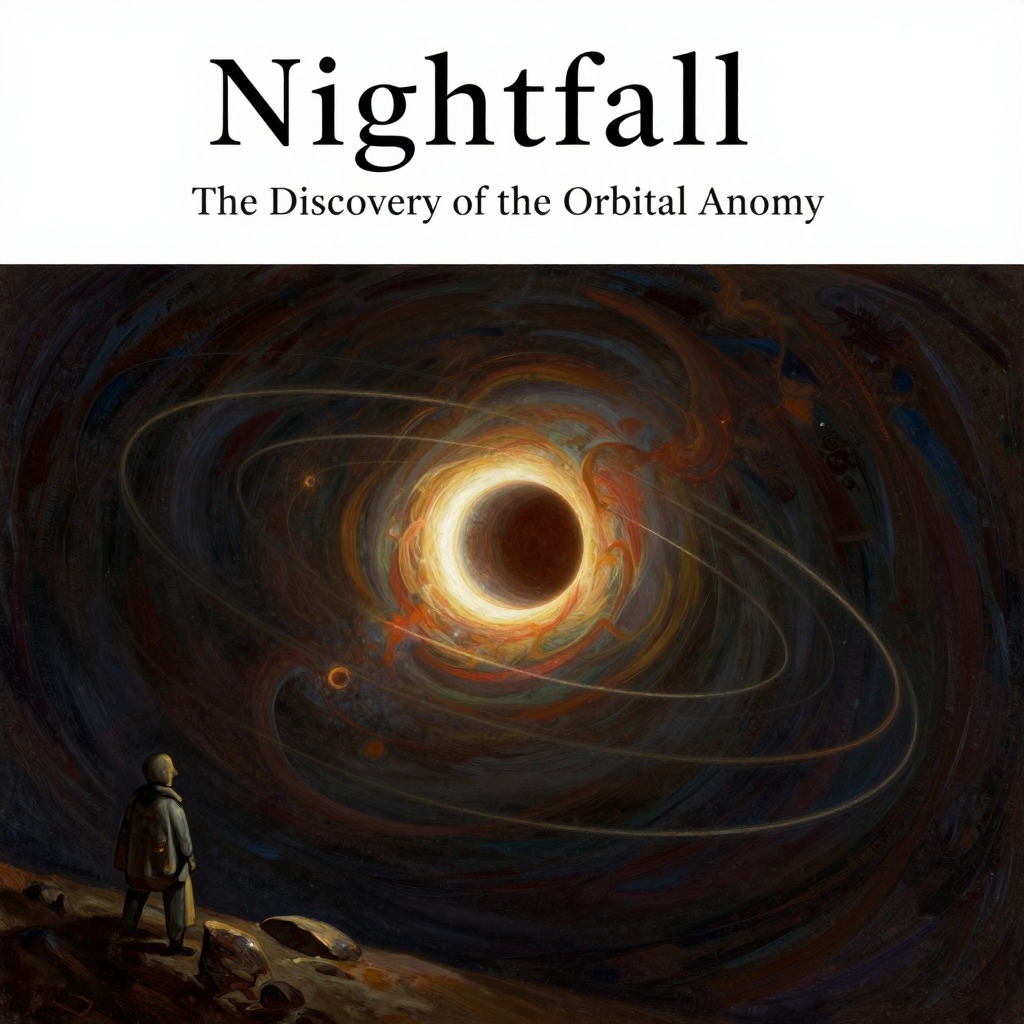
Theory of Universal Gravitation
NightfallThe Theory of Universal Gravitation stands as the supreme intellectual achievement of Kalgash's civilization, a mathematical framework that for a generation had been regarded as an unassailable pillar of cosmic order. Formulated and perfected by Athor 77 some thirty years before the events of the novel, the theory accounts exactly for the orbital motions of Kalgash and all six of its suns according to rational principles of attractive forces. It was Athor's great triumph, the making of his lofty reputation, and it is enshrined in the Saro University Observatory as a sacred artifact of scientific history—a thin sheaf of paper displayed alongside the crude telescopes of pioneers and the gnarled meteorites that fell from the sky. To Beenay 25, the young astronomer who reveres Athor as a mentor and a second father, the Theory of Universal Gravitation is one of the pillars of the cosmos, perhaps the most basic pillar; he cannot imagine what he would do if that pillar were to fall.
Challenge from the Orbital Anomaly
Beenay, using modern computational equipment, had been calculating some aspects of Kalgash's orbit around Onos, its primary sun, when to his horror he observed that his figures did not check out properly in terms of the Theory of Universal Gravitation. The deviation was trivial—a matter of a few decimal places—but that was not trivial at all in the larger sense of things. The theory was so precise that most people preferred to refer to it as the Law of Universal Gravitation. Its mathematical underpinning was considered impeccable. But a theory that purports to explain the movements of the world through space has no room for even small discrepancies. Either it is complete or it is not complete: no middle way was permissible. Beenay went over his figures until he was sick of reworking them, but the result was always the same. He called in two brilliant graduate students, Faro 24 and Yimot 70, and set them to work on the problem without telling them what it was about. They confirmed his findings, producing the same dismaying, shattering, inconceivable, totally unacceptable culminating result. Beenay was aghast, feeling that he had to choose between violating his own scientific conscience and ruining Athor, the man he looked upon not simply as the head of his profession but as his own philosophical mentor.
Athor's Response and the Discovery of Kalgash Two
When Beenay finally brought his findings to Athor, the old astronomer surprised him. Far from being angry at the challenge to his life's work, Athor was furious that Beenay had hesitated to bring him the news. Athor insisted that the Theory of Universal Gravitation itself was not necessarily wrong; what was needed was to rethink their comprehension of the universe and determine whether they were ignoring some mysterious factor exerting gravitational force on Kalgash. Invoking Thargola's Sword—the principle of parsimony that dictates striking the more complex hypothesis—Athor argued that it was simpler to try to find something they may have overlooked than to come up with a new general law governing the movements of heavenly bodies. After days of intense, exhausting work, Athor produced Postulate Eight: a non-luminous planetary body similar to Kalgash, in orbit not around Onos but around Kalgash itself, with a mass nearly the same as that of Kalgash, sufficient to exert a gravitational force that causes the perturbations Beenay had observed. This hypothetical satellite, which they called Kalgash Two, travels around Kalgash on an enormous ellipse that carries it extremely far from the planet for many years at a time, making it invisible due to the eternal blaze of the six suns and the light-scattering properties of the atmosphere.
Consequences and Thematic Significance
The validation of the Theory of Universal Gravitation through the discovery of Kalgash Two had profound and terrifying consequences. Beenay and Faro independently calculated that the orbit of Kalgash Two would bring it into a position to cause a total eclipse of Dovim when Dovim was the only sun visible in the sky, an event that occurs once every two thousand and forty-nine years—the exact length of a Year of Godliness according to the Apostles of Flame. The eclipse would plunge the world into total Darkness for hours, and the psychologist Sheerin 501 predicted that this would cause universal madness, leading people to light fires in a desperate attempt to get light, thereby burning down their own civilization. The theory thus became the linchpin connecting the astronomers' scientific predictions with the apocalyptic prophecies of the Apostles of Flame, and it set the stage for the catastrophic Nightfall that follows. The Theory of Universal Gravitation, once a symbol of cosmic order and human reason, ultimately revealed the terrifying mechanism of the world's periodic destruction, demonstrating that even the most elegant scientific framework can lead to devastating conclusions when the full picture of the universe is finally understood.