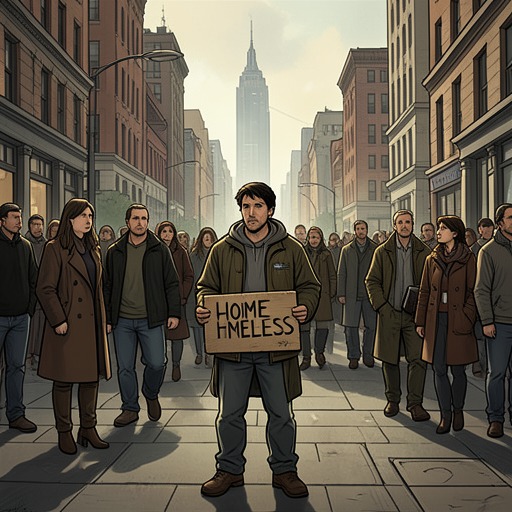
Local ordinances criminalizing homelessness
NomadlandLocal ordinances criminalizing homelessness make everyday acts such as sitting on a sidewalk or sleeping in a car grounds for punishment, narrowing the places where people without conventional housing can safely stop. The book presents these rules not as an isolated urban policy but as part of a wider struggle over who may use streets, parking lots, and public land—and whether a vehicle can count as shelter without making its occupant a target of enforcement.
Scope and growth
A 2016 report by The New York Times described a growing set of laws that effectively criminalized homelessness in cities including Orlando, Santa Cruz, and Manchester. By the end of 2014, 100 cities had made sitting on a sidewalk a crime, a 43 percent increase from 2011, according to a survey of 187 major American cities by the National Law Center on Homelessness and Poverty. During the same period, the number of cities banning sleeping in cars rose from 37 to 81.
The book places that expansion alongside urban gentrification and rising housing costs. As expensive cities such as New York, San Francisco, Los Angeles, Washington, and Honolulu changed, homelessness increased, while rules governing public space made some ordinary means of shelter more precarious. For people who live in vehicles, the distinction between having a place to park and being permitted to remain in it can determine whether a night’s rest is possible.
Streets, vehicles, and parking lots
The laws’ practical force is captured in the book’s account of a rule that allows a car to remain in a place while forbidding its occupant to stay there. This division treats a vehicle as property but its use as shelter as a violation, placing the needs of housed passersby and property owners ahead of those who have nowhere else to sleep. The book argues that this prioritization has received little public debate.
Parking lots reveal how permission can be conditional even where overnight stays are ordinarily tolerated. Walmart has long allowed RV travelers to stay overnight at many stores, though the policy is not universal: some cities prohibit the practice, and some stores have withdrawn permission after visitors overstayed or established encampments. After a March 2015 confrontation at a Walmart Supercenter in Cottonwood, Arizona, involving police and an eight-member family of Christian musicians living in a Chevrolet Suburban, one traveler died; the store then began removing overnight visitors. The episode illustrates how fragile a tolerated parking arrangement can be, although the evidence does not attribute the confrontation to a particular ordinance.
The AllStays Walmart Overnight Parking Locator maps stores in the United States and Canada, marking some red, where travelers may be moved along or towed, and most yellow, with user reports about individual locations. The app turns an uneven patchwork of permission and restriction into information travelers need to consult before stopping. Its color-coded map makes visible a basic condition of vehicle living: access to shelter may depend on local rules and the enforcement practices of a particular lot.
Public land and limits on staying
Restrictions also reach beyond city streets and commercial parking. In Arizona’s Coconino National Forest, rangers have questioned people camping in vans and RVs about their home addresses. Campers judged to be making residential use of the forest can be ticketed and evicted; a vehicle sticker showing that its owner has camped in Quartzsite may be treated as evidence of permanent nomadism. The book also reports that the Forest Service was developing a smartphone app through which members of the public could report suspected long-term campsites.
The contrast with federal desert camping near Quartzsite shows that access is regulated even where camping is expressly allowed. Under the Bureau of Land Management’s rules, visitors may camp free for up to two weeks before moving at least twenty-five miles to another patch of federal land, or paying to stay in the La Posa Long Term Visitor Area. These limits are not themselves the same as city ordinances criminalizing homelessness, but they shape how long nomads can remain in one place and where they must go next.
Mobility, identity, and the cost of exclusion
People living nomadically must keep moving through a landscape of changing permissions, yet the law also requires them to maintain a fixed official domicile for responsibilities such as vehicle registration, licensing, taxes, and voting. That mismatch makes mobile residents administratively legible through an address while their actual shelter remains dispersed among parking spaces, campsites, and roadside stopping places. Seasonal travelers may pull into Walmart lots, truck stops, or quiet suburban streets, then leave again before their presence attracts notice.
The pressure is also social. Many vehicle dwellers call themselves houseless rather than homeless, emphasizing that they have shelter and transportation even when they lack a conventional home. Yet LaVonne Ellis’s account of city life in a van records how being perceived as homeless can alter a person’s own sense of identity and lead to efforts to appear normal while hiding in plain sight. In this context, criminalizing rules do more than regulate where someone may sleep: alongside stigma and surveillance, they make continued mobility a practical necessity and turn the search for a place to stop into a recurring negotiation.