Gaza Strip
OsloThe Gaza Strip is both a lived landscape and a contested political question in the play: its crowded streets expose the human cost of the conflict, while proposals over its control become a test of whether secret negotiations can turn contact into agreement. The play returns to Gaza as a place whose inhabitants face severe material constraints and whose future is argued over by people negotiating elsewhere.
Geography and Living Conditions
Mona Juul describes the Gaza Strip as a narrow band of land along the Mediterranean, physically cut off from the West Bank by Israel. The play gives that geography a stark human scale: about a million Palestinians live in an area twenty-five miles long and only a few miles wide, most without regular electricity or water. Its population is described as growing within boundaries that leave little room for expansion. The account makes physical confinement more than a map detail; it shapes the conditions under which daily life and political conflict unfold.
The play also registers how unfamiliar the landscape is to the Norwegian visitors. Terje Rød-Larsen imagines conducting a proper survey of living conditions, while Mona’s description emphasizes the limits of what such observation can capture. The contrast places the visitors’ impulse to study the place beside the density and urgency of the lives already there.
Encounter Amid Violence
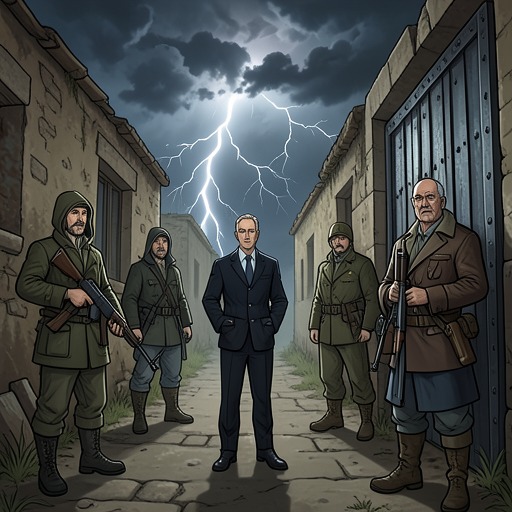
In a back alley in Gaza, Mona and Terje Rød-Larsen encounter a scene of public violence. Palestinian voices call for Israel’s death and for Yasser Arafat’s return; Mona recalls crouching with Terje behind an overturned car as people fall. Amid the danger, they see two boys facing one another with weapons: one in uniform, the other in jeans. Their faces appear identical in fear and in their wish not to be there, or to harm the other boy.
For Mona, that recognition marks the beginning of something. The scene does not erase the boys’ opposing positions or the weapons between them. Instead, it makes their shared fear visible within the confrontation. Gaza thus becomes the setting for the play’s most concentrated image of common humanity across enemy lines: not a resolution of conflict, but a recognition that can alter how the people witnessing it understand the conflict and their own work.
Territory in the Negotiations
The Gaza Strip also gives the secret negotiations a concrete territorial stake. Terje Rød-Larsen proposes a second channel built not around grand declarations between governments but around intimate discussions between people, in an isolated place where Israeli representatives and the Palestine Liberation Organization can meet. That channel is a negotiating method, not a meeting held in Gaza; Gaza is among the questions the participants must address.
The question becomes explicit when Yair Hirschfeld tells Rød-Larsen that the Palestinians propose an Israeli withdrawal from Gaza and Palestinian self-government there. Hirschfeld sees the proposal as a possible end to the First Intifada and notes that Shimon Peres had long offered withdrawal, which the Palestinians had previously rejected. But when Ahmed Qurie and Hassan Asfour examine the draft Declaration of Principles, Qurie asks where the direct reply is to their concrete offer to take control of Gaza. He objects that the Israeli draft supplies eloquent generalities rather than a specific response. The exchange distinguishes a broad framework from an answer to the actual territorial proposal.
Later, Uri Savir says Israel is willing to relinquish control of Gaza, while Qurie insists that this must be paired with relinquishing control of Jericho. The issue is therefore negotiated as part of an exchange, not as an isolated concession. During a walk on the estate grounds, Savir says that he and Peres want the process to work; Qurie answers that Yasser Arafat and he want it to work as well. They then agree that the Palestinians will drop their demand for third-party international arbitration over outstanding disputes, while the Israelis agree to negotiate turning over Gaza and Jericho. Their understanding is provisional: Savir says each will return home with a deliberately antagonistic account, and that Terje Rød-Larsen will call two days later with agreement to the demands.
Shared Space and Unfinished Consequences
The play contrasts the closed room where participants argue with the space outside it, where Terje Rød-Larsen asks them to share meals, talk about family, and light the fire. His rule is meant to make personal contact possible despite disagreement. That practice echoes the earlier image from Gaza: recognition of a person across a divide may support negotiation, but it does not itself settle questions of territory, security, or political authority.
The later account returns to Gaza through the violence of September 2000. Seven years after the Accords were signed, violence erupts again in the Occupied Territories. In Gaza, Hassan Asfour is beaten almost to death in the hallway of his apartment building; his attackers are never found, and he retires from public life. The episode does not establish that the earlier negotiations caused this attack. Rather, it places the human cost of renewed conflict beside the history of attempted agreement, leaving Gaza as both a proposed site of political change and a place where violence remains present.