168-hour archaeological research clause
OzymandiasThe 168-hour archaeological research clause is the expedition charter’s minimum research period: it gives Dr. Leopold the right to investigate a landed-on world for at least one hundred sixty-eight hours, or one week, despite Colonel Mattern’s demand for an immediate departure. The clause temporarily protects archaeological work from military impatience, but its reach has limits. Once Ozymandias is classified as a source of weapons intelligence, Mattern invokes emergency authority to end the expedition and take the robot to Earth. The rule secures time for inquiry; it does not secure the discoveries inquiry produces.
Origin and Purpose
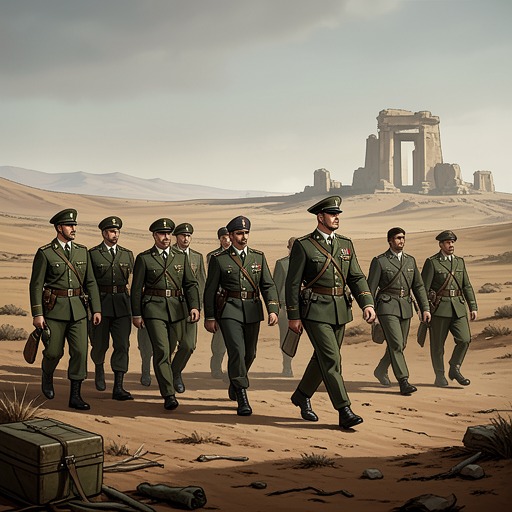
The clause operates within a mission whose competing purposes are built into its organization. The General Staff of the Armed Forces of the United States of America supplied seventy percent of the budget and expected practical results: weapons and strategic materials. Dr. Leopold led the non-military segment, tasked with archaeological research into dead civilizations, while Colonel Mattern and his military personnel searched for fissionable material, alien weapons, lithium, tritium, and other resources of strategic use.
That imbalance made the research period a formal safeguard rather than a sign that the expedition’s priorities were evenly shared. Military personnel outnumbered the archaeologists, and the crew knew that discoveries of military value were meant to be found before the Other Hemisphere could reach them. The charter’s minimum interval ensured that a world could not simply be abandoned as soon as its immediate usefulness to the military seemed doubtful.
The safeguard also reflected a political compromise. The expedition’s charter expressly set out the period for on-site research, while the military’s Public Liaison branch had ensured that the scientific team retained some rights despite the military’s dominant contribution. Archaeologists were included partly because public opinion frowned on purely military expeditions. Their presence—and the time reserved for their work—gave the mission a recognized scientific purpose, though that purpose remained vulnerable to security claims.
Invocation on the Dead Planet
When the expedition orbited down to a sere, brown world, its first impression was that the planet had been dead for about a million years. Colonel Mattern saw no useful target for his team and urged the crew to pack up. Dr. Leopold answered that he would apply the limiting clause: since they had landed, he would insist on spending the minimum time allotted for scientific research.
Mattern objected that the ancient world had no strategic consequence and that even its remaining signs of civilization had turned to dust. Leopold’s response was not a claim that the site already promised a significant find; it was an insistence on the agreed procedure. The crew had reached the world, and the charter gave him the right to explore it for at least 168 hours.
Mattern accused Leopold of prolonging the stop to spite him or demonstrate the intellectual superiority of scientists. Leopold rejected the personal framing. Mattern protested, then conceded that Leopold was within his rights to remain for one week, warning that the expedition had better be ready to leave as soon as the time expired. The concession acknowledged the clause’s force while making clear that Mattern still expected departure at the first permitted moment.
What the Protected Time Makes Possible
The week first appears to vindicate Mattern’s impatience. The archaeologists dug through the ground and found no artifacts, skulls, teeth, or household objects. Foundations survived as weathered stumps, but the million years of sand, wind, and rain had erased almost everything else. Those remains could establish that a civilization had existed, not reconstruct its laws, technology, or philosophy.
The decisive change comes when the crew discovers an intact robot amid the ruins. At first, its alien speech cannot be understood; Dr. Leopold suspects it was built as a guide for visitors and outlasted both its makers and their monuments. Dr. Anderson recognizes the irony in a machine left to proclaim the glories of a vanished people, and names it Ozymandias. The discovery transforms the barren site into an extraordinary archaeological record—but it also exposes the limits of the clause’s protection.
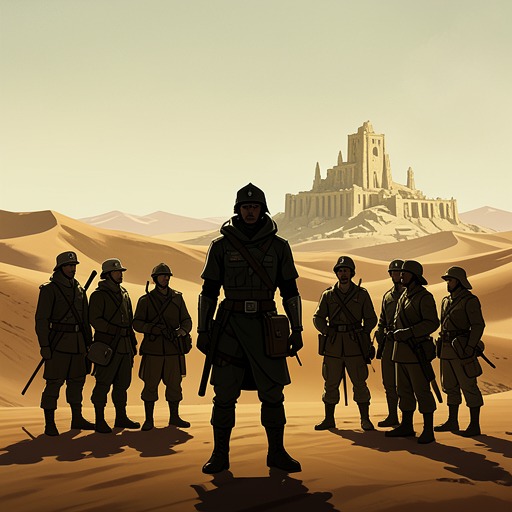
Over the ensuing period, Ozymandias learns enough English to converse with the crew and guide them through the remains of his civilization. He identifies his people as the Thaiquens and recounts a culture that had flourished for three hundred thousand years. His stored memories include the city of Durab, once home to eight million people; its Temple of Decamon, sixteen hundred feet high; the Eleventh Dynasty; and a library that held fourteen million volumes. The books themselves are gone, but Ozymandias says he read them and retains their contents in memory. The scientific team’s allotted time has brought it from bare foundations to an archive of a lost civilization.
Limits and Consequences
The clause gives Dr. Leopold time to investigate, not authority over the expedition’s final decisions or ownership of what the crew finds. Colonel Mattern later declares Ozymandias a military asset because the robot knows the Thaiquen weapons. He says that the team has already learned about weapons of immense scope and argues that a superweapon explains why the planet has no surviving life—not even grass. This explanation is Mattern’s conclusion from the discovery, not a finding established by the clause itself.
Mattern places Ozymandias in sealed quarters aboard the ship, invokes the emergency power entrusted to him, declares the expedition ended, and orders an immediate return to Earth. Dr. Leopold cannot stop him. The contrast with the earlier dispute is pointed: the charter could compel Mattern to tolerate one week of archaeology, but military emergency authority could override the expedition’s continuing scientific work once the archaeological discovery became a possible strategic resource.
The rule therefore shapes both the expedition’s procedure and its central conflict. It prevents the military commander from dismissing a world before the agreed research period has run, giving the archaeologists time to encounter evidence that a hurried survey would have missed. Yet it does not protect that evidence from being reclassified, sealed away, or carried off for military purposes. The one-week guarantee opens the door to knowledge; it leaves control of that knowledge contested.