The expedition’s first orbit of Planet Four
The Dead World
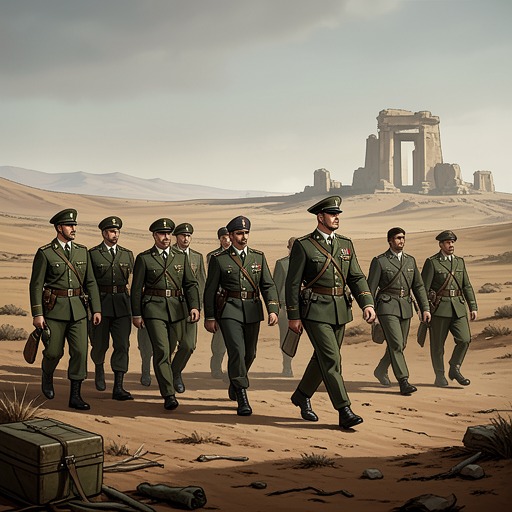
When the expedition descended over the fourth planet, the members saw a dry, brownish planet, as if it had been dead for about a million years. This planet once nurtured a civilization, but its cities and the traces of almost all its inhabitants had been erased by time and natural forces
During the first discussion after landing
Mattern Demands Departure
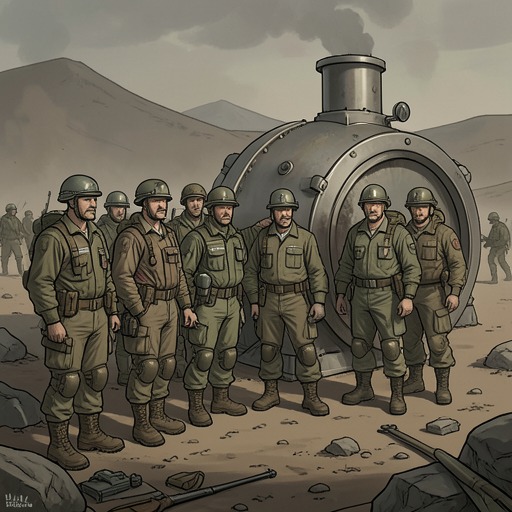
Colonel Matten believed the fourth planet had no strategic value and urged the expedition to depart for a more promising planet. His employer, the United States General Staff, expected military discoveries rather than archaeological research
At the end of the landing-day dispute
A Week Secured
Although annoyed by the delay, [Colonel Mattern](entity:character-recall-character-colonel-mattern-b52ee8ec8bd2) admitted that [Dr. Leopold](entity:character-recall-character-dr-leopold-77b2dbb511db) had the right to allow the expedition to stay on this planet for a week according to the regulations. Mattern clearly stated that once the prescribed time had passed, the scientists should be ready to leave
Before the first field survey
The Expedition’s Divided Purpose
The expedition was ordered to investigate a planet that had already been surveyed in search of signs of life. Military personnel searched for fissionable materials, fusion materials, and abandoned weapons; [Dr. Leopold](entity:character-recall-character-dr-leopold-77b2dbb511db)'s archaeologists were responsible for studying civilizations that had already vanished long before the expedition arrived. The
Before the teams set out
The Nameless Planet
this planet has no official name. the expedition refers to it by its astronomical designation: the fourth planet in a galaxy orbiting a hot type 5 subgiant star; while a nominal united nations organization is discussing borrowing a name from ancient earth mythology
The first morning of archaeological work
Field Teams Depart
Five archaeologists divided into three small teams, driving into the dunes with half-track vehicles, excavation tools, cameras, and recording equipment. [Dr. Leopold](entity:character-recall-character-dr-leopold-77b2dbb511db) headed west toward a dry riverbed; Marshall and Webster went southeast to the buried hills; [Anderson](entity:character-recall-character-anderson-48f9ba8e7f7e) and Gerhart headed north to search for
During the first drive into the desert
Gerhardt Fears Abandonment
[Anderson](entity:character-recall-character-anderson-48f9ba8e7f7e) and Gerhart crossed the empty desert, Gerhart expressing his doubts: Major Matern might take the ship and leave the archaeologists here. He pointed out that Matern despised their work and had decided to keep military personnel at the base. Anderson dismissed this, believing Matern would not abandon
Later on the first day in the field
A City Beneath the Sand
After driving through a desolate area of about thirty miles, [Anderson](entity:character-recall-character-anderson-48f9ba8e7f7e) and Gerhart arrived at a large linear city ruins. The buildings were all buried under sand, with only weathered foundations and scattered fragments of building materials on the ground. They dug for several hours, moving large amounts of soil, but
During the first day’s excavation
Shelley in the Sands
After another unsuccessful excavation, [Anderson](entity:character-recall-character-anderson-48f9ba8e7f7e) whispered a line from Shelley's poem, describing a lonely, flat desert stretching into the distance. Gerhart asked him what it meant, then continued working without delving into the literary reference
Late on the first day in the field
The Other Teams Find Nothing
As the sky grew darker, [Anderson](entity:character-recall-character-anderson-48f9ba8e7f7e) and Gerhart began driving back to the base, having taken only pictures of the foundation and almost nothing else. The long day of this planet was about to end, and the desolate landscape along the way made them doubtful about finding better discoveries on the return trip
At dusk on the first day
Leopold’s Mysterious Find
[Dr. Leopold](entity:character-recall-character-dr-leopold-77b2dbb511db) announced via radio that he had discovered something too heavy to handle alone, and ordered other squads to rush to his coordinates. He would not reveal what it was, always keeping the secret until the vehicles converged in the darkness
At dusk on the first day
The Buried Robot
At the discovery site of Leopold, [Anderson](entity:character-recall-character-anderson-48f9ba8e7f7e) and others saw a tall rusted metal figure, with its knees buried in the sand. Its face was replaced by a receiver plate, although worn by time, the body still looked extremely solid. When Leopold spoke to it, the machine answered
Immediately after the discovery
The Robot’s Ancient Tour
The robot turned around, gesturing toward the surrounding scenery while speaking, as if introducing to visitors a once-great memorial building that no longer exists. Archaeologists inferred that it was originally designed as a guide for the vanished city; even though the entire city has become ruins, it continues to give tours
At the robot’s discovery site, first evening
The Ozymandias Name
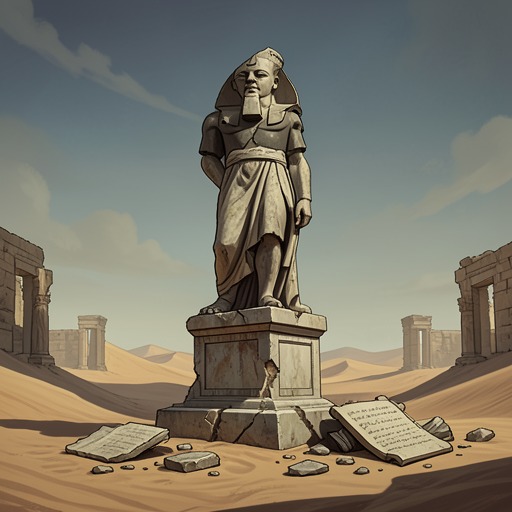
[Anderson](entity:character-recall-character-anderson-48f9ba8e7f7e) proposed naming the robot [Ozymandias](entity:character-recall-character-ozymandias-423d26bd0a81), as in his view, it resembled a guide left behind, proclaiming the greatness of the creator even after the city had vanished. Webster then added to this allusion, recalling the lines that spoke of nothing remaining but broken ruins. This name both conveyed
The first evening after the discovery
Leopold Hides the Find
When archaeologists discussed whether to move the machine weighing several hundred pounds, Leopold decided to leave it in place. He wanted to keep it as a surprise for Colonel Matern; that whole day, Matern had been belittling their work, considering it useless. Gerhart was worried the
That night
Silence at the Base
[Dr. Leopold](entity:character-recall-character-dr-leopold-77b2dbb511db) ordered the archaeologists not to tell [Colonel Mattern](entity:character-recall-character-colonel-mattern-b52ee8ec8bd2) about [Ozymandias](entity:character-recall-character-ozymandias-423d26bd0a81). When the military men asked what the scientists had found, the group reported that the day had yielded almost nothing—a claim that was largely true of everything except the robot.
Mattern’s men took the report as confirmation that the stop had been wasted. The archaeologists’ excitement was difficult to conceal, however, and their evasiveness about where they had worked gave Mattern reason to suspect that they were hiding something.
The morning after the first field day
Mattern Begins Prospecting
[Colonel Mattern](entity:character-recall-character-colonel-mattern-b52ee8ec8bd2) announced that his men would take one halftrack to search for fusion materials, leaving two vehicles for the archaeologists. [Dr. Leopold](entity:character-recall-character-dr-leopold-77b2dbb511db) accepted the arrangement but refused to identify the area the scientists planned to investigate.
Mattern noticed the concealment but presented his own search as a sensible use of the time remaining. Though he believed radioactive materials had long since decayed, he was still interested in possibilities such as lithium, showing that military priorities could persist even on a world that seemed barren.
The second morning in the field
Return to the Robot
The archaeologists returned to the place where they had left [Ozymandias](entity:character-recall-character-ozymandias-423d26bd0a81). In the morning light, with the wind stirring sand around it, the machine stood exactly where they had found it, its battered metal body glowing against the rising sun.
Webster filmed the robot as the group approached. They expected to resume the previous evening’s attempt to communicate, but the next words they heard were in English.
The second morning, after the group’s return
Ozymandias Learns English
[Ozymandias](entity:character-recall-character-ozymandias-423d26bd0a81) greeted the archaeologists in halting English and explained that it had deciphered their language. It had listened to them the night before, organized the sounds, and begun to connect words with concepts; now it asked them to talk more so it could expand its vocabulary.
The group quickly realized that the robot was not merely repeating isolated phrases. It was learning to communicate, turning itself into a living archive accessible to human researchers. The discovery made it possible to question the machine directly about the world that had built it.
During the next two hours
A Conversation Takes Shape
For two hours, the archaeologists supplied [Ozymandias](entity:character-recall-character-ozymandias-423d26bd0a81) with words and explanations, helping it relate new terms to the sounds it had already absorbed. Its English grew quickly enough for it to hold a passable conversation with them.
Ozymandias then pulled its legs free from the sand that had held it for centuries. It began to move under its own power, ready to perform the guiding role for which it had been built and to lead the explorers through the civilization that had made it.
During the second day’s tour
The Thaiquen Archive
[Ozymandias](entity:character-recall-character-ozymandias-423d26bd0a81) identified its makers as the [Thaiquens](entity:character-recall-character-thaiquens-3ad70c3dbc95) and said that they had lived and prospered for three hundred thousand years. In their declining era, they had constructed it as an indestructible guide for their supposedly indestructible cities.
Those cities had nevertheless crumbled, leaving Ozymandias alone with memories of their existence. The machine’s durability turned it into an extraordinary archaeological source, while its account of the Thaiquens’ vanished world gave the barren landscape a history the exposed foundations could not provide.
During Ozymandias’s tour, second day
The City of Durab
[Ozymandias](entity:character-recall-character-ozymandias-423d26bd0a81) described Durab as a city that had once held eight million people. It identified the place where the group stood as the site of the Temple of Decamon, which had risen sixteen hundred feet above the Street of the Winds.
The account transformed the dunes from a blank expanse into a cityscape in the archaeologists’ minds. The robot could name buildings and describe their former scale even when no visible structure remained, making its recollections more valuable than the physical ruins the expedition had first searched.
During Ozymandias’s historical narration
The Eleventh Dynasty
[Ozymandias](entity:character-recall-character-ozymandias-423d26bd0a81) recounted that the [Eleventh Dynasty](entity:time-recall-time-eleventh-dynasty-ecffdb9b777a) began with the accession of Chonnigar IV to the Presidium, in the eighteenth thousandth year of the city. It was during this dynasty, the robot said, that the [Thaiquens](entity:character-recall-character-thaiquens-3ad70c3dbc95) first reached neighboring planets.
The detail revealed a society with long political records and the technological capacity for interplanetary travel. Its history was not merely a tale of lost monuments: Ozymandias preserved the chronology of a civilization that had once expanded beyond its home world.
During Ozymandias’s tour, second day
The Lost Library
[Ozymandias](entity:character-recall-character-ozymandias-423d26bd0a81) pointed out the former site of Durab’s library, which had contained fourteen million volumes. It said that none of those books survived, but that after the builders were gone it had spent time reading them and retained their contents in its own memory.
The robot thus held not only a guide’s knowledge of streets and monuments but a vast record of the [Thaiquens](entity:character-recall-character-thaiquens-3ad70c3dbc95)’ written culture. Its survival offered the archaeologists a chance to recover information that the world’s weather and the disappearance of its people had otherwise erased.
During Ozymandias’s historical narration
The Plague Record
Among the episodes [Ozymandias](entity:character-recall-character-ozymandias-423d26bd0a81) recalled was a plague that killed nine thousand people a day for more than a year. Its account placed catastrophe within a history extending across many millennia, alongside dynasties, cities, and cultural achievements.
The brief but devastating detail showed the breadth of the robot’s stored memories. The [Thaiquens](entity:character-recall-character-thaiquens-3ad70c3dbc95)’ past was not a simple catalogue of triumphs; Ozymandias preserved the disasters as well as the accomplishments of the society that had made it.
At the end of the second day’s tour
A Civilization Recovered
[Ozymandias](entity:character-recall-character-ozymandias-423d26bd0a81) continued its narration as the archaeologists followed it across the desert, recording its words. It supplied details about the [Thaiquens](entity:character-recall-character-thaiquens-3ad70c3dbc95)’ cities, political history, library, and calamities, expanding its explanations as it absorbed more of the explorers’ language.
The group understood that a single machine contained more knowledge than years of conventional excavation could uncover. They returned to base overwhelmed by the scale of the find and eager to spend years studying the archive, unaware that the military team had also learned of the robot.
During the night after the robot’s English breakthrough
Mattern Investigates
The archaeologists again concealed their discovery, but their excitement and [Dr. Leopold](entity:character-recall-character-dr-leopold-77b2dbb511db)’s refusal to reveal their worksite aroused [Colonel Mattern](entity:character-recall-character-colonel-mattern-b52ee8ec8bd2)’s suspicion. During the night, Mattern and his men drove into the desert to investigate.
Their detectors led them to a metal object roughly twenty miles west of the base. They found [Ozymandias](entity:character-recall-character-ozymandias-423d26bd0a81) and spoke with it, learning that the archaeologists’ supposedly fruitless expedition had uncovered a machine of exceptional importance.
The morning after Mattern’s night search
Mattern Claims the Robot
At breakfast, [Colonel Mattern](entity:character-recall-character-colonel-mattern-b52ee8ec8bd2) confronted [Dr. Leopold](entity:character-recall-character-dr-leopold-77b2dbb511db) about hiding [Ozymandias](entity:character-recall-character-ozymandias-423d26bd0a81). Leopold objected that the robot was an archaeological treasure and declared it off limits to the military, fearing that a careless experiment could damage its memory.
Mattern countered that Ozymandias belonged to his own preserve, arguing that its knowledge of ancient weapons made it a matter of military security. He had already taken the robot to the ship and placed it in sealed quarters, leaving Leopold with no practical way to protect the discovery.
During the breakfast confrontation
The Weapon Revelation
[Colonel Mattern](entity:character-recall-character-colonel-mattern-b52ee8ec8bd2) said that [Ozymandias](entity:character-recall-character-ozymandias-423d26bd0a81) had already revealed the existence and details of the [Thaiquens](entity:character-recall-character-thaiquens-3ad70c3dbc95)’ formidable weapons. He argued that a superweapon had destroyed the planet’s life, reasoning that a million years of natural change could not by itself account for a world without even a blade of grass.
To Mattern, the robot was now a source of weapons that might make the [United States of America](entity:location-recall-location-02c39be84c37) impregnable against the [Other Hemisphere](entity:organization-recall-organization-other-hemisphere-daa13d9e019f). His claim turned the archaeologists’ historic treasure into an immediate military asset and recast the planet’s lifelessness as evidence of the danger concealed in its past.
Immediately after the weapon revelation
Leopold’s Defeat
[Dr. Leopold](entity:character-recall-character-dr-leopold-77b2dbb511db) looked to the other archaeologists but found no way to challenge Mattern’s authority. He conceded that he could not stop the military from taking [Ozymandias](entity:character-recall-character-ozymandias-423d26bd0a81) and left the mess hall without touching his food, suddenly appearing old and defeated.
His loss was not simply custody of a machine. The scientific group had hoped to study a complete record of an ancient society, but the expedition’s military structure gave Mattern the power to redirect that knowledge toward weapons research and to end their work without consultation.
After Leopold leaves the mess hall
The Thaiquen Weapon Legacy
[Anderson](entity:character-recall-character-anderson-48f9ba8e7f7e) reflected that the [Thaiquens](entity:character-recall-character-thaiquens-3ad70c3dbc95)’ science had culminated in weapons so powerful that they had destroyed all life on their own world. Their surviving machine now carried the knowledge of those weapons to another civilization, whose leaders were already preparing for conflict.
The inheritance therefore seemed less like a triumph of discovery than a transfer of a deadly legacy. The scientists had found the sum of a civilization’s knowledge, but the portion most likely to command attention was the knowledge that had accompanied its ruin.
At the end of the breakfast confrontation
Departure Ordered
[Colonel Mattern](entity:character-recall-character-colonel-mattern-b52ee8ec8bd2) declared the expedition over and ordered the crew to prepare for immediate departure with [Ozymandias](entity:character-recall-character-ozymandias-423d26bd0a81) aboard the ship. [Anderson](entity:character-recall-character-anderson-48f9ba8e7f7e) heard the order but was absorbed by thoughts of the machine’s military cargo and the scientists on [Earth](entity:location-recall-location-dd4e41a8f628) who would begin studying it.
The expedition had stayed only because the archaeologists insisted on using their research allowance; their discovery had now brought that work to an abrupt end. The military would carry the robot away, and no one in the story could know what consequences its knowledge would have once it reached Earth.
As the expedition prepares to leave Planet Four
The Final Ozymandias Allusion
[Anderson](entity:character-recall-character-anderson-48f9ba8e7f7e) returned in thought to Shelley’s image of a proud ruler commanding the mighty to look upon his works and despair. The [Thaiquens](entity:character-recall-character-thaiquens-3ad70c3dbc95)’ achievements had vanished, but their weapons survived in the memory of the robot, now claimed by humans who hoped to use them for their own security.
The allusion closed the story with an altered warning: the new inheritors might find cause to despair not at the ruins of the old civilization, but at the destructive knowledge they had taken from it. [Ozymandias](entity:character-recall-character-ozymandias-423d26bd0a81)’s remembered world offered a bleak lesson about the fragile life of civilizations and the military use of their science.