Age of Space Exploration
OzymandiasThe Age of Space Exploration is the three-century-old period of human interstellar travel that frames the expedition to a planet dead for roughly a million years. Its defining contradiction is that extraordinary reach has not brought humanity beyond terrestrial conflict: the search for ancient civilizations and the search for military advantage proceed together, until the discovery of a surviving alien record makes their competing purposes impossible to separate.
Interstellar Reach and the Expedition’s Mission
By the time of the expedition, space exploration had been under way for three centuries. Yet its travelers had not encountered intelligent life: worlds visited by the crew might once have been inhabited, but none held living civilizations. The expedition was assigned to examine in detail a group of planets near the Galactic Rim that an earlier survey had passed over after finding no signs of present life. Its work thus begins not with a meeting between living peoples but with the problem of interpreting remains.
The planet that becomes the expedition’s immediate concern appears to confirm the limits of that work. From orbit its brown, barren surface suggests a world long dead; the narrator estimates that a million years have passed since its last living being breathed. The crew initially finds no artifacts, bones, or small objects, only the weathered stumps of building foundations. The scene sets a severe measure of time against the era’s technological confidence: interstellar travel can bring archaeologists to a lost world, but it cannot restore the evidence that erosion has erased.
Exploration Under Earthly Rivalry
The expedition’s resources and institutional design reveal that exploration is not a unified human undertaking. The General Staff of the Armed Forces of the United States of America supplied 70 percent of the budget and expected practical results: weapons and strategic materials. The military contingent, led by Colonel Mattern, searched for fissionable material, alien weapons, and possible supplies of lithium or tritium for fusion. Dr. Leopold’s five-person archaeological group was charged with studying dead civilizations, but the narrator acknowledges that, from the expedition’s security-minded perspective, the archaeologists could seem like costly ballast.
Their presence reflects domestic political pressure as much as scientific priority. Public opinion in America had frowned on purely military expeditions, so archaeologists were added as a concession to the country’s conscience. That arrangement gives the scientific group a place aboard the mission without making its aims equal to the military’s. The expedition can be described as a human venture into space, but its members are in practice Americans, not representatives of a united Earth.
That distinction matters because the planet is divided and strategic anxiety remains active. Tension is rising, and the Other Hemisphere might end its century of quiescence and return to space. The crew understands that any military resource found beyond Earth could become part of that rivalry. Exploration therefore extends the old arms race into the galaxy: the unknown is approached both as a record of other life and as a possible advantage over a terrestrial opponent.
From Ruins to an Alien Voice
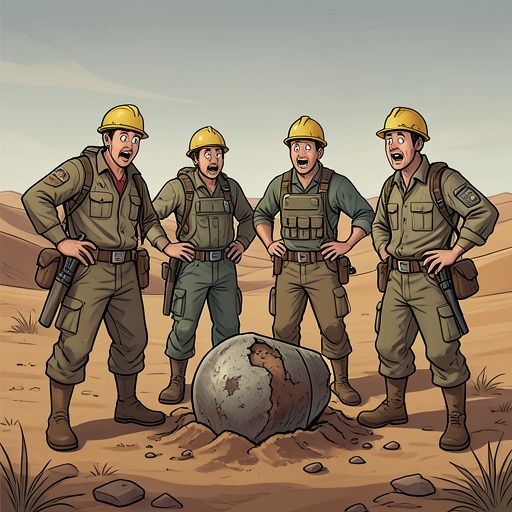
The first excavations sharpen the sense of failure. After an hour of labor in the heat beneath thin spacesuits, the crew has moved thousands of cubic yards of soil and opened a large pit without finding a single artifact. The surviving foundations can establish that a civilization once stood there, but cannot by themselves disclose its laws, technology, or philosophy. The Age of Space Exploration has carried the archaeologists across interstellar distances only to confront an evidentiary void.
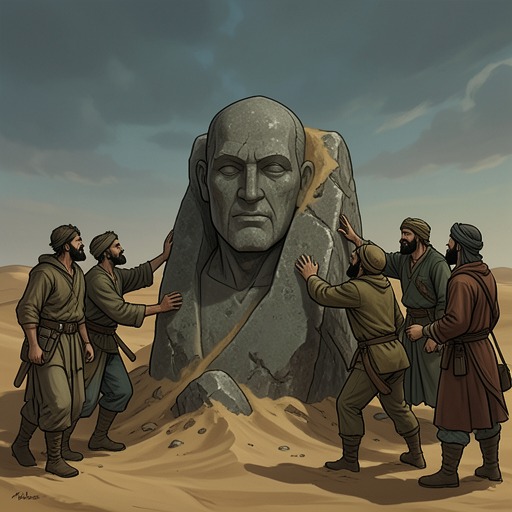
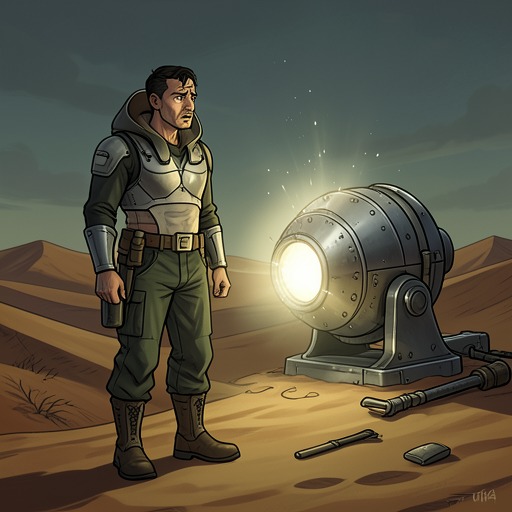
That judgment changes when the crew uncovers a massive robot, more than seven feet tall and buried in sand up to its knees. Its humanoid shape has receptor plates where a human face would have eyes, ears, and a mouth; its dark metal body is pitted and corroded by immense age. When Leopold addresses it, the machine answers in an unfamiliar language. For the crew, whose era of exploration has lasted three centuries, hearing a language not born on Earth is a historical threshold. The robot is not merely another ruin: it is a surviving voice from the civilization the ruins can no longer explain.
Leopold initially treats it as a guide built to give information to visitors, one that has outlasted the monuments it was meant to describe. Its gestures support that interpretation: it turns ponderously, sweeps an arm across the landscape, and continues speaking as though presenting the nearby remains. Anderson recognizes a different significance in the contrast between the lost cities and the still-functioning machine, naming it Ozymandias after the image of a ruler’s boast surviving amid vanished works. The allusion makes the robot’s endurance an emblem of the gap between a civilization’s confidence and what time leaves behind.
The machine’s survival also transforms the expedition’s relationship to knowledge. The crew’s first encounter yields sounds they cannot understand; the following day, Ozymandias speaks in English, explaining that it has deciphered the language and presenting itself as a guide. What seemed to be meaningless output becomes coherent communication. In a world where ordinary physical traces have largely disappeared, the robot’s continued operation supplies a route into the past that excavation alone could not provide.
The Military Claim on Discovery
The new possibility of learning from Ozymandias immediately exposes the expedition’s unequal authority. Mattern learns that Leopold has concealed the robot’s existence. He explains that his men found it after their detectors registered a metal object about twenty miles to the west, and says Ozymandias was surprised to discover that other Earthmen were present. Leopold apologizes for not reporting the find but asks Mattern and his men to leave the robot alone, treating it as part of the archaeologists’ preserve.
Mattern answers not as a fellow investigator but as the officer responsible for security. He has Ozymandias taken to the ship and placed in sealed quarters, declares the expedition ended, and orders an immediate return to Earth. He claims the robot holds a storehouse of information about ancient Thaiquen weapons, including a superweapon that explains the planet’s lifeless condition: in his account, a million years of weather alone could not have removed every blade of grass. He says the Thaiquens developed other formidable weapons as well, and that Ozymandias knows their details.
The claim changes the meaning of the archaeological find. What had appeared to be a guide to a vanished culture is reclassified by the military as a strategic archive. Mattern argues that the information could make America impregnable and insists that, although Ozymandias was Leopold’s discovery, the robot belongs to the military. The narrator recognizes the institutional logic behind the seizure: this is fundamentally a militaristic mission, and the anthropologists were added to it rather than placed in command of it. The crew has found knowledge that could enlarge general understanding, but the expedition’s governing purpose assigns greater weight to weapons and possible use against the Other Hemisphere.
The Age of Space Exploration consequently appears less as a clean break from Earth’s history than as its expansion. The same technology that makes distant worlds accessible also carries national rivalry, security claims, and unequal control over research beyond Earth. At the moment when a lost civilization becomes capable of speaking again, the question is not only what its surviving record can teach, but who has the power to preserve, interpret, and use it. The robot’s endurance opens the past to the expedition even as its removal threatens to place that past behind military control.