Leopold–Mattern conflict
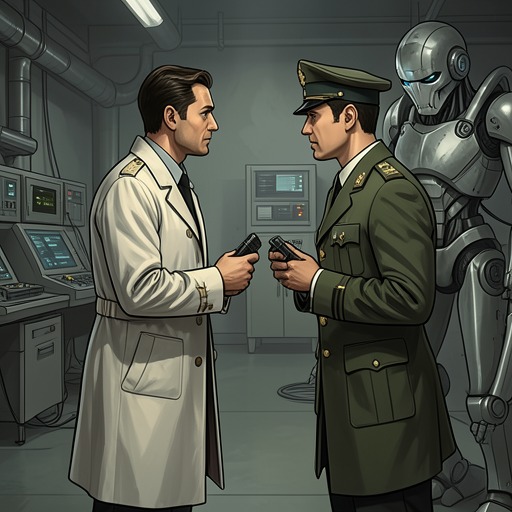
OzymandiasThe Leopold–Mattern conflict is the expedition’s institutional struggle between the pursuit of archaeological knowledge and the military’s demand for strategic resources. It begins as a dispute over whether to spend a guaranteed week on a seemingly barren world and ends when Colonel Mattern classifies Ozymandias as a military asset, seizes control of him, and orders the expedition back to Earth. The reversal exposes how the expedition’s formal allowance for research coexists with a deeper imbalance of money, authority, and purpose.
Institutional Stakes and Unequal Priorities
The expedition had been sent to examine worlds near the Galactic Rim that a survey mission had passed over after finding no present life. Its two branches were assigned different work: Dr. Leopold’s non-military team was to investigate dead civilizations, while Mattern and his military personnel were to seek fissionable material, alien weapons, and materials such as lithium or tritium that might serve military needs. The expedition therefore contained two competing definitions of a useful discovery from the outset. Archaeology sought evidence about the past; the military sought resources and capabilities that could matter in a future confrontation.
That hierarchy was built into the financing. The General Staff of the Armed Forces of the United States of America had supplied seventy percent of the budget and expected practical results, especially weapons and strategic materials. The archaeological team was included partly because American public opinion frowned on purely military expeditions. Its presence offered a civilian and scientific justification, even though its members were acknowledged to have little immediate empirical value to national security. Mattern treated the scientists as ballast, and the narrator recognizes that, in the expedition’s pragmatic structure, that description was not entirely wrong.
The military urgency also reflected Earth’s divided political situation. Tension between America and the Other Hemisphere was rising again after a century of relative quiet, and the expedition’s personnel understood that the rival power might return to space. If the dead worlds held anything of military value, their own side wanted to find it first. The expedition thus carried terrestrial strategic competition into archaeological work far from Earth; the disagreement was not simply a clash of temperaments, but a struggle over what kind of knowledge the expedition was built to produce and who would benefit from it.
The Research Clause and the First Confrontation
The first conflict comes when the expedition reaches a planet that appears to have been dead for about a million years. Its surface is sere and brown, and the remnants of civilization seem reduced to weathered foundations and stumps. Mattern sees no strategic consequence and wants to leave for a more promising world. For him, the absence of obvious resources or surviving artifacts is enough to make further work an unjustifiable expense.
Leopold answers not by claiming that the planet is already valuable, but by asserting the expedition’s rules. A clause gives him the right to explore a world for at least 168 hours, or one week, once the expedition has landed. He insists on using that minimum period for scientific research. The guarantee is a specific limit on the military’s ability to dictate the expedition’s schedule: Mattern may control much of its practical agenda, but he cannot simply cancel the archaeological team’s allotted time.
Mattern interprets Leopold’s insistence as personal obstruction. He asks whether the delay is meant to spite him or demonstrate scientists’ intellectual superiority, and complains that the world appears useless to both branches. Leopold rejects the personal framing and points instead to the limits of their reconnaissance: they have barely examined the planet, which might answer questions about galactic history or even contain powerful weapons. Mattern’s sarcasm makes clear that he regards this uncertainty as a poor reason to stay. The exchange reveals the underlying disagreement about proof: Leopold treats incomplete knowledge as a reason to investigate; Mattern treats the absence of immediately useful evidence as a reason to depart.
Mattern eventually accepts that Leopold is within his rights, but makes his concession conditional in tone: when the week is over, he expects the expedition to leave. The agreement is therefore not a reconciliation. The clause secures a temporary space for research without changing the military’s larger control of the expedition or the strategic terms by which discoveries will be judged.
A Find That Reverses the Dispute
The first excavations appear to vindicate Mattern’s impatience. The archaeologists uncover no portable artifacts, bones, utensils, or other tangible remains. Wind, sand, and rain have worn the surviving building foundations down to stumps. The narrator admits that such traces can establish that a civilization once existed but cannot readily reconstruct its laws, culture, technology, or philosophy. For a time, the planet seems to offer neither the practical material Mattern wants nor the evidence Leopold needs.
That judgment changes when the group encounters Ozymandias, a durable machine that appears to have survived the civilization and its monuments. It speaks in an alien language and seems to act as a guide to the ruins. Leopold proposes that it was built to give information to visitors, then calls the find magnificent and suggests that the language might be deciphered. The robot gives the archaeological team a reason to stay that the exposed foundations could not: it may preserve a record where the ordinary material archive has disappeared.
After listening to the humans, Ozymandias begins organizing their speech into sense. The team supplies vocabulary, and within two hours the machine can hold a passable conversation, free its legs from the sand, and guide them through the civilization it was built to serve. Leopold’s research case has now become exceptionally strong. Ozymandias identifies his people as the Thaiquens and tells the group that they had lived and thrived for three hundred thousand years. The machine had been made in their declining era as an indestructible guide to their cities; those cities later crumbled, leaving it as the surviving bearer of their memories.
The information is concrete enough to transform the find from a curiosity into a vast historical resource. Ozymandias recalls Durab, a city said to have held eight million people, and describes the Temple of Decamon as sixteen hundred feet high. He recounts the Eleventh Dynasty and the first journeys to neighboring planets, and identifies the former site of a library that held fourteen million volumes. The books themselves no longer exist, but he says that he read and memorized them after their builders were gone. His value to Leopold’s team lies not only in a tour of visible ruins, but in his preserved knowledge of a civilization whose physical remains have largely vanished.
Leopold’s description of Ozymandias as an archaeological treasure-house sharpens the conflict rather than settling it. To the researchers, the robot’s enduring memory compensates for the nearly complete loss of material evidence and could sustain years of study. The very qualities that make him an extraordinary historical archive, however, also make his information available for another interpretation and another claimant.
From Research Preserve to Military Asset
The decisive confrontation follows when Mattern and his men have investigated during the night and discovered Ozymandias. Mattern says his group was led to the area by their manner the previous evening and by detectors showing a metal object about twenty miles to the west. He accuses Leopold of concealing a discovery of extreme strategic importance. Leopold says he had intended to disclose it before departure, but Mattern’s accusation immediately recasts the issue from research practice to security and possession.
Leopold responds by trying to protect access through the same kind of jurisdictional claim that had secured the initial week of research. He asks Mattern and his men not to meddle with the robot, warning that a casual experiment might short-circuit his memory channels. He then declares Ozymandias part of the archaeological group’s preserve and off limits to the military personnel. The concern is specific: an intervention could damage the very memory system on which the historical record depends. For Leopold, custody is necessary both to protect the machine and to keep its knowledge available for archaeological work.
Mattern turns Leopold’s own language back against him. He declares Ozymandias part of the military preserve and off limits to the archaeologists. The reversal shows how little force the word “preserve” has when authority is disputed by a commander with power over the expedition. Leopold’s earlier clause could guarantee time on a planet, but it cannot guarantee lasting control of a discovery once the military identifies it as relevant to its mission.
Mattern’s justification is the contents of Ozymandias’s memory. He says the robot holds extensive information about ancient Thaiquen weapons and argues that those weapons could make America impregnable. The same archive Leopold sees as a record of cities, political eras, books, and catastrophe is now described as a storehouse of intelligence. Mattern links the lifelessness of the planet to the possibility that a superweapon destroyed its life, and claims that Ozymandias knows its details. The scene presents this as Mattern’s explanation and basis for military action, not as a conclusion independently established by the archaeologists.
The conflict therefore turns on competing uses of a single machine rather than competing discoveries. The archaeologists want sustained access to an irreplaceable source of historical knowledge; the military wants control of information it believes could be converted into strategic power. Mattern does not dispute that Ozymandias is Leopold’s find. He argues that military usefulness overrides the circumstances of discovery and makes the robot belong to the military instead.
Outcome and Significance
Mattern announces that Ozymandias has already been taken to the ship and placed in sealed quarters under top-level security. Invoking the authority entrusted to him for emergencies, he declares the expedition over and orders an immediate return to Earth with the robot. The seizure ends not only Leopold’s claim to the find but the archaeological expedition’s opportunity to investigate the civilization through its surviving witness.
Leopold understands that he cannot stop Mattern. After the commander’s explanation, he gives in, leaves the mess hall without touching his food, and appears to the narrator suddenly old and defeated. The expedition’s scientists offer no effective support. Their silence reflects the imbalance the conflict has exposed: although archaeological research had been protected by a formal time allowance and Leopold had tried to claim Ozymandias as part of the group’s preserve, the military personnel remain the expedition’s decisive power.
The conflict’s progression gives it its central irony. Mattern first argues that the dead world is useless and wants to leave; Leopold insists on the research time that makes the discovery possible. Once the robot proves valuable, Mattern changes the definition of that value from historical to strategic and uses military authority to take possession. The archaeological case for preserving and studying Ozymandias is not answered on its own terms; it is overtaken by the expedition’s founding military priorities.
In this way, the Leopold–Mattern conflict dramatizes the militarization of scientific knowledge through budgets, mission design, access rules, and custody. The research clause can slow the military’s timetable, but it does not redistribute control over the expedition’s most consequential result. Ozymandias’s memory survives the disappearance of the Thaiquen cities; whether it will serve as a record of that civilization or as a source of weapons intelligence is decided, for the moment, by the institution that can seal him away and end the expedition.