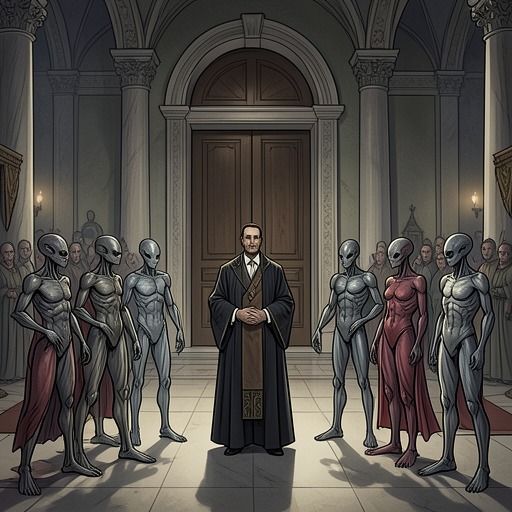
“Long life and good fortune!”
Peacemaker“Long life and good fortune!” is an acclamation voiced first by the young speaker’s great-grandmother and then taken up by the assembled crowd. In the scene, the repeated words transform an anxious pause after his speech into a shared expression of support.
The Acclamation
The young speaker has just finished, but instead of confidence he feels embarrassed: he worries that his ideas ran together, that he sounded foolish, and that he may have offended his father. The room is silent. Then his great-grandmother strikes her cane against the floor three times and calls out, “Long life and good fortune!” The crowd answers with the same words, almost together.
The Crowd’s Response
The phrase becomes a collective reply rather than a private reassurance. Its repetition marks a change in the moment: the young speaker, who fears he has made a serious mistake, draws a full breath as his father places a hand on his shoulder. The acclamation does not erase his uncertainty; it gives him an immediate sign of acceptance before his father asks, ominously, whether his grandmother wrote the speech.
Narrative Function
The scene makes the phrase’s significance depend on who speaks it and when. The great-grandmother’s three cane strikes initiate the response, and the crowd’s near-unison carries it beyond her individual voice. The words provide a brief public affirmation at the precise moment the speaker expects disapproval, while the father’s pointed question leaves the scene with its humor and uncertainty intact.