Offer them a doorway from their way to your way
Peacemaker“Offer them a doorway from their way to your way” is a compact lesson in persuasion: a successful approach must begin by understanding the other side, yet can also make compromise easier by allowing others to feel they helped devise it. Spoken by a father to his son, the phrase holds together two modes of diplomacy—attentive engagement and tactful influence—and echoes the book’s account of institutions built through cooperation across old divisions.
The Advice and Its Meaning
The saying comes as part of a practical answer to the question of how to deal with people who may not be pleased. The father first advises asking for their opinion, listening, and acknowledging something worthwhile in their idea. When his son asks what to do if there is nothing good to praise, the father offers the doorway: find a route from the other person’s position to one’s own. The lesson is not simply to flatter or conceal disagreement. Its stated condition is understanding both sides; persuasion depends on knowing the position one hopes to change as well as the one being offered.
The metaphor makes that effort spatial and reciprocal. A doorway does not erase the distance between two positions, nor does it require either side to pretend the distance was never there. It gives someone a way across. The phrase therefore presents diplomacy as more than winning an argument: it is the work of making a different outcome approachable to the person who must accept it.
Courtesy and Strategy
Ilisidi recognizes the phrase’s potential for strategic use. Her response is to offer tea, nod politely, charm the other party, and allow them to modify their position while believing they devised the compromise. The resemblance to the father’s advice is deliberate in the scene: both approaches seek movement without openly forcing it. But they are not identical. The father emphasizes understanding both sides; Ilisidi describes the social skill of preserving another person’s sense of authorship as their position changes.
The son hopes he may someday become as clever as his elders. The exchange presents diplomacy not as an effortless gift but as a learned capacity, involving listening, judgment, and attention to how a proposal will appear to the person receiving it. Its lightness—the child’s puzzled question and the adults’ different answers—does not diminish the seriousness of the lesson. It shows how a principle can be taught both as an ethical discipline of comprehension and as a practical art of influence.
A Personal Bridge Between Cultures
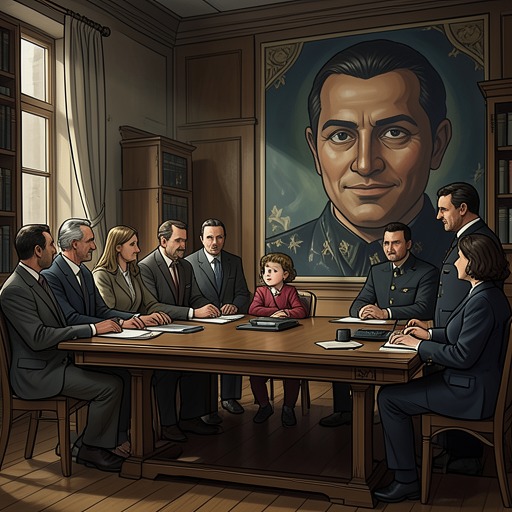
The phrase sits within a scene concerned with how young humans will be received by people who have never seen humans and may not want them on the continent. Jase is described as supporting good relations between ship-humans and Atevi and as knowing Atevi customs. He can help his guests present themselves well to a roomful of people. That task gives the saying an immediate social counterpart: successful contact requires attention to the audience’s expectations, not merely the speaker’s intentions.
In this context, a doorway is a fitting image for cross-cultural contact. The people involved do not begin with identical assumptions, and making a favorable impression cannot by itself settle their differences. The advice instead points toward a way of meeting them: learn how the other side sees the matter, acknowledge what can be acknowledged, and make the proposed path comprehensible from their position.
The Political Echo
The book’s account of Atevi political development gives the metaphor a wider resonance. Before the Foreign Star appeared, eleven regional associations agreed to build a railroad from Shejidan westward without going to war. As construction continued, project leaders had to coordinate guilds, clans, and sub-clans and uphold agreements made by individual clan lords. The project depended on creating ways for groups with separate interests to cooperate.
That cooperation was tested when three powerful lords sought to alter the arrangement and divide the railroad into administrative districts. The Assassins’ Guild backed the aiji in holding them to their agreement; the resulting trade benefited even the clans that collected no tolls. The account stresses that broader associations of common purpose, rather than the simple disappearance of regional distinctions, helped produce relative peace. This is not presented as a direct application of the father’s phrase, but it makes the phrase’s logic legible on a political scale: durable agreement requires routes between differing interests, and those routes can matter more than the boundaries separating them.
After the War, the aiji proposed that guild membership and assignments cross clan and regional lines and be based on qualification rather than kinship. Guild masters supported the proposal, which became an internal rule despite resistance from some regional associations. The Assassins’ Guild accepted an additional political restriction on its members in exchange for protections from political pressure. These arrangements show cooperation taking institutional form: not just a polite exchange, but rules that make participation across inherited divisions possible. Against that history, the doorway is both a counsel for conversation and an image for the negotiated structures through which people with different loyalties can act together.