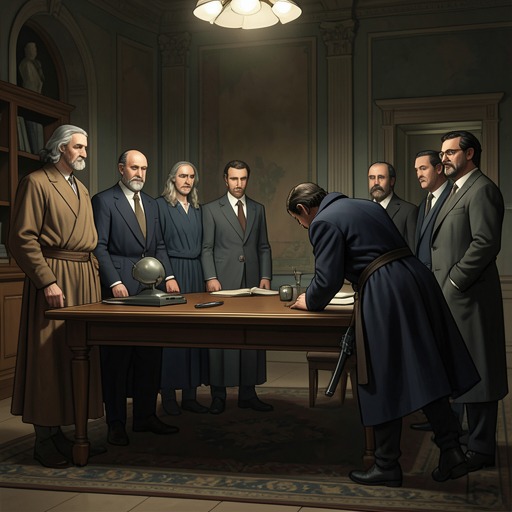
“if we violate the rules trying to take down the violators—what do we have left”
PeacemakerThe expression “if we violate the rules trying to take down the violators—what do we have left?” frames the Assassins’ Guild’s struggle to answer unlawful violence without destroying the legal authority that distinguishes the legitimate Guild from its splinter. It is not a plea for passivity: it identifies the danger that a victory gained through procedural violations could leave the Guild unable to prove or enforce the law it claims to defend.
Meaning and Legal Context
The question draws its force from the Guild’s formal procedures for assassination. Before action may be taken against a person or institution, a Filing of Intent is required, except when defending against an illicit attack. The filing states the dispute in a Document of Intent entered into the state registry; the document is sealed, ribboned, and archived, and an answer is filed in the same way. The process makes a potential use of force a publicly recorded legal case rather than an unaccountable act.
The filing also triggers notice and opportunities for scrutiny. The Guild Council may obtain depositions from both sides, determine whether adequate cause exists, debate the filing’s merits, and consider remedies short of lethal action. It may hear testimony from Guild members employed by either side and impose further delay while seeking settlement. If the filing is approved, a date is set after which action may proceed. In smaller disputes, such as property or divorce cases, an office of the Council may approve a filing on the basis of witness depositions; the usual limit is ninety-nine days, after which attempts must cease and the filing is set aside.
These requirements make restraint part of the Guild’s enforcement system. They provide time to prepare, allow the Guild to mediate, and make room for negotiated resolution. The expression therefore asks what remains of law when its defenders discard the procedures that give it public standing and constrain its use of force.
The Coup and the Guild’s Failure
The question takes on immediate political weight during the coup. After the first report that Tabini had been killed at his Bujavid residence, the legitimate Assassins’ Guild mistakenly accepted orders from the conspirators. When word came that Tabini was alive, followed by a report that he had been killed in Taiben, Guild members again took orders from their superiors and from Murini, without understanding that trusted authorities included people hunting Tabini and Damiri.
The Shadow Guild had violated the centuries-old procedures and laws described in Wilson-paidhi’s essay. Yet the legitimate Guild, seeking to preserve the lives of the lords who formed the backbone of the aishidi’tat, continued to follow its rulebook. Within hours, some legitimate Guild members began gathering in secret because they suspected that something was wrong in their own ranks. They were troubled by the new aiji’s initial orders and by the deployment of units to search the Taibeni woods while other units were held back.
The contrast is not between a flawless institution and an obvious enemy. The legitimate Guild’s reliance on the chain of command had helped the conspirators at the outset. Its members had acted on orders before grasping the larger plot. The expression gives that failure a further test: correcting complicity by abandoning procedure might answer one breach with another, while leaving the Guild’s own conduct open to challenge.
Proof, Authority, and Restoration
The Guild’s role as a source of information is central to the dilemma. When seeking to establish who had been behind an assassination, one naturally asked the Assassins’ Guild. But trustworthy conclusions depend on trustworthy records and a process capable of examining them. If Shishogi expected to be dismissed, he might destroy records; without proof, the opponents of the current Council could not persuade the membership that the Council itself had broken the law.
A bloody confrontation, even if it defeated the wrong members, could kill innocents or deprive the legitimate Guild of the evidence needed to make its case. Relying instead on Tabini’s decree and the authority of the aijinate might restore control, but it would not establish the Guild’s legitimacy through its own rules. The proposed alternative was to enter the Council Chamber and prove the case before the Council.
The expression thus holds institutional principle and practical necessity together. The rules matter not as ceremony but as the means by which the Guild can distinguish lawful judgment from factional force, preserve evidence, and regain the confidence of its membership. Its decisive concern is what the Guild would still be if, in fighting those who broke the law, it ceased to be governed by law itself.