Age of the First Northern Rulers
PeacemakerThe Age of the First Northern Rulers is presented as a formative period following the collapse of the Southern Island culture, remembered through monumental art and contested accounts of cultural inheritance. Its surviving traces place it at a point of contact between northern traditions and the knowledge carried by Southern Island survivors, while leaving the deeper origins of some peoples and objects unresolved.
Cultural Remains and Historical Sequence
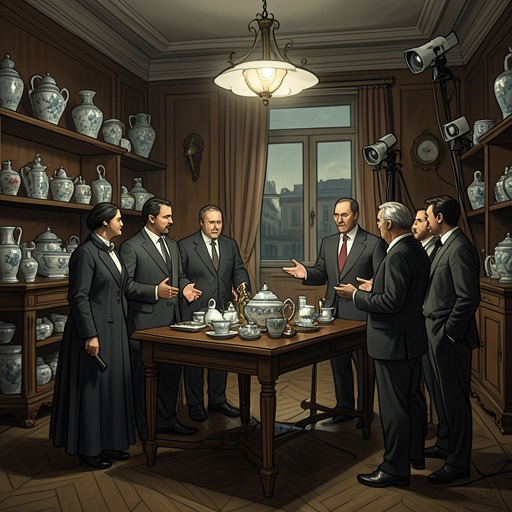
A museum guide describes a sequence of massive figured ware followed by freestanding figures associated with the Age of the First Northern Rulers. The order matters: the figures belong to a historical development placed after the Southern Island’s collapse, not simply to an isolated artistic fashion. Elsewhere in the collection, the lost Southern culture is evoked by legendary Southern blues, a glassy aqua color that could no longer be made by the old methods after the Great Wave destroyed that culture.
One theory heard by Bren connects the elaborate figured porcelains of the current age to the pillar-like Reverence Statues of the northern lands. In this account, northern traditions met porcelain techniques preserved by survivors of the Southern Island, producing a later artistic form. The relationship is offered as a theory rather than a settled history, making the period part of an ongoing effort to reconstruct how cultural practices crossed a catastrophe.
Competing Accounts of Ancestry
The historical interpretation becomes more contentious when the guide raises a possible connection between northern figures and the Grandmother Stones familiar to museum-goers on Mospheira. Those stones are largely unknown on the mainland except in places where the Edi and Gan settled. The proposed connection therefore links material remains not only to artistic influence but also to the disputed origins of tribal peoples.
The guide notes that this question is bound up in controversy: the tribal peoples reject the claim that they descend from northern culture and maintain instead that they came from former lords of the Southern Island. In their account, the Southern Island’s Grandmother Stones were swept away in the flood. The surviving evidence does not resolve the dispute. The Age is consequently framed through fragments and rival histories, in which the interpretation of monuments bears directly on whose ancestry and inheritance are recognized.
Later Political Transformations
The account also sets this distant past against a much later transformation in Atevi political life. Before the Foreign Star appeared in the Heavens, Atevi had already reached the age of steam and begun to move beyond the clan structure that had contributed to ruinous wars. Eleven regional associations agreed to build a railroad from Shejidan westward without fighting over the project. This is not presented as an event of the Age of the First Northern Rulers; rather, it shows the longer historical movement through which political forms changed after the ancient cultural sequence described by the guide.
The railroad required elected aijiin to manage agreements among clans, sub-clans, and guilds, and to carry construction through districts whose lords had pledged support. The Assassins’ Guild began as a small group that protected those aijiin from assassins serving individual lords. When three powerful lords later sought to break the railroad agreement into administrative districts, the Guild backed the aiji in holding them to their commitments. The project’s success encouraged further railways and larger associations, while trade benefited even clans that collected no tolls.
Institutional Legacy and Historical Scale
After the War, the aiji proposed that guilds operating across regional lines should continue to recruit and assign members without regard to clan origin, regional association, or kinship. Guild masters would control membership and assignments. The Assassins’ Guild accepted an additional restriction against its members holding political office or lordships, in exchange for statutory protections against political pressure, including control over its records and internal investigations. These arrangements show a later society trying to make cross-clan institutions durable; they should not be mistaken for direct evidence about the ancient age itself.
The book’s historical scale ultimately reaches the shuttle-fleet era. With mainland society increasingly unstable and decisions in the Heavens threatening to exclude Atevi, Tabini-aiji sent Bren, Ilisidi, and Cajeiri to investigate conditions in space. That mission belongs to another turning point, separated from the Age by immense change. Read together, the ancient artifacts and later political history make the past less a closed chronology than a field of inherited claims: cultural origins remain disputed, while institutions repeatedly form around the practical need to cross boundaries and preserve agreements.