Rule Excluding Spouses from Clan Succession
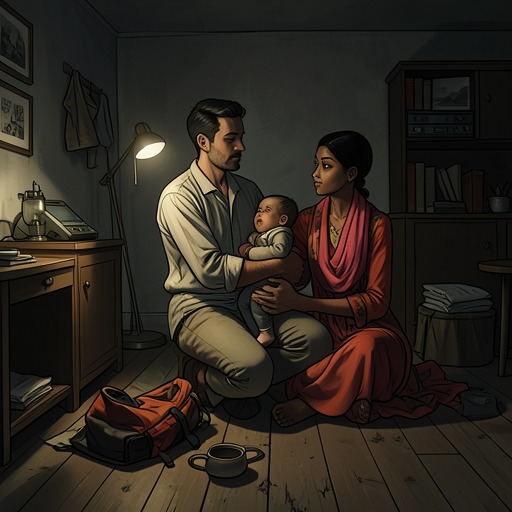
PeacemakerThe Rule Excluding Spouses from Clan Succession bars a lord’s consort, whether male or female, from taking part in clan rights and inheritable privilege by virtue of the marriage. At Tabini’s son’s Investiture, this principle left Damiri formally outside the inheritance even as her son publicly acknowledged her; the distinction makes the rule’s force, and its limits, visible.
Definition and Operation
The rule separates a spouse’s place in a household from a clan member’s claim to succession. At the Investiture, Damiri had no formal role in the ceremony and was legally uninvolved in the question of inheritance. Tabini’s address traced the lines of succession without naming her, not as a personal slight but because a consort did not belong in that account.
The boundary applied to consorts of either sex. A lord’s spouse did not gain clan rights or inheritable privilege through marriage, and marital status alone did not make the spouse part of the succession. The ceremony presented this exclusion as ordinary procedure: the inheritance belonged to the relevant line, not to the person married to its lord.
Damiri and the Public Acknowledgment of Kinship
Damiri’s position at her son’s Investiture showed that exclusion from inheritance did not erase her relationship to the heir. While she stood among those congratulating the family, Cajeiri acknowledged his mother where Tabini’s account of succession had not. The narrative treats that acknowledgment as properly his to make: a son could recognize his mother even when the inheritance rules gave her no formal place in the transfer.
Damiri’s presence also carried political meaning. She wore pale green pleated satin rather than the brilliant red and gold associated with her husband’s banner, and the color suggested Atageini without declaring it outright. On an evening when she had no official part, the choice could be read as politically measured. Her clan was absent from the succession ceremony, as was the Kadagidi clan, whose members had been proven traitors; meanwhile, Cajeiri’s acknowledgment gave his mother a place in the public scene without changing the inheritance.
The rule did not mean that Damiri lacked every possible claim or political standing. After her father’s death left Ajuri without a lord, she was one candidate for the Ajuri lordship, although Tabini strongly preferred that she not take the frequently vacated office. Her possible candidacy arose in the context of her own clan and her father’s death, not from her position as Tabini’s consort. The distinction between her Ajuri ties and her marriage to Tabini is essential to understanding why she could be discussed as a candidate in one succession while remaining excluded from her husband’s inheritance.
Kinship, Marriage, and Political Risk
Damiri’s family position had already been shaped by competing clan attachments. As a young woman, disaffected with her Ajuri father, she left a family outing during the Winter Festivity in Shejidan and asked her influential Atageini uncle, Lord Tatiseigi, to take her in. Tatiseigi informed the Ajuri lord that she was staying with him, while privately seeing in her a possible heir at a time when he had no child of his own. This history helps explain why Damiri’s clan affiliations could matter politically without making marriage itself a route into inheritance.
Later, her possible return to Ajuri authority was bound up with more than customary succession. Bren explained that Tabini had forbidden her to take the Ajuri lordship because her great-uncle had been implicated in a conspiracy and the Guild’s political interference had put households at risk. Tabini had rejected proposals to dissolve his marriage for political convenience and insisted that Damiri was not complicit in her great-uncle’s actions. Thus the rule’s separation of consort from inheritance did not shield her from political pressures; it coexisted with decisions about her safety, loyalties, and future influence.
Custom and the Wider Political Order
Ilisidi provides a pointed contrast to the ordinary boundary. She had twice stepped forward to claim the regency and had brought a case before the legislature to take the Ragi inheritance as her own. Bren recognizes the audacity of that effort, rather than presenting it as routine consort authority. Her example shows that political power could be asserted through exceptional circumstances and institutional action, even where ordinary custom denied a spouse a role in clan inheritance.
The wider constitutional arrangements also distinguish clan affiliation from other kinds of authority. During the formation of the expanded Aishidi’tat, guilds were permitted to recruit and assign members without regard to clan origin, regional association, or kinship. The Assassins’ Guild accepted an additional restriction: its members could not seek or hold political office or a lordship, in exchange for immunities protecting the Guild from political pressure. These provisions do not establish the consort rule, but they place it within a political order that allocated authority differently across clans, guilds, and public office.
At the Investiture, the rule’s effect was both practical and ceremonial: Damiri could be Cajeiri’s mother, Tabini’s wife, and a figure with consequential clan ties, yet she could not participate in the inheritance as consort. Cajeiri’s acknowledgment affirmed a family bond the succession formula did not include. The scene makes clear that exclusion from inherited privilege is not the same as social or political insignificance.