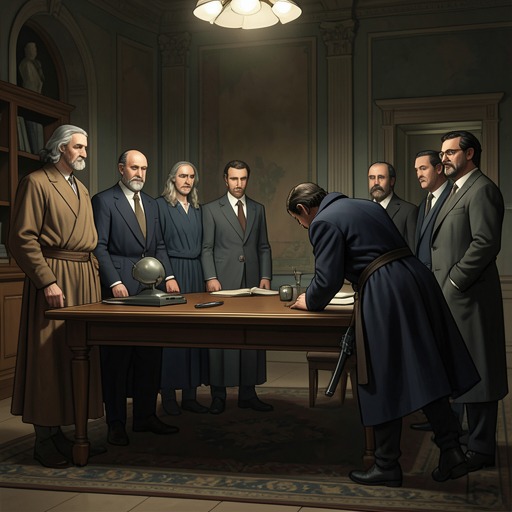
Law Prohibiting Unauthorized Violence against Citizens
PeacemakerThe Law Prohibiting Unauthorized Violence against Citizens ties the use of force to procedure: outside specified defenses, violence against a fellow citizen is forbidden, and action against a person or institution requires a Filing of Intent. The rule gives the Assassins’ Guild a central role in authorizing and enforcing lethal action, but also makes its authority depend on records, review, and adherence to its own law.
Scope and Exceptions
The law forbids anyone other than an Assassins’ Guild Assassin from bringing violence against a fellow citizen, except in defense of self, an employer, a household, clan property, or national treasure. Separately, a Filing of Intent is required before action may be taken against a person or institution, unless the action is defensive force against an illicit attack. The exception is defined narrowly: an attack begins with movement within arm’s length of the defender, or with the first use of a distance weapon or a weapon of stealth, such as poison. The rules therefore distinguish between violence that is authorized through Guild process and immediate force used in defense.
A person who violates the prohibition is outlawed and becomes subject to lethal action by the Guild without a time limit. The law nevertheless provides a route back to judgment: an outlaw may surrender to the ruler’s decision, made in consultation with the Guild. This provision places even the consequence for unlawful violence within a framework of authority rather than leaving it to private retaliation.
Filing and Review
The Filing of Intent begins with a document entered in the official state registry. It records the dispute and is preserved as a permanent archive record; any response is filed in the same way. The process then requires public notice that the Guild Council is considering action and gives the Council an opportunity to take depositions from both sides. It must first determine whether adequate cause for a Filing may exist, then debate the merits and consider whether a remedy short of lethal action is possible. The Council may hear from Guild members employed by either side about the possibility of settlement, and it may delay action again while urging the parties to resolve the dispute.
Only after those measures fail can the Council approve a Filing by vote and set a date after which action becomes possible. For smaller disputes, particularly those involving property or divorce, an office of the Council may approve a Filing without a full Council debate, but witness depositions are still required. That route generally imposes a ninety-nine-day limit: once the period expires, attempts to carry out the assassination must stop and the Filing is set aside. The time limit and opportunities for mediation make the procedure a restraint on violence as well as a means of authorizing it.
Enforcement and Legitimacy
The Guild’s process is designed to give the targeted party’s bodyguard time to prepare and to keep the parties’ permanent guards in contact with the central Guild. Either side may ask the Guild to mediate a mutually acceptable suspension of action. Guild units may also seek a truce to advise their employer that the defense has failed and that the disputed matter must be ceded. These provisions reflect the Guild’s stated interest in avoiding bloodshed among its own members, even when a Filing has advanced toward lethal action.
That distinction between lawful procedure and illicit force becomes politically decisive after Murini’s coup. The Shadow Guild had violated the established rules, while the legitimate Assassins’ Guild continued to follow them, even as it mistakenly took orders from conspirators during the attacks on Tabini. Later, the danger was not only that the current Guild leadership might act unlawfully, but that a response outside the rules would destroy the institution’s claim to enforce them. Jago warned that a direct assault on Guild Headquarters could cost innocent members and destroy crucial assignment records. The case against the Council therefore required proof that it had broken the law, established before the membership rather than imposed solely by political decree.
The exiled senior Guild members who returned to reclaim the institution were described as immaculately loyal to the law, despite their opposition to humans and their earlier refusal to serve the current leadership. Their aim was to investigate the records and restore lawful authority. The conflict thus tests the rule at two levels: whether individual force has been properly authorized, and whether the Guild itself can be trusted to obey the limits that give its actions legitimacy.
Guild Autonomy and Restoration
The Guild’s legal authority is part of a wider institutional arrangement. In the postwar settlement, guilds were to recruit and assign members across clan and regional lines, with appointments based on qualification rather than kinship or origin. The Assassins’ Guild accepted an additional restriction: its members could neither seek nor hold political office or lordship. In exchange, it received statutory protections against political pressure. Lords could not summon its records, its members testified only before their own Guild Council, and the investigation of a member’s disappearance or death belonged to the Guild under its own rules.
Those protections give the Guild room to enforce its procedures, but they also make internal accountability and credible records indispensable. During the struggle over the Council, Shishogi died after an incendiary fire at his office; the records were damaged but not destroyed, and a man was intercepted carrying several notebooks from the office. The ensuing accounting included two resistance members killed, fourteen people wounded in the building, 147 who voluntarily stood down pending resolution, and sixteen arrested for sorting and testimony. These details show the practical stakes of preserving evidence: without it, the law’s procedures could remain formally intact while the case for enforcing them became impossible to establish.
After the old leadership returned, it began interviewing Guild members, starting with assignments to the Bujavid and examining service, loyalties, kinship, references, and other testimony. The restoration was therefore not simply a change of officeholders. It was an effort to re-establish the evidentiary and procedural basis on which Guild authority—and the prohibition on unauthorized violence—could be believed.