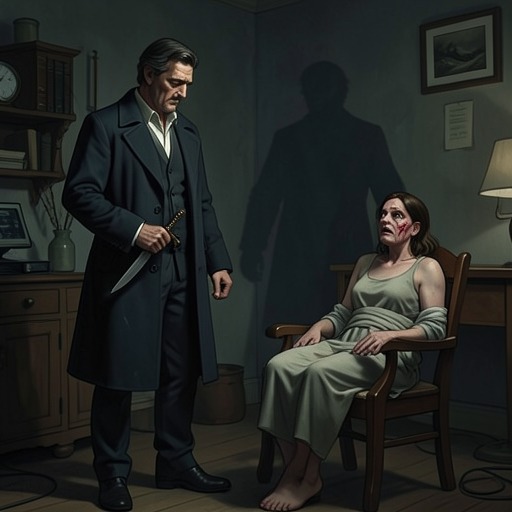
Guin asks Talon to track down the guild contracted to kill Ashla's family
PleasureGuin’s appeal to Talon turns a threat against Ashla and her newborn into a test of the assassin’s code: he asks Talon not merely to stop one killer, but to find and eliminate the entire guild that accepted the contract. The request carries a grim deadline, a deliberate method of terror, and the risk that Talon will be branded a traitor by his own kind. Talon does not accept at once; he agrees only to consider whether he is willing to undertake the work and its consequences.
Causes and Stakes
The immediate cause is a contract on a pregnant woman and her future baby. Guin tells Talon that the woman who arranged it has already killed a baby, making the danger more than a speculative threat. The intended victims are to be murdered two months after the woman gives birth. The contract calls not just for their deaths but for a scene so cruel that the husband and father will return to find his family’s remains scattered throughout the home. Guin’s account makes the threatened violence a calculated assault on a family, not simply a killing for hire.
That specific target changes the scale of Guin’s request. He first distinguishes the matter from an ordinary mark: he needs Talon for something more complex, then states that the task is to take out an entire guild. There are three guilds that would accept so low a contract, so the responsible organization must first be identified among several possible suspects. The threat is thus both personal and institutional: Ashla and her child face the attack, while the search requires Talon to penetrate the world of the guilds that make such violence possible.
The Assignment and Its Risks
Guin offers to provide all the particulars and gives Talon at least six to eight months, assuming the pregnancy continues without miscarriage. The time allowance is not a reason to delay. Talon must discover which of the three guilds took this particular contract, identify every assassin belonging to it, and kill them all. The wording of the assignment makes its completeness central: stopping the first attack would not satisfy Guin’s demand if the organization behind it remained intact.
The work also carries a cost beyond danger to the intended targets or to Talon himself. If his responsibility is discovered, he will be regarded as a betrayer of his own kind. Guin acknowledges the difficulty of conducting the investigation anonymously in such close quarters, rather than presenting the task as a simple exercise of Talon’s skills. The danger of exposure is built into the mission: to protect a family, Talon may have to turn his knowledge and position against the network from which that knowledge comes.
Conscience and Allegiance
Talon initially reacts to the demand by standing up sharply and treating the conversation as over. Guin counters not with a promise of payment alone, but with the identity of the intended victims: a woman and a newborn. Talon hesitates, then sits again, visibly affected by the account. His response reveals a moral boundary beneath his cold-blooded exterior. He says that, even when he was young and eager for reasons to hunt and kill, he would not target a child, a pregnant woman, or an innocent.
Talon connects that boundary to Guin’s own break with the guild world. He recognizes that Guin likewise rejected violence against innocents, and recalls that Guin had once been deceived into believing he was hunting a power-hungry dictator who meant to crush the Shadowdwellers. Once Guin recognized Malaya for what she truly was, that false account could no longer justify the mission. Talon’s recollection makes the present request echo Guin’s earlier moral refusal: the same distinction between a supposed enemy and an innocent person now shapes the choice Talon must make.
An Unsettled Decision
Guin offers Talon a way to leave the life of the guilds if the mission exposes him. Friends in the upper levels, he says, could use Talon’s abilities on the proper side of the law; the offer includes a possible change of career rather than only payment for one dangerous job. Talon laughs at the prospect and doubts that such work could absolve all his past sins. Guin does not claim that the transition would erase them. Instead, he presents the opportunity as a practical future attached to the present assignment.
Talon does not give Guin an immediate yes. He says he needs time to think, while expressing confidence that he can carry out the operation and uncertainty about whether he can do so anonymously. He weighs abandoning everything he knows against the money on offer, even as Guin suggests that a pretty face had been enough reason for him to make a comparable change. The event therefore ends at a decision point rather than with the guild found or the danger removed: the contract’s terms are clear, Talon’s scruples have been stirred, but his commitment remains pending.