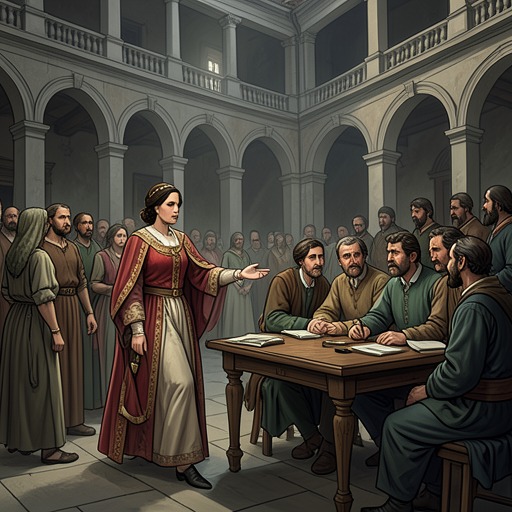
Shadowdweller Civil War
PleasureThe Shadowdweller Civil War is the violent crucible behind Malaya and Tristan’s survival, Guin’s lifelong service as Malaya’s protector, and the fragile political order that followed. The war’s private cost is clearest in the assault on the twins’ hideout: their escape plan kept them from searching for one another, but Trace was taken in the fighting and believed dead. The truth—that he survived and endured captivity—made the raid a wound that continued to shape the postwar struggle.
Historical Frame
The prologue places the hideout attack about thirteen years before the present-day Senate proceedings. It presents the twins as imperial heirs and prospective Chancellors whose enemies had discovered their otherwise nondescript refuge. Their location had been betrayed, turning a concealed household into a battlefield. The conflict is described as a struggle among clans for power and belief, with the heirs’ survival essential to continuing their cause.
The twins’ bodyguards, Guin and Xenia, had prepared for precisely this danger. Malaya and Tristan were kept at opposite ends of the same floor, each under a different protector, so that an attack would not force either sibling to waste time searching for the other. Their instructions were stark: reach safety independently, without hesitation or looking back. At least one heir had to survive if their side was to endure the war. The arrangement treated separation not as a failure of family loyalty but as a condition of political survival.
The war’s chronology is marked differently in separate recollections. The prologue dates the hideout episode to about thirteen years earlier, while Sagan recalls losing his former handmaiden in the civil war almost twenty years earlier. The latter memory shows that the conflict’s reach extended beyond the heirs’ immediate struggle: it also cost Sagan the one permitted intimate relationship in his priestly life, after which he refused to appoint another handmaiden.
The Attack on the Hideout
The assault began at night, while Malaya was in her rooms with Guin. He was following his nightly routine, kneeling outside her bedroom to open his bedroll; she was across the sitting room, braiding her hair beside the visible exit. The first violence sounded from the manor’s front rooms. Guin surged upright, and the distance between protector and charge—only several strides—became suddenly perilous. Malaya and Guin met each other’s eyes as the crisis seemed to slow around them.
Guin called for K’yatsume as shouting and weapons clashing carried through the house. Malaya and Tristan were in separate locations, as their escape plan required. The attack was therefore not only a test of their defenses but of whether each heir could obey the plan under pressure: they were not to reunite first, even when the other’s safety was uncertain. The scene follows Guin’s concern for Malaya while the wider danger reaches the separate group protecting Tristan.
Rika, Malaya’s vizier and friend, joined them in the shadows, shaken and out of breath. She reported that Trace, Tristan’s vizier, had been helping defend Tristan and Xenia when a blade pierced his abdomen. Rika had seen him fall and feared he was dead. His wound and capture made that fear credible: even a strong fighter might not survive such an injury, especially in enemy hands. The report turned the escape from a question of protecting the heirs alone into one shadowed by the apparent loss of a close ally.
Tristan and Xenia then reached the group, looking battered but alive. Malaya threw herself into her twin’s arms, heedless of the blood on him. Xenia urged them to leave before an attacker discovered the hidden stairs. With the heirs reunited and the hideout no longer secure, survival meant abandoning the refuge rather than defending it. The scene ends with retreat, not victory: the immediate duty was to get out before the enemy found another way in.
Trace’s Capture and the War’s Human Cost
Rika’s belief that Trace had died was mistaken. During the same invasion, Acadian took him prisoner. She healed his wounds so that he would be alive and strong enough for her torture; he remained captive for the better part of a year while his companions believed him dead. When Guin eventually found him, Trace’s body bore the scars of that ordeal. Guin had respected Trace’s strength and intelligence, yet at first believed that little remained of him beyond his damaged body. Trace’s eventual recovery testified to a resilience that the raid’s first account could not reveal.
The aftermath of the capture reached beyond the rescue itself. Acadian had concealed her face, and no one Guin could locate knew what she looked like; he concluded that she had operated under another identity. Years later, Nicoya confessed that her mother was a member of the Senate. The revelation connected wartime torture to a continuing campaign against the twins’ rule: Acadian used legal deception and assassination attempts to weaken those around them. The old assault thus became part of a longer chain of political violence rather than an isolated battlefield episode.
The war also altered lives away from the battlefield. Sagan’s former handmaiden was killed during the conflict, ending his participation in the religious tradition that allowed a priest to have sexual relations only with his appointed handmaiden. He chose not to replace her, a decision that became a source of disagreement with other priests. His refusal persisted in part because M’gnone Magnus, head priest of Sanctuary, did not press him to conform. The conflict’s losses therefore continued to shape private choices and institutional tensions after the fighting had passed.
Postwar Order and Continuing Conflict
In the present-day Senate, the war’s settlement is described as recent enough to remain politically fragile. Jericho argues that the monarchy has been free of challenges for only about a decade and presents an ancient marriage law as a way to secure Malaya’s reign. Malaya answers that the law is 1,846 years old, made for an era of warring clans and hostile neighboring Nightwalkers. She points to the twins’ firm position in the Chancellery and the defeat of challengers who confronted them directly. The debate shows how the memory of clan conflict can be invoked both to defend custom and to argue that old rules no longer fit the peace.
That peace is not the same as an end to violence. The clans have been dissolved, but some former members have become secret assassin guilds; some retain scruples, while others do not. A law drafted by Trace makes it a high crime for one Shadowdweller to kill another without provable and imperative cause, but clandestine groups remain outside the reformed order. Guin, once an insider among the clans, believes he can return to those hidden networks despite having left his people to serve Malaya. The war’s legacy is therefore both constitutional and personal: it produced a monarchy and new limits on violence, yet the old machinery of faction and revenge continues beneath them.
Narrative Significance
The hideout episode gives the civil war a human scale through divided rooms, a bedroll at a doorway, a braid unfinished near an exit, and the hidden stairs that offer the survivors a way out. Its governing tension is between attachment and discipline: Malaya and Tristan must not risk both heirs by searching for each other, while Guin must protect his charge amid threats he cannot control. Their reunion brings relief, but the loss of Trace’s freedom remains concealed even from those who think they understand the night’s cost.
Later revelations revise the meaning of the raid without undoing its immediate terror. Trace’s supposed death becomes prolonged captivity; the unknown torturer becomes Acadian, whose daughter’s confession links her to Senate power and later assassinations. Meanwhile, the postwar Senate debate shows the civil war surviving as an argument over succession, custom, and who has authority to define peace. The conflict is both a past battle and the condition from which the characters’ present political dangers emerge.