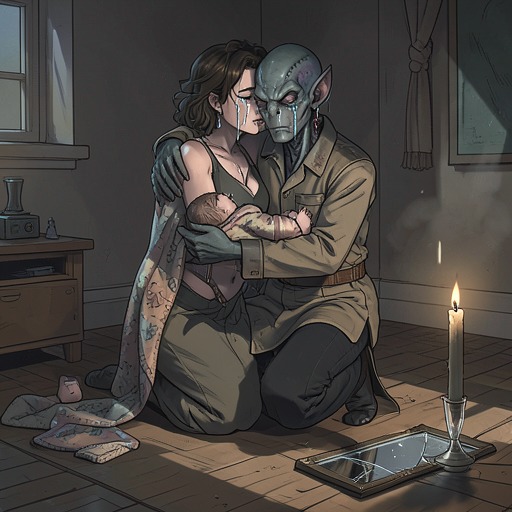
Magnus and Daenaira’s Marriage
PleasureMagnus and Daenaira’s marriage is both a loving partnership and a family bond exposed to the political and supernatural dangers surrounding them. Its defining test comes when an attack on Daenaira places her pregnancy in peril: Magnus must choose between saving his wife and preserving their unborn child, while Daenaira must live with the consequences of that choice. Their grief does not undo their commitment; it makes their shared love, and their refusal to let their enemy dictate its meaning, unmistakable.
Marriage, Faith, and the Prospect of a Family
Magnus and Daenaira are religious companions whose marriage carries an intimacy that reaches beyond their shared faith. When Daenaira is found unconscious in their bedroom, Magnus brings Guin directly to his rooms in Sanctuary. Guards stand outside, and handmaidens and priests gather around the bed. Magnus dismisses them, then explains that Daenaira will not wake and that he found a threatening letter on her. His fear is controlled but close to breaking through; even before he understands the full danger, his attention is fixed on his wife’s vulnerable body and the possibility of reaching her.
The threat has taken Daenaira into the Dreamscape, where Acadian has trapped her while Magnus slept beside her. The letter gives Magnus only until the Senate dismisses to save her. As he prepares to enter the Dreamscape with Guin, he understands that rescue may cost the life of their unborn child. The choice is not an abstract conflict between competing duties: it is a decision about the future they had begun to share and the woman whose life is already bound to his. Magnus rejects the idea of preserving a child only to leave it with a mother unable to move or acknowledge it. He believes Daenaira would want to fight back, and refuses to let Acadian gain satisfaction from his pain.
Their family hopes exist within a society where marriage and succession are also political concerns. In the Senate, Malaya faces pressure to take a mate and provide an heir; the old law presents marriage as a means to secure the monarchy and prevent unrest. Senators argue that arranged marriages once helped preserve peace, and press Malaya to choose within a year from candidates they have selected. Her proposed reform would make the obligation gender-neutral, defer it until age sixty if a monarch had not chosen a partner, and keep the final decision with the royal household. Against that institutional demand to treat marriage as succession policy, Magnus and Daenaira’s endangered pregnancy makes the human stakes of having a child painfully immediate.
Grief, Blame, and Mutual Care
When Magnus returns with Guin from the Dreamscape, he senses that something is wrong before he reaches Daenaira’s side. The bedroom is crowded with twice as many healers and servants as before. Daenaira lies limp in a bloodied bed, the sheets between her legs making the loss of the pregnancy unmistakable. Magnus ignores the attendants trying to strip the bed and the healers seeking access; he climbs beside her and gathers her close. His decision to save her has preserved their marriage, but it cannot spare them the bodily evidence of what the rescue cost.
Daenaira reaches for Magnus when his embrace stirs her. He apologizes through tears, saying he had to choose her. She answers that there was no choice: Acadian had said she would take the baby either way. Daenaira had hoped that threat was only meant to frighten her, and now reproaches herself for not fighting back or using her power to save their child. The exchange shows their grief taking different forms—Magnus’s anguish over having made the choice, Daenaira’s distress at having been unable to prevent the loss—without turning either spouse against the other.
Later, Daenaira cannot accept the offer of spiritual comfort from Malaya. She knows where her child has gone; the blood on the sheets is what she saw, and she fears that consolation about the afterlife would be unbearable. What she asks of Magnus instead is relief from the present and a return to the happiness they shared. He answers that they are still in love and can endure even this unhappiness. Their marriage does not make grief disappear; it gives them a language of attachment in which they can acknowledge it without treating it as the end of their life together.
Daenaira initially blames herself because Acadian came after her for killing Nicoya, and she connects that act to the danger to the baby. Magnus rejects that account of responsibility: he says Daenaira had to kill Nicoya, whose corruption had nearly taken over Sanctuary, and that her action saved hundreds of lives and futures. He then turns the accusation toward himself, recalling that he slept beside Daenaira while Acadian poisoned her and left threatening poetry on her body, and that he had openly announced the pregnancy. Daenaira points out that the pregnancy would soon have become visible and reminds him how exhausted he was. Together they recognize that assigning blame would let Acadian continue to hurt them, and Daenaira refuses to give her that power.
Their care for one another becomes practical as well as emotional. Magnus asks Daenaira to eat and sleep, and offers to watch over her in the Dreamscape. She agrees that she needs to recover, but frames recovery as preparation: when Acadian returns, she wants to be ready to fight. The marriage that had been tested by an impossible choice thus settles into mutual protection, shared grief, and a renewed determination to face the danger together.
Marriage as Law and Private Bond
The institution surrounding Magnus and Daenaira’s marriage is contested in the Senate through Malaya’s struggle over succession. The old royal rule presents marriage not merely as a personal union but as a safeguard: a female monarch must take a mate to secure an heir and strengthen her position against men or enemies who might consider her vulnerable to overthrow. Malaya recites the law accurately, then calls attention to its age—1,846 years—and argues that its assumptions belong to an era of rival clans and territorial conflict, not the present Chancellery. The debate makes the distinction between a marriage chosen by the people who enter it and one imposed as an instrument of political security especially sharp.
The senators answer with historical examples, a prepared booklet, a proposed one-year deadline, and a list of men they deem suitable. Malaya’s counterproposal would make the succession obligation apply regardless of the monarch’s sex, postpone it until age sixty if the ruler had not chosen a partner, and reserve the final decision to the royal household. That dispute gives the prospect of children a public, dynastic meaning, while Magnus and Daenaira’s crisis reveals its intimate cost: their child is not an abstract guarantee of continuity but a future they had begun to imagine together. The marriage’s significance therefore lies partly in the contrast between a state seeking to regulate who may wed and inherit, and spouses whose bond is tested through care, grief, and decisions no statute can make for them.
Shared Agency and Moral Partnership
The crisis tests not only what Magnus will sacrifice for Daenaira, but whether their marriage can preserve her agency amid the choices Acadian has forced upon them. In the Dreamscape, Magnus reasons from what he believes Daenaira would want: to survive, resist, and confront the person attacking her. Afterward, Daenaira’s grief turns against herself, as she treats her inability to use her power to save their child as a failure and links the danger to her killing Nicoya. Magnus restores the moral context she has lost sight of: Nicoya’s corruption threatened Sanctuary, and Daenaira’s action saved hundreds of lives. Their bond is therefore not simply protective; it also lets each spouse recognize the other’s judgment and strength when grief threatens to erase them. Daenaira’s resolve to recover and be ready when Acadian returns carries that partnership forward, refusing to let the attack define her only by what she could not prevent.