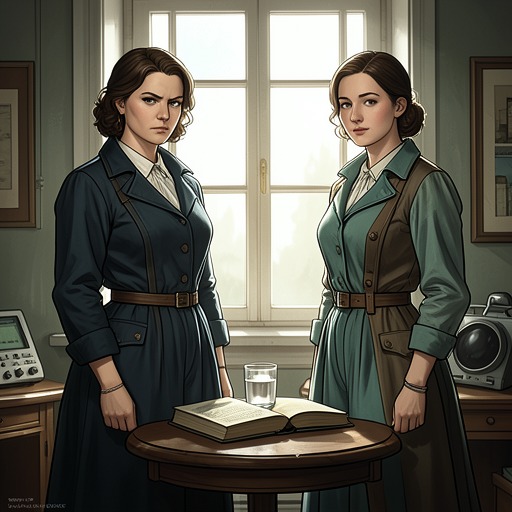
Malaya foresees Acadian threatening her with Guin's life
PleasureMalaya’s vision of Acadian threatening her with Guin’s life is a warning that becomes, in the moment of waking, an intimate crisis. Its images place Guin in Acadian’s power, but the terror they provoke reaches beyond the danger to him: Malaya fears that love may make someone else pay for her survival.
The Vision and Its Images
Malaya’s scream tears through the household without warning. Guin, armed, rushes through the door and finds her sitting upright in bed, arms stretched out and fingers grasping, her eyes fixed sightlessly on the ceiling. She calls for him again. Knowing that she hates waking from a vision before other people and is afraid of how she may behave while caught in one, he climbs into bed and gathers her close. His response is immediate and protective; the first task is to bring her back from the vision without making her face an audience.
When Guin asks what she saw, Malaya names Acadian. She has not seen Acadian’s face. Instead, the threat is made legible through her hands: artificial claws of brutally sharp steel, described as dull enough to make a victim feel the tearing as they rake up his spine. The vision’s most arresting image is Guin chained like an animal while Acadian holds the claws to his throat. Malaya identifies the threatened body as his, then clutches him as the possibility of his death overwhelms her. The scene gives the premonition both a concrete menace and an emotional center: not merely an enemy’s weapon, but the prospect of Guin suffering and dying under Acadian’s control.
The Cost of Being Protected
Malaya rejects Guin’s attempt to soften the vision by treating its images as possible representations of something else. To her, the warning points toward a real choice between their lives, whether he stays or leaves. Her terror is not simply that Acadian may kill him; it is that someone she loves might trade their life away because of her. The vision turns protection into a moral danger: the person guarding Malaya may become the person she must watch lest he sacrifice himself.
Guin initially misunderstands what she is saying. He assumes that Malaya’s greatest fear is something happening to Tristan, and when she insists that she fears losing anyone she loves through such a sacrifice, he hears the opposite: that he himself matters less. He concludes that he is expendable, a painful reading of the very plea intended to keep him safe. The exchange exposes a fault line between them: Malaya speaks from fear of what love might demand of another person, while Guin hears a judgment about the value of his own life.
Malaya answers by redirecting his attention to the danger she sees in him. Everyone knows, she says, that Guin would trade his soul for his brother’s well-being; the person who needs watching is Tristan, not her. She proposes that they speak with Tristan and Xenia that evening and work out how to protect him. This practical response does not dispel her fear, but it gives it a specific object beyond the vision itself: the possibility that Guin’s devotion to his brother could make him vulnerable to the same kind of self-sacrifice she dreads.
Her appeal then becomes unmistakably personal. She begs Guin to stay, first as a friend, and says she would rather remain unmarried than have him leave. Her promise that she will never marry if that is what it takes to keep him nearby is deliberately extravagant, but beneath its flawed logic is a direct admission of how urgently she depends on his presence. Guin laughs at the argument, yet agrees to stay for now. When she insists that she will do anything to make him stay, his playful gesture against her pouting lip gives the exchange a teasing warmth; his private awareness that staying so close to her is dangerous leaves the promise conditional. The vision thus closes not with certainty about what it foretells, but with Guin beside Malaya and their closeness made harder to mistake.
Precognition and Agency
The vision also belongs to a broader portrait of Malaya as someone whose foresight is inseparable from the work of making a future possible. Years of fighting for her rightful place have taken away her youthful naïveté, but not her capacity to imagine outcomes others might miss. Guin sees her expectations as realistic, if sometimes achievable only through methods she alone can envision. Her precognition lets her glimpse what may come; faith and creativity allow her to find a way toward it.
That distinction gives the warning about Acadian its particular tension. Malaya experiences the threat with the force of certainty, while Guin leaves open the possibility that a vision’s images may represent something other than their apparent scene. The vision therefore supplies neither a settled account of the future nor a simple escape from it. Its immediate consequence is to sharpen the characters’ attention to the choices and loyalties that could shape what happens next. In this way, the scene makes foresight less a guarantee than a burden of interpretation: seeing danger matters, but what follows depends on how Malaya and those around her respond.
The History Behind Her Plea
Malaya grounds her demand that Guin stay in a history of repeated rescues: he has saved her life too many times for her to doubt the protection his presence offers. That record makes the request more than panic in the aftermath of a vision; she treats his continued watchfulness as a condition of safety. Yet the exchange does not end in solemnity. After Guin agrees to remain for now, Malaya turns the moment into a teasing challenge, insisting that something can persuade him and that she will discover what it is. Her playful confidence meets his private apprehension, leaving the scene suspended between familiar intimacy and a closeness neither can treat as harmless.