Morrigan and Davide break into Valera's cabin and seize her
PleasureMorrigan and Davide break into Valera's cabin and seize her, turning her remote home from a refuge into a place controlled by armed intruders. The episode moves from an unexplained voice in the winter darkness to a coerced entry, the systematic blacking out of the house, and the arrival of a body. Valera's efforts to stay quiet and think clearly become her only immediate means of meeting a threat whose purpose remains uncertain.
The Approach and Seizure
Valera is already exposed before the men appear. She has been trying to protect her supplies from a creature nearby, but the deep cold has pushed her beyond the time she can safely spend outside. Rather than return to an unheated shed, she drops the food she is carrying and moves quietly toward the cabin, hoping not to draw further attention. The interruption comes as a voice asking whether she is going somewhere. Living on a remote mountainside among elk and bears, she is unaccustomed to being spoken to; she screams and turns to find two men who seem to have appeared from nowhere.
The imbalance is immediately clear to her: she is alone, with no police or neighbors nearby, while the men are both well over six feet tall and heavily built beneath their parkas and snow gear. As they close in, Valera reads the encounter as a threat to her safety. Davide reaches toward the muffler covering her face, and she jerks away. His companion, Morrigan, treats her resistance as unfriendliness; Davide answers that the cold is the reason to take her inside and warm her. The suggestion of warmth carries a sinister implication for Valera, but she does not challenge them aloud.
Davide grabs her and shoves her toward the cabin. At the entrance he moves cautiously, placing his back against the outer wall before thrusting her in front of the door. His fingers dig through her parka and bruise her arm. The movement makes the threat physical rather than merely implied: she is being used to reach the entrance and forced to do what the men want. Valera stays quiet, watches them, and tries to keep her attention on what can be understood rather than surrendering to panic.
Control of the Cabin
Davide orders Valera to open the door, enter the first room, and turn off the lights. He presents the demand as part of a temporary arrangement: the men want a place to rest during the day, food, and “a bit of comfort,” after which, he claims, they will leave her to her life. He also warns that resistance will change the situation for the worse. His assurances do not persuade her. Valera recognizes that he has deliberately left the word comfort undefined and suspects that his promises are lies; she understands that these are powerful, dangerous men.
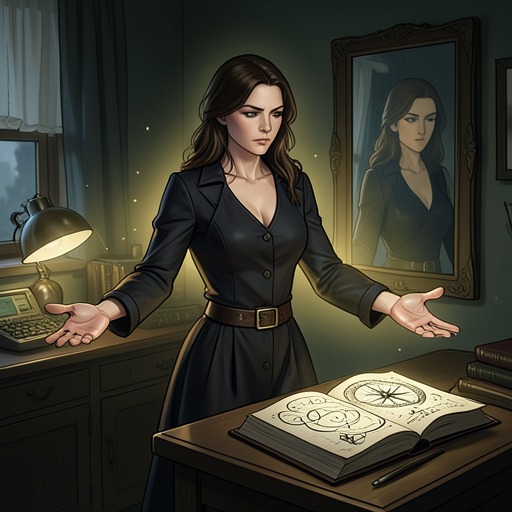
The order to extinguish the lights extends their control beyond Valera's movements to the conditions inside her home. She resents being told to put out the fire, an ever-burning fixture of the house, but keeps that response to herself and concentrates on practical decisions. She turns off the lamps and fetches water. With the fire out, the house will grow colder and the generator will consume fuel faster, though the recently filled tank should last for hours. That calculation offers a limited measure of control: the immediate danger has to be faced before the later costs of a cold house and dwindling fuel.
Once the fire is doused, Davide hustles Valera through the house to ensure there is no light left. He even pulls the digital clock's plug, removing the red glow of its numbers. He then shoves her onto the nearest couch in the dark. The intruders do not simply ask for shelter; they determine how the house will be lit, where Valera will sit, and what she can see. The contrast between the domestic fire and the darkness they impose makes the cabin feel newly unfamiliar to its owner.
The Body in the Living Room
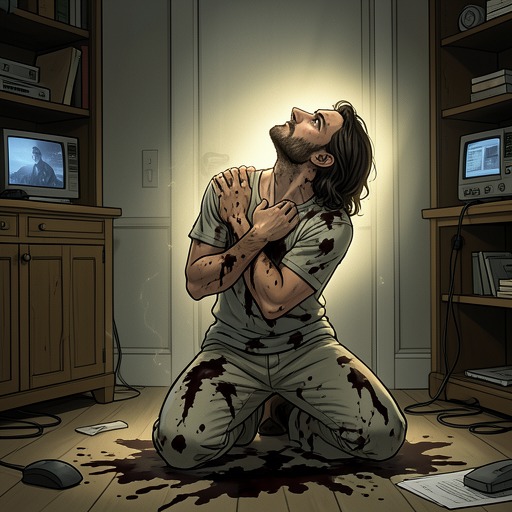
Morrigan enters carrying a large burden over one shoulder, wrapped in burlap. He drops it onto the wooden floor; the impact is hard and solid. Valera recognizes at once that it contains a body. When the fall produces no sound from the person inside—not even an indication of pain or life—nausea rushes over her. The stillness gives the arrival a force beyond the men's earlier threats: someone has been brought into her home in a condition that makes Valera fear he is dead.
The body may be the priest the men mentioned. Earlier, Morrigan had been told to get the priest, so Valera has reason to connect the request with the bundle; she does not yet know who the person is or what has happened to him. Her questions remain unanswered. The scene therefore turns a vague threat into a concrete mystery: the men have come not only to occupy her cabin but also to bring a silent, apparently injured or dead person inside it.
A Refuge Made Vulnerable
For nine years, Valera has treated this isolated place as a way to disappear from the rest of humanity. Only the people who labored to build the house know its location; others have merely glimpsed her when she goes into town for supplies and wondered about her. She has even hung a hand-carved wooden sign on the door as a private joke: “Shangri-La.” The intrusion breaks the privacy that the name represents. A home chosen for its distance from other people has left her without nearby help when danger arrives.
The episode's decisive shift is from solitude as protection to solitude as exposure. Valera cannot call on neighbors or police, and the men quickly turn the cabin's ordinary features—the fire, lamps, clock, entrance, and couch—into parts of their control. Yet she continues to observe, calculate, and withhold her reactions. Her composure does not make her safe, but it preserves her attention in a scene designed to disorient her. The unidentified body deepens the danger while leaving the intruders' larger purpose unresolved.