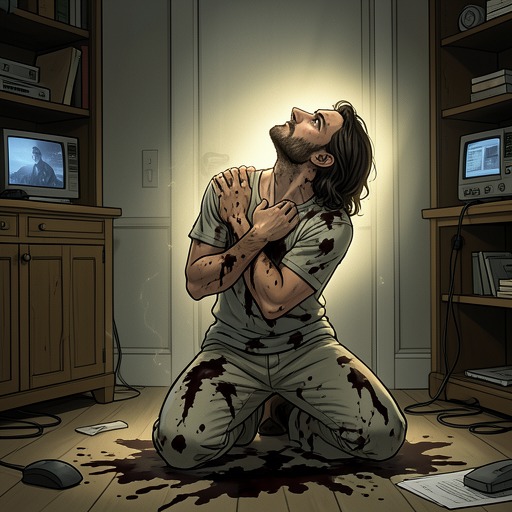
Nicoya's poisoning and abduction of Sagan
PleasureNicoya's poisoning and abduction of Sagan turns a small wound into a defeat with consequences that outlast the attack itself. The poison overwhelms Sagan with hallucinations, leaves him in Acadian's custody, and—according to the healers—ultimately helps erase his memory of the insurrection and how he was poisoned. His later return to Sanctuary therefore does not restore the history that was taken from him.
Causes and Stakes
Sagan understands the attack as a defeat in a wider conflict: he has lost a crucial battle against enemies of Sanctuary, the Shadowdweller religious house, and the royal house of the Chancellery. Nicoya, whom he identifies as a k’ypruti and the source of the threat, has treated her weapons with a racially engineered poison. A scratch is enough to bring him down. The disparity between the slightness of the wound and the scale of its effects makes the attack feel less like a contest of strength than the sudden disabling of a defender.
The danger extends beyond Sagan. In his fevered reckoning, Nicoya will go unchallenged into the world to continue her evil, while Acadian, her mother, has her agents drag him away. Sagan imagines he is to become Acadian's newest plaything. He has already seen the scars and torture on a friend's body, so the prospect of what Acadian might do is not abstract to him. His account links Nicoya's poisoned attack to Acadian's coercive power and to the threats facing Sanctuary and the royal house.
Poisoning and Captivity
The poison's first defining effect in the scene is not pain alone but hallucination. Sagan can scarcely distinguish what is real from the strange rushes filling his feverish mind. He tries to resist by repeating basic truths: his name, his priestly office, his identity as one of the gods' five elite chosen ones, and his work of hunting those who sin and forcing them to repent. He also reminds himself that he is a Shadowdweller and a Nightwalker, formed by a world of nighttime and darkness. These facts become a deliberate means of holding on to the present as his perception breaks apart.
That effort at self-grounding gives the poison's assault a personal as well as physical cost. Sagan's account moves from stable statements of identity to the blunt recognition that he is going to die. He takes comfort in that certainty and in his belief that Drenna will welcome him into the Beyond. The comfort does not mean the danger has passed: he expects death or, if he survives, Acadian's torture. His faith supplies a way to face the anticipated end, while the poison has stripped him of control over what happens next.
Return and Lost Memory
The later account at Sanctuary changes the apparent ending of the capture. Daenaira tells Sagan that Nicoya is dead and that she is relieved he survived; Nicoya had claimed to have killed him. Daenaira and Magnus had feared that Acadian had taken him after they could find no trace of him and learned that Nicoya was Acadian's daughter. Sagan, however, cannot follow the explanation. He asks what Acadian has to do with the events, why he would fight Nicoya, and what happened to Henry. Magnus and Daenaira support him as they bring him across the threshold into Sanctuary.
A day later, Magnus watches Sagan in the healers' clinic, where he appears quieter and more withdrawn than usual. The healers believe the trauma of the poison wiped out his memory. He has apparently escaped Acadian and made his way back, but cannot recall fighting Nicoya, her insurrection, or how he was poisoned. The return is thus a survival, not a recovery of the missing episode: Sagan is physically back among his allies while the attack remains inaccessible to him. Daenaira's anger at Nicoya's toxic weapon, and her wish that she could kill her again, underscores the violence that his amnesia has not undone.
Narrative Significance
The event is presented first through Sagan's compromised awareness and later through the knowledge of those who receive him. During the poisoning, he can name the enemy, the weapon's effect, the capture, and his own likely death, but hallucination makes even immediate reality unstable. At Sanctuary, other characters can supply the outline of Nicoya's insurrection and Acadian's involvement, yet Sagan's questions show that explanation cannot simply return his experience to him. The shift between these accounts makes the gap in his memory part of the event's aftermath.
The episode also reverses the apparent finality of Sagan's conviction that he is dying. He survives, and Nicoya is dead, but survival leaves him without the memories that would connect the attack to his return. His priestly practice of naming who he is becomes especially poignant against that later loss: during the poisoning, repetition is an active defense against mental disorientation; afterward, the people around him know a history that he cannot retrieve. The attack therefore marks both a physical defeat and a rupture in his continuity with the events that brought him home.