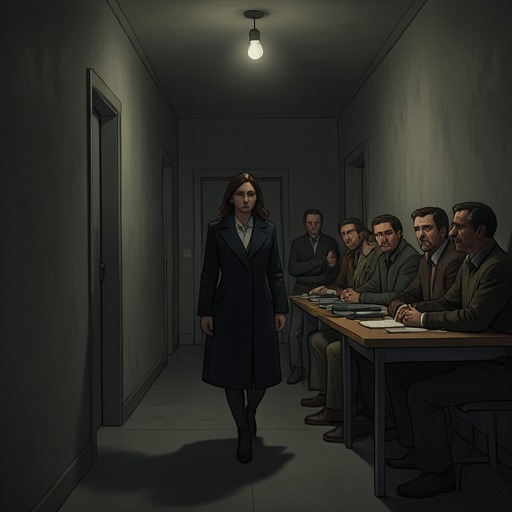
Trace's captivity and torture by the Acadians
PleasureTrace’s captivity and torture by Acadian is a wartime atrocity whose consequences outlast the imprisonment itself: Trace returns bearing lasting scars, Guin’s rescue becomes one of the most painful moments of his life, and the pardon of wartime acts later blocks ordinary prosecution of the crime. The episode also establishes Acadian’s methods and concealed identity as continuing threats to the postwar order.
Capture and Concealment
During the civil war, Acadian took Trace prisoner on the night of the invasion of the twins’ household. Rika believed she had seen Trace die, and for much of the following year his allies shared the false assumption that he was gone. His disappearance thus concealed not a death but an extended captivity, leaving those closest to him without knowledge of what had happened.
Acadian’s treatment of Trace was deliberately sustained. She healed his wounds so he would be healthy when she began torturing him. The healing did not signal mercy; it served the torture, making his restored physical condition part of her method. Trace remained in her hands for the better part of a year, and the damage was visible afterward in horrific scars across his skin.
Rescue and Recovery
Finding Trace was one of the best and worst moments of Guin’s life. Guin respected Trace’s power and intelligence, but when he reached him, he thought only of the damaged body before him and feared that little of Trace remained. The rescue therefore brought relief and devastation together: Trace was alive, but the length and brutality of his captivity had made his condition difficult to face.
That first impression did not define Trace’s ending. He recovered, demonstrating a strength of will and character that contradicted Guin’s fear that the torture had left nothing but damage. His recovery is a consequence of the event, but it does not erase the scars or turn the captivity into a temporary ordeal without lasting cost.
The Captor’s Hidden Identity
Trace never saw Acadian’s face, and Guin could find no one who knew what she looked like. Her anonymity made the captivity more than a closed wartime crime: the person responsible could remain an unknown figure with power and access. After Nicoya confessed that her mother was a member of the Senate, Guin connected that disclosure to Acadian and concluded that the torturer had an alternate identity.
The captivity also belonged to a wider campaign against the twins’ hold on power. Acadian’s covert efforts included legal deception and illegal attacks on people around them; the attempts on Malaya and Magnus, as well as two attacks on Trace, were understood as part of that campaign. The torture of Trace therefore joins private bodily harm to political violence, while the captor’s concealed identity frustrates attempts to establish responsibility.
Amnesty and Accountability
The postwar settlement made the crime difficult to prosecute. Tristan explained that the population had been brought together by pardoning all acts of war and giving everyone a clean slate. Since Acadian’s torture of Trace was a war crime, she could not be tried for it under that settlement. Malaya’s turn toward possible treason or sedition reflects the resulting gap between the known harm and the available legal charge: proof might exist, but it first had to be found, and Acadian herself had to be located.
The episode’s consequences return in the later confrontation with Acadian. Magnus identifies her crimes as crossing both common and religious law and uses his truth-compelling third power to question her repentance. The scene does not undo the amnesty’s barrier to a trial for Trace’s wartime torture; instead, it shows another form of answerability being pursued. Trace’s captivity thus remains both a personal wound, marked on his body and answered by his recovery, and an unresolved test of how a society can seek accountability after granting wartime pardon.